
The Journal of Foreign Affairs at Carolina
Get the latest from our undergraduates at
The Column at JFAC

An Eye for an Eye, a Jewel for a Jewel: The Truth of Art Theft in France

Photo from Canva.
Here in the Southern United States, the activities one might be taking part in at 9:30AM on a Sunday morning include sleeping in, going to church, making breakfast, and perhaps even getting in a quick workout. Of the many things a person might be getting up to on a sleepy Sunday morning, what they likely aren’t doing is robbing the most visited museum in the world.
Making off with an estimated 100 million dollars in sapphire necklaces, emerald earrings, and a diamond encrusted diadem, four suspects pulled off the most daring museum theft in decades. Their plan was simple: dress up like construction workers, climb up a giant ladder on wheels, use an angle grinder to break into the window, snatch the priceless jewels, and ride away on four motorbikes…all in seven short minutes. Unsurprisingly, this real life National Treasure reenactment caused a frenzy in the Louvre and across the world.
The four thieves, who were likely part of a greater organized crime group, got their hands on some of France’s most monetarily and culturally valuable items. The eight items each represented a part of France’s past. They once laid on the necks of royalty and rested on the heads of queens. It is easy to gloss over the true loss of history and culture in order to enjoy the story like a chapter in a crime novel, but the impact is truly devastating to art lovers worldwide. ABC News quoted French President Emmanuel Macron as saying the theft was an “attack on a heritage that we cherish because it is our history.” Unfortunately, the future of the artifacts is uncertain, as art thieves often destroy the pieces in order to sell them for parts.
This isn’t the first time the Louvre has lost pieces of art indefinitely to theft. In 1998, a painting by Camille Corot was also stolen, never to be returned. Professor Laura Evans, an art crime historian, author and professor, noted “I don’t think that thieves probably care about the historical, cultural, or emotional significance of these gems as they were, and would not blink at cutting them down into different shapes and sizes…” It is this notion of “cutting down” that is so abhorrent to any enjoyer of art or history. Inexplicably, humanity is tied to the expressions of beauty and memory; it hurts us when those things are sacrificed for greed.
The Louvre’s relationship with greed, beauty, and memory bears scrutiny. It is in reality, not a French museum. The Louvre boasts invaluable art works from places like Easter Island, Sierra Leone, Egypt, and many more. It is easy to feel repulsed by the idea of a greedy, entitled, powerful person, stealing pieces of art and culture for themselves. But what makes the dungeon of a billionaire any different from the Louvre itself? NPR reports that “French museums alone hold around 90,000 objects from Africa” and CNN states that, “About 90% of Africa’s cultural heritage is now believed to be in Europe.” If it is true that art is an expression of our deepest humanity, then almost all of Africa’s is still bound by the chains of European greed.
Luckily, there have been positive steps towards justice. In 2021, President Macron returned 26 artworks that were stolen from Benin by colonial soldiers in 1892. Along with the return, President Macron made a commitment to continue returning African works to their homes. Unfortunately, these goals seem to have fallen to the side, as bureaucratic challenges stand in the way of reuniting these heritage pieces to their peoples. The 26 returned Beninese works were out of 5,000 the country is still demanding back. In the wake of the Louvre theft, instead of relishing the thrill of the chase, we should focus on having empathy for those who have been stolen from before. Art is more than its monetary value, jewels are more than currency. They are how we represent ourselves. They are what we chose to do with our fleeting moments on earth. We should demand for them to be in the hands of those who created them, so they can live not trapped in a bank vault, or under the blinding lights of imperialist museums, but in the hearts of those they represent.

The EU’s $1 Billion AI Push—A Step Toward Digital Independence or A Symbolic Move?

Graphic by Luke Valencia.
In early October, the European Union pledged €1 billion euros to accelerate innovation and the use of artificial intelligence across Europe, particularly in key industries including healthcare, manufacturing, science, energy, automotive, defense, and pharmaceuticals. Advancements in these sectors would include examples such as advanced AI-screening healthcare centers and agentic AI used in manufacturing, agriculture, and pharmaceuticals. Furthermore, this pledge is part of the broader picture of Europe’s AI Continent Action Plan to support start ups and mid-size enterprises to train AI models and promote an AI first policy. This initiative is supported by the EU’s agenda to build multiple AI data labs, factories, and gigafactories with private investment of up to €20 billion to foster AI adoption in key industries and build digital autonomy within Europe by 2030. The investment is a response to the accelerated spread of artificial intelligence across the globe, most notably the United States and China as key leaders in AI development. Europe’s initiative highlights the EU’s efforts to pursue digital sovereignty and push to be a top contender in the global market. European Commissioner for Technological Sovereignty, Security, and Democracy Henna Virkkunen stated, “The initiative will address ecosystem bottlenecks and downstream demand by Europe’s industry, enhancing both competitiveness and sovereignty in frontier AI development.” While the EU makes attempts towards a more AI-influenced society, it is far behind research funding in comparison to the US and China, who have already poured €58.5 billion and €12.9 billion respectively into venture capital for artificial intelligence—compared to the EU’s €7 Billion. Will Europe be able to compete with the U.S. and China on the digital scale, and what effect will the creation and dependency of AI have on people and society?
The decision made by Europe to jump two feet into an AI first initiative is not surprising as it attempts to develop greater technology independence. Many Europeans and European institutions are heavily dependent on exported technology of American cloud providers and Chinese hardwares, which makes them vulnerable and susceptible to their trade policy agendas. However, fulfilling this pledge will be challenging considering their current AI regulation, which includes the EU AI Act. One can certainly argue that they will need to reduce their AI regulations in order to become rapidly self-reliant. Furthermore, because individual European countries will weigh the benefits and considerations around AI to varying extents, it will prove difficult to reach consensus on policy specifics, such as individual country investments or where physical factories will be built.
This initiative places more global attention on the speed at which AI is advancing and what the societal implications for that are. How will it affect jobs in all sectors and will it push humans out of certain fields? Does the increased dependency on AI foreshadow the loss of human interaction and how we communicate with each other? Will relationships among humans diminish with AI being involved in many aspects of our lives? What new jobs may be produced from AI and will it be beneficial to only the economy, employers, or society in general? These questions indicate that even though the growth of AI can be deemed extraordinary, it leaves us with many unanswered questions. If there is no regulation or separation of using AI in daily life, some may argue it can be counter-productive to human evolution.
Nevertheless, the world and, particularly Europe in this case, can find balance in using AI if approached properly. This includes regulations that keep AI manageable but also promotes innovation, coordination between governments and industries, and investment in sovereign digital infrastructure. Europe is taking the needed steps towards a more autonomous future but will likely need to invest more resources to keep pace with outside competitors. Without a pragmatic shift, even the best funding will end up lost in bureaucracy and become wasted.
Southeast Asia: The Battle Ground Against Online Scams
Amidst today’s increasingly competitive job market and rising costs of living, it is not surprising that the promise of a high paying job would attract many people seeking better opportunities. However, few would imagine that such an opportunity would lead to kidnappings, torture, or even death. Yet, this is the grim reality that awaits numerous victims of the online scam centers located in Southeast Asian nations, including Cambodia, Myanmar, and Laos. In recent years, these scams have become more widespread and powerful, targeting victims from a range of countries. Last year, these online scams stole a total of $10 million from victims in the United States.
South Korea’s Recent Crackdown
The issue resurfaced this past Wednesday as South Korea held a press conference announcing its efforts to bring back the South Koreans who had disappeared after being lured to Cambodia by online scam centers. This year, 330 South Koreans were reported missing after travelling to Cambodia, lured under the pretense of high paying jobs. However, upon arrival, they were coerced into defrauding other South Koreans. Out of those who were missing, 79 are still unaccounted for. The news sparked outrage in South Korea. In response the South Korean government has issued travel bans for South Koreans to travel to certain parts of Cambodia where the scam centers are most prevalent. President Lee called for the removal of these illegal job ads.
How do these Scam Centers Operate?
These online scam centers emerged out of the collapse of Southeast Asia’s gambling industry during the Covid-19 pandemic. Criminal gangs which had previously operated casinos sought new sources of revenue, leading to the development of this new cyber-scam model. These scam operations are fairly new and highly sophisticated. They often employ advanced, deepfake technology in order to scam their victims, making it difficult for governments to track.
Many of the victims of these scams are educated, skilled workers looking for legitimate employment. The horrific experience of one victim was illustrated in the story of Samuel (alias), a Ghanan IT worker who was lured to Thailand with the promise of a data-entry position at a warehouse company. Instead he was forced to work in a scam center across the border in Myanmar. In the center, workers such as Samuel were forced to convince unsuspecting people to invest in fake products or cryptocurrency schemes. If they failed to meet their quotas, their salaries were withheld. Other stories commonly feature threats, physical assault, and sexual assault. A 22 year university student was even found dead earlier this year.
Currently, Cambodia has become the main focus of international concern. Earlier this summer, Amnesty International found 53 online scam centers across the nation and accused the Cambodian government of “deliberately ignoring abuses by cybercrime gangs that have trafficked people from across the world, including children, into slavery at brutal scam compounds.” The Cambodian government denied such claims and said that Cambodia itself was a victim of the crimes and should be receiving international help rather than scorn. These online scam centers not only operate in Cambodia but have been found in Laos and Myanmar, particularly near the Thai-Myanmar border. The interesting aspect of these crimes is that they typically are run by foreign criminal groups operating in these Southeast Asian countries. A large number are composed of large Chinese criminal syndicates, but in recent years there have been a growing number of Korean and Japanese criminal groups conducting these operations.
South Korea is just the latest in a string of countries attempting to combat these scam centers. Earlier this year, the US and UK imposed sweeping sanctions across targets in one of Cambodia’s large scam networks—Prince Group Transnational Criminal Organization—and indicted its chairman, Chen Zhi. China also led a massive crackdown and rescued thousands from scam centers in Myanmar in February this year.
Despite these efforts, the scam centers continue to operate, luring thousands of workers every year. Their ability to manipulate, coerce, and disguise their operation makes them difficult to dismantle. Moreover, since many of these scams operate in developing countries, international cooperation and sustained support are essential to effectively combat these crimes.

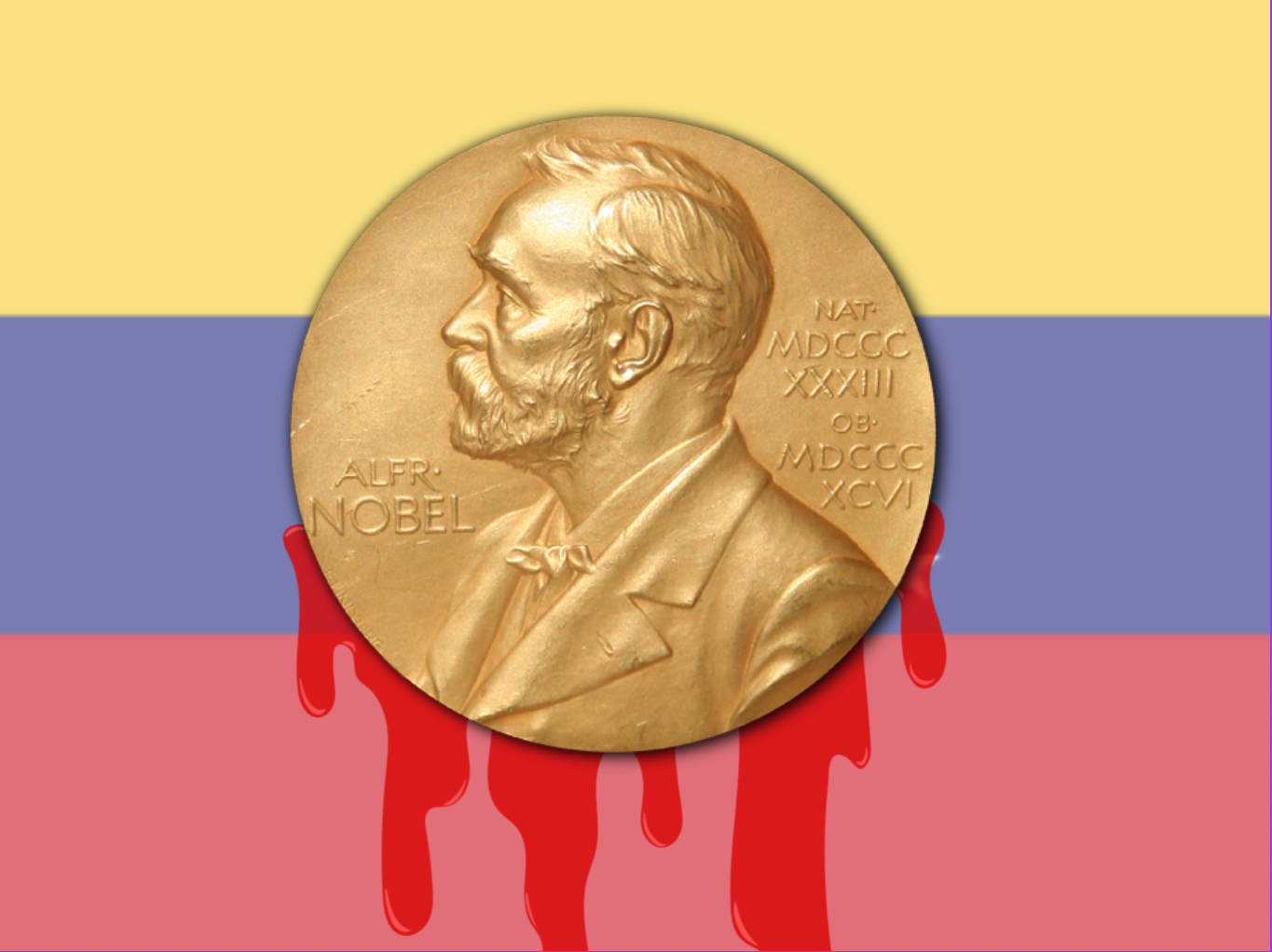
Peace Through Violence? The 2025 Nobel Prize Sends a Troubling Message
Graphic by Miles Kershner.
On October 10th, the 2025 Nobel Peace Prize was awarded to Venezuelan opposition leader María Corina Machado. Machado was described by the Norwegian Nobel Committee as “a brave and committed champion of peace,” who received the award due to “her struggle to achieve a just and peaceful transition from dictatorship to democracy.” She attempted to run against Venezuelan president Nicolas Maduro in the 2024 presidential election, but the Maduro regime voided her candidacy. Machado instead supported a fellow opposition figure, Edmundo González, who overwhelmingly won the election. Despite the victory, Maduro denied the results and has since clung to power.
Machado’s courage is certainly commendable, as the Committee has pointed out. Leading opposition efforts against the corrupt and authoritarian Maduro regime, especially given the consequences faced by many who dare to resist, requires extraordinary bravery. Her leadership has given hope to millions of Venezuelans suffering under devastating poverty and repression. However, the enemy of an enemy isn’t always a friend. While Machado may champion democracy, she does not do so peacefully—which constitutes an unfortunate yet not unheard of error by the Nobel Committee.
Backlash came from both sides of the aisle following the announcement of the 2025 prize. In Washington, the White House and other MAGA republicans publicly voiced their dismay that the award had not been given to US president Donald Trump. Conversely, many on the left were quick to label Machado as “right-wing,” drawing parallels to Trump-style populism and authoritarianism. Machado does advocate for liberal economic reform: the privatization of state enterprises, a free market, and a reduced social safety net—a sharp contrast to Maduro’s socialism—but she also has fairly relaxed stances on abortion and gay rights. Machado is definitely conservative, but not a hardliner. The real issue is not her ideological stance, but rather whether she actually represents peace.
Machado has explicitly and repeatedly called for US military intervention in Venezuela. In interviews following her Nobel win, she described Maduro's government as a "narco-terrorism structure,” echoing Trump’s claims that Maduro is perpetrating the flow of illicit drugs into the US. By awarding Machado in the name of peace, the Committee has legitimized Trump's escalating military operations in the Caribbean. This will only further embolden the US to continue the illegal strikes.
Machado’s call to action has certainly not fallen on deaf ears: in the weeks following her Nobel victory, Trump revealed that he had authorized the CIA to conduct covert operations inside Venezuela with the goal of forcefully removing Maduro. The White House also recently sent Congress a memo declaring a "non-international armed conflict" against unnamed drug cartels, effectively issuing a declaration of war. As such, the prize also validates Trump’s dangerous fiction of "peace through strength"—the idea that military might creates stability.
It can be argued that while Machado would probably be better for the future of Venezuela, she is still undeserving of the Nobel Peace Prize. Maduro's regime has driven over one-fifth of Venezuela's population out of the country, presided over economic collapse, and maintained power through election fraud and violent repression. True, Machado has articulated plans to address this devastation and restore democratic governance. But deserving democracy doesn't justify foreign invasion. And awarding a peace prize to someone actively advocating for violent regime change confirms a problematic and antiquated precedent: that democracy can and should be delivered from the barrel of an American gun.
How Tourism Made—and broke—Spain
Following the end of Francisco Franco’s dictatorship in 1975, Spain underwent immense change in just a generation. In 1982 Spain joined NATO, and four years later it joined the EU. Spain’s economy and culture was put on the global stage in rapid succession. Spain, which historically had been a country of emigration and poverty, transformed into one of Europe’s strongest and most important economic and cultural players.
One of the reasons behind this became the massive growth of Spain’s tourism sector, which had already begun at the end of Franquismo, and only continued to grow as the country became better integrated with the West. “Spain is different” became the slogan that drew in millions of tourists annually. The warm, dry Mediterranean climate led to massive growth in cities by the coast such as Málaga and Benidorm. The 1992 Olympics introduced the world to Barcelona, now a global hotspot for tourism. In 2023, 71% of the growth in the Spanish economy derived from tourism. In 2024, tourism accounted for roughly 15.6% of Spanish GDP. However, this economic miracle and tourism boom has not come without consequence.
Housing costs in Spain have reached a record high across many regions, and coupled with the continent wide cost of living crisis, this has made life increasingly unaffordable for many Spaniards. Wages, and hence prices, have historically been very low in Spain, incentivizing tourists from richer countries to visit and spend money. However, as many tourists take up housing via AirBnB or simply buying property, the cost of living (particularly housing) has shot up dramatically, whilst wages have not caught up. Locals have been priced out of cities like Barcelona, Málaga, and Madrid. Spaniards living in the Balearic or Canary islands, massive hotspots for tourism, have protested that their quality of life has deteriorated significantly and called for limits on tourist numbers. In Barcelona, protests made global headlines for throwing water on tourists and occupying luxury shops. Most Spaniards argue that tourism is not the problem in and of itself, but rather that mass tourism strips away their sense of community and ability to find affordable housing.
The current government of Spain led by center-left Pedro Sánchez has unveiled a plan to convert many short-term rentals into permanent rentals for Spaniards, especially young people and those wanting to start a family. However, critics of the plan question its constitutionality and lambast the government for not consulting Spain’s autonomous communities, which do the vast majority of management when it comes to tourism.
As Spain wraps up a year with a forecasted 100 million tourist arrivals, the nation stands at a crossroads. Tourism has undoubtedly fueled Spain’s rise as a global economic and cultural power, yet it now threatens the very communities that made the country so attractive in the first place. Balancing economic growth with sustainability and quality of life will determine whether Spain can continue to welcome the world without losing its soul.
No one wants to be the French Prime Minister
“One cannot serve as prime minister when the necessary conditions are not met.”
Former, now present, French Prime Minister Sébastien Lecornu made this remark on his short 26-day stint as prime minister in a resignation speech delivered on October 6th. He declared that his “mission is over” shortly after facing criticism for his ministerial lineup and in anticipation of a vote of no confidence led by the far-left France Unbowed party and the far-right National Rally.
Four days later, he was reappointed by Macron with a mandate to return to the role. Lecornu’s resignation made him the third French prime minister to leave office since December 2024. Lecornu’s reinstation illustrates the desperate attempt by President Emmanuel Macron to repair the volatile, divided state of French politics.
Macron’s decision to dissolve the National Assembly, the lower house of Parliament, and hold snap elections following his defeat in summer of 2024 has come back to haunt him. The result of the elections was a new parliament split into the left, center, and far-right, with no single group able to form a functioning government. This “hung parliament” has split the government between three ideologically opposed blocs, unable to compromise on France’s most pressing troubles, including the budget.
The budget problem has been the downfall for previous prime ministers Michel Barnier and François Bayrou. Under Bayrou, heavy cost-cutting measures were implemented that ultimately froze welfare, cut civil service jobs, and discarded two public holidays—all measures deeply reviled by the French. French debt currently amounts to 114% of GDP, with government spending high and the future of reforms, pensions, and the state of the historical French welfare system up in the air.
Already, Lecornu has made attempts to resolve the budget crisis in his second term as Prime Minister. In his reappointment, he declared that “we must put an end to this political crisis that exasperates the French people and to the instability that is harmful to France’s image and its interests.”
Lecornu suspended the 2023 pension reform on October 15th under great pressure while advocating for more cost-cutting measures, though the exact numbers are up for debate. These moves work against the far-right and far-left, who have threatened to vote against Lecornu, but won over leftist support from the Socialist Party, with the group starkly against the 2023 reform. The pension suspension was a rare compromise from the prime minister and Parliament, yet illustrated a last-ditch effort to allow Lecornu to stay in power and survive the no-confidence vote.
The institutional instability within parliament reflects wider than the National Assembly—it points to a weakened France, on both the European and world stage. Macron’s approval rating is at a record low of 14%, and his concession to the reform points to the end of Macronism and the collapse of his attempt to modernize France.
The revolving door of Prime Ministers makes this position appear to be a “curse” greater than that of just the national debt problem. The lack of cohesion and compromise amongst the parties makes solving the economic issue nearly impossible, with reforms unable to pass parliament. The internal disorder within French politics further reflects a growing issue in Western Europe of unpredictable, increasingly polarized and fragmented politics.
With vote of confidence after vote of confidence, and resignation after resignation, it is apparent—no one wants to be the French Prime Minister. Resolving the crises involves an uphill battle against the uncompromising political structure which no one seems able to face.
Perhaps in his second run as prime minister, Lecornu will get closer to resolving the issues.
Or, he may simply resign again.
A New Force for Haiti: Promise or Repetition?
As gang violence pushes Haiti to the brink of collapse, the UN’s new security force offers hope, while simultaneously reviving classic fears of foreign overreach.
On September 30, the United Nations Security Council approved a new international force for Haiti, a 5,550-member Gang Suppression Force (GSF) designed to confront the country’s current wave of gang violence and political collapse. The U.S.-backed resolution passed with 12 votes in favor and abstentions from China, Pakistan, and Russia, signaling widespread but hesitant support for another intervention in the Caribbean nation.
The GSF replaces the Kenya-led Multinational Security Support (MSS) mission, launched in 2023 but crippled by underfunding and restricted manpower. That smaller mission never managed to contain gangs that now control about 85 percent of Port-au-Prince. Haiti’s security vacuum has only expanded since the 2021 assassination of President Jovenel Moïse, leaving state institutions deadlocked and violence unchecked.
“The international community failed Haiti with [MSS]. It didn’t have the opportunity to demonstrate whether it was effective or not,” said an analyst with the International Crisis Group.
The new force will work closely with the Haitian National Police and armed forces to conduct intelligence-based operations, protect civilians, and secure key infrastructure. It will also have the power to detain suspected gang members, implementing a more aggressive mandate than its predecessor, the MSS. Alongside the force, the UN is establishing a Support Office in Haiti (UNSOH) to provide logistics, medical aid, and communications support.
More than 5,500 people were killed in gang-related violence in 2024, and nearly 1.3 million Haitians are displaced. The situation on the ground can best be described by the UN as a “multi-dimensional humanitarian emergency” as kidnappings, sexual violence, and food insecurity continue to spread.
The GSF brings hope, as officials from Washington to Nairobi describe the GSF as a “turning point.” U.S. Ambassador Mike Waltz said the mission is “five times the size of its predecessor,” while Haiti’s own UN representative, Ericq Pierre, called it “a decisive moment in the country’s fight for survival.”
But not everyone is convinced. And perhaps rightfully so. Haiti’s history with foreign forces, including a prior UN peacekeeping mission that introduced cholera and allegations of sexual abuse and rape from peacekeepers, has left deep mistrust in the international order.
The GSF thus represents both hope and hesitation: a chance to restore order, but also a reminder of how fragile international aid can be when it substitutes for local governance. Haiti’s future stability may depend less on the force’s strength than on whether it can eventually make itself unnecessary, leaving behind not occupation, but sovereignty.

Russian Interference and Disinformation: Implications of a Pro-EU Parliamentary Victory in Moldova

Leaders of Moldova’s pro-EU party, Party of Action and Solidarity, rally at Chisinau in August. Image by Vladislav Culiomza.
“Today, dear Moldovans, you have given a lesson in democracy, worthy of being written in history books.” – Maia Sandu, President of Moldova
With the victory of the pro-European Party of Action and Solidarity (PAS) against the Patriotic Electoral Bloc (BEP) in Moldova’s most recent parliamentary elections held on September 28th, many are reminded of the fragility of democratic institutions—and the unpredictability that accompanies them. This is especially true among former Soviet republics trying to veer away from Russian spheres of influence as they navigate internal and external obstacles in solidifying their path towards European integration.
Debates surrounding corruption, judicial reforms, energy security, and persistent economic hardship dominated the campaign period. The PAS positioned itself as the party of transparent governance and European engagement, pledging to curb Russian influence in state institutions and accelerate integration with the European Union. By contrast, pro-Russian parties such as the BEP capitalized on economic uncertainty and skepticism toward the EU, advocating for closer ties with Moscow and reaffirming Moldova’s posture of “neutrality” in foreign affairs.
The ruling pro-European Party of Action and Solidarity (PAS), led by President Maia Sandu and parliamentary leader Igor Grosu, won a clear majority with approximately 50.16–50.2% of the vote. This gave PAS around 55 of the 101 parliamentary seats, securing a stable single-party majority government. Meanwhile, the main opposition was the pro-Russian Patriotic Electoral Bloc (BEP), which received about 24.2% of the vote and won 26 seats.
Yet in the months leading up to the national elections, Moldovan authorities reported waves of Russian cyberattacks, AI-generated content, and other forms of disinformation on social media platforms such as Telegram, TikTok, Instagram, among others. NewsGuard, an organization responsible for tracking the spread of misinformation, documented 39 fabricated stories alone originating from the Russian group “Matryoshka,” all of which focused on the pro-European President Maia Sandu and the PAS.
These strategies are consistent with Russia’s broader strategy of “hybrid warfare,” which centers on diminishing trust in democratic institutions through creating a sense of disorientation in the information environment. To be clear, these campaigns are not concerned with getting others to subscribe to a certain belief, but rather, the goal is to push the idea that nothing is true.
In addition to virtual campaigns, reports indicate illegal financing of pro-Russian parties and violent destabilization plots in the form of bomb threats by those sympathetic to pro-Russian causes. In one case, Moldovan police detained three men from the breakaway region of Transnistria—a territory which the Council of Europe formally designated as being “under military occupation by Russia” in 2022—who attempted to supply groups involved in election destabilization.
The securing of a parliamentary majority for the PAS marks a critical juncture in Moldova’s pursuit of integration with the European Union—an aspiration widely galvanized by Russia’s invasion of Ukraine in 2022. A national referendum in October of 2024 which codified support for EU accession within the Moldovan Constitution affirmed this trend. While this election marks another step forward, Moldova’s pro-European path remains far from guaranteed.
The challenges facing Moldova extend beyond the country, however. The risks of unrestricted AI-generated content and social media in spurring extremism and disinformation is a trend which transcends borders, no matter how robust a state's democracy might appear to be. Understanding the power of these tools in shaping the political consciousness, Russian disinformation efforts capitalize on exploiting political institutions throughout Europe and the United States from within.
As hybrid threats continue to evolve, the success of pro-European coalitions will depend not just on electoral victories, but on their ability to deliver tangible reforms and maintain public trust amid a volatile information landscape.
As seen in Moldova, elections alone do not guarantee the strength of democratic institutions; vigilance, transparency, and accountability must follow.

From Apollo to Artemis: A Second Space Race or Race for Humanity?

Graphic by Isabella Garcia.
What the world has deemed the “second space race" appears aptly named. In August, NASA fast-tracked its goal of landing a reactor on the moon by late 2029. As stated in The Wall Street Journal, this land-based reactor would contain a 100-kilowatt system that would not only have enough power to supply a modest neighborhood, but also be of unprecedented capacity for its size.
However, NASA will be racing against China and Russia, who have also been exploring the idea of jointly deploying nuclear energy to the moon, with their estimated timeframe being around 2030. Clearly, NASA’s goal is to arrive just ahead of Russia and China.
The permanent nuclear reactor NASA hopes to stabilize on the moon would open up a world of new possibilities, including those that Hollywood has continuously tried to pursue, such as tourism, research, and more. A nuclear reactor would offer a sense of consistency that solar power, charged with batteries, simply can’t manage. To put this reactor into perspective, a two-week lunar night would generate a decade's worth of energy. It is no surprise that the US and China are racing for dominance and assertion authority on the moon once again.
Not only would this reactor enable an array of new scientific and economic activities, but fission energy would also allow governmental and private companies to develop permanent settlements on this lunar territory.
In addition to obstacles associated with the infrastructure of this reactor, lack of international regulation could pose problems. On Earth, there are norms regarding safety zones around reactors. These do not exist on the moon, and the political implications surrounding this issue have led to several concerns within NASA. In 2019, President Trump signed the 1967 Outer Space Treaty into law, which was additionally signed by China, Russia, and other nations. This treaty included a memorandum outlining how a reactor in space would be licensed. Needless to say, the process has yet to be attempted since the signing, leaving political actors currently in a “wait-and-see” stance.
But what is making this a second space race? According to the acting head of NASA, China and Russia have a similar plan to the US: to build a permanent base for humans to live on the lunar surface. NASA fears that China and Russia “could potentially declare a keep-out zone” on the Moon, raising questions tied to the 1967 Outer Space Treaty. Planetary science specialist Dr. Barber observed, "If you build a nuclear reactor or any kind of base on the moon, you can then start claiming that you have a safety zone around it, because you have equipment there."
Although the symbolism of red, white, and blue is often perceived as American hegemony, Dr. Barber raised an insightful point that this “flash from the past” is disappointing and, quite honestly, concerning from the scientific perspective. He contends, "Competition can create innovation, but if there's a narrower focus on national interest and on establishing ownership, then you can lose sight of the bigger picture, which is exploring the solar system and beyond."
It would appear that the innate human instinct for survival of the fittest proceeds beyond Earth's atmosphere. Nevertheless, Jeremy Hansen, an astronaut from the Canadian Space Agency, raised a point humanity should consider applying beyond this “space race”:
“Collaboration needs to be the ultimate goal if eight billion of us are going to have a bright future on this planet…As we come around the far side, just having humanity stop for a moment and say, ‘Wow, look at what we can do when we work together,’ let’s just set goals to do a better job of that on this planet today,” Mr. Hansen said.
Whether we want to accept it or not, a more efficient energy source is needed, and as noted by Dr. Sungwoo Lim,
"Nuclear energy is not just desirable, it is inevitable."
Rather than approaching this lunar issue through a lens of nationalistic competition, humanity should be reminded of the ultimate goal: providing a bright future for the eight billion people who call Earth home. This approach opens the door to how humanity could function and thrive to life on a lunar landscape. The eight billion who hope to continue the existence of humanity should pursue the image Mr. Hansen painted, of coming around the far side of the moon, gazing upon the earth, and thinking, “Wow, look at what we can do when we work together.”

The Possibility of Renewed US Presence in Afghanistan
Graphic by Miles Kershner.
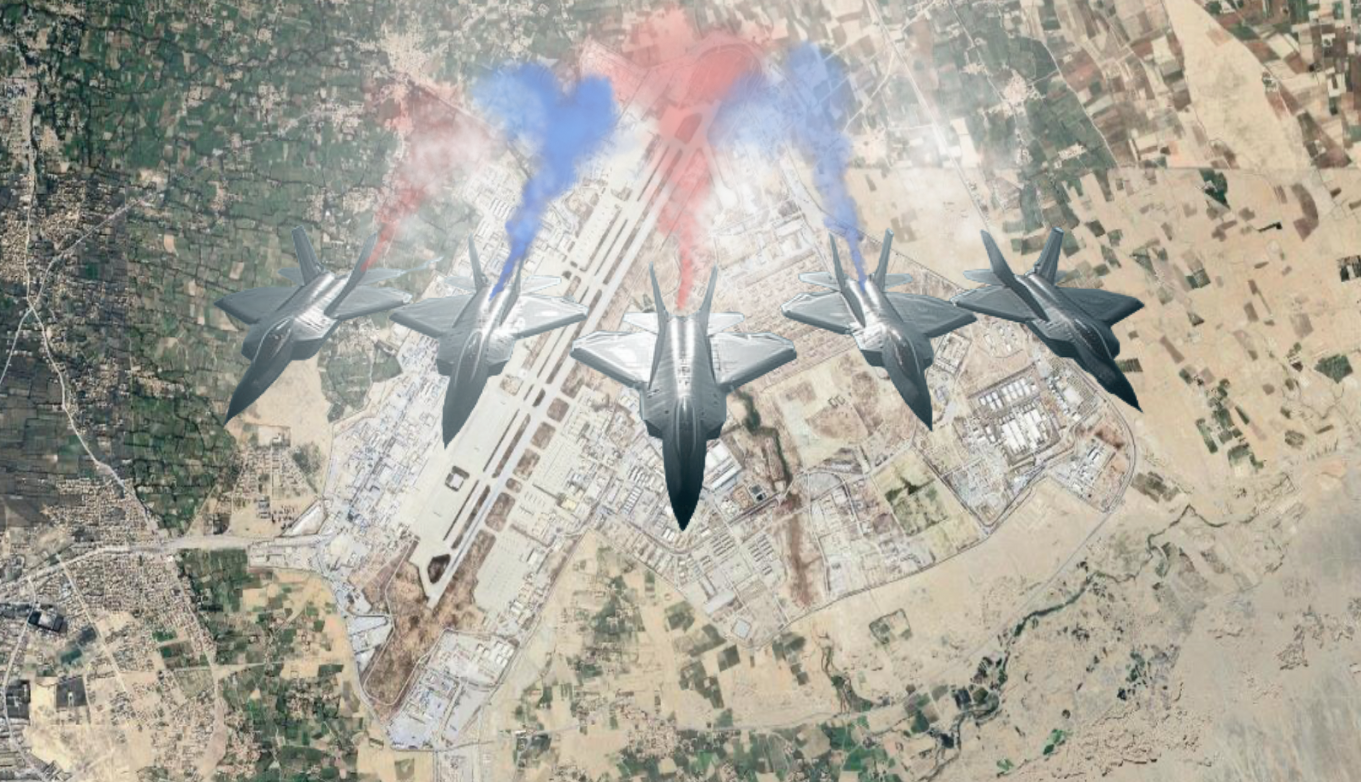
When the US withdrew from Afghanistan in July of 2021, it left behind Bagram Airfield, a strategic stronghold 30 miles outside of Kabul that once hosted US and NATO forces, a prison complex, and a fully functioning hospital. It served as the logistics and operations hub for the 20 year war in Afghanistan. Now it sits deserted, with the majority of its supplies and equipment having been either destroyed in the wake of the US evacuation or looted by the Taliban.
In recent weeks, however, US president Donald Trump has expressed desire to regain control of the base. In a September Truth Social post, Trump warned that “bad things are going to happen” if the Taliban does not “give Bagram Airbase back to those that built it.” The statement is highly ironic for multiple reasons. For one, Bagram was built by the Soviet Union in the 1950s, not the US. For another, during his first term, Trump himself signed the very agreement with the Taliban that set the stage for the eventual withdrawal. “The US pledged that ‘it will not use or threaten force against the territorial integrity or political independence of Afghanistan, nor interfere in its internal affairs,” said a Taliban spokesperson. Retaking the base would certainly be in violation.
So why does Trump want it back? While the base is a strategic location for running counterterrorism operations, Trump seems more concerned about competition with China. The Chinese have been accelerating their engagement in Afghanistan since the US withdrawal by pursuing the country’s deposits of rare earth minerals and embedding itself in Afghanistan’s critical infrastructure. Trump also claimed that the base sits “an hour away from where China makes its nuclear weapons.” This is only partially true—China tests nuclear weapons at a site a little over 1,200 miles away, reachable in an hour via F-16 fighter jet. It would also simply be a projection of US power in the region, aligning with Trump’s supposed “peace through strength” model.
To be fair to the President, retaking Bagram is not a pipe dream. While the Taliban have publicly rejected the idea of US military presence in Afghanistan, internal divisions within the group may leave the door open for that conversation. There are backdoor diplomatic channels at Trump’s disposal, such as using Qatar or the UAE as intermediaries, should the Taliban be willing to negotiate.
The question is not one of feasibility, but rather cost-benefit. Powers such as China, Russia, and Iran, who also seek to assert power in the region, would see the move as a threat, heightening tensions amidst an already fraught geopolitical situation. The open-ended threat from Trump that “bad things are going to happen” suggests that the US may be willing to take Bagram by force should negotiations with the Taliban fail (or fail to occur at all). This puts the US at a high risk for mission creep—history shows that “limited” engagements often do not stay limited. Practically, getting the base back to operational standards would be a costly logistical nightmare given the security situation on the ground in Afghanistan.
The US withdrawal from Afghanistan was a chaotic, messy disaster, but the motivations for doing so should not be ignored: two decades, trillions spent, and thousands of lives lost with no stable democracy achieved. The US should not ignore its regional history and risk another potentially lengthy, deadly, and costly entanglement.
Why a U.S. Golden Dome Won’t Work
On May 20th, President Trump, joined by Defense Secretary Pete Hegseth in the Oval Office, announced plans for a $25B investment in a space-based missile defense system dubbed the “Golden Dome” after Israel’s notedly successful Iron Dome. The full estimated costs at the time were around $175 billion, and the promise was to upgrade a national defense system in dire need of an update. Space-based nuclear defense systems are not a new concept; they are simply the modern iteration of President Reagan’s Strategic Defense Initiative (famously dubbed “Star Wars”) and its direct descendant, the “Brilliant Pebbles” program, both of which were largely unsuccessful. However, despite modern advances in technology, the “Golden Dome” initiative is still a distant fantasy, one that is doomed to fail due to insurmountable flaws in physics, economics, and vulnerabilities.
The logic of a space-based shield is to hit and destroy a missile when it is at its weakest point. For most intercontinental ballistic missiles, that point comes during its “boost phase”, which are the first few minutes after launch when the engines are still burning. In this phase, the missile is a large, hot, slow-moving target with a bright rocket trail that is easy to track. The appeal of this strategy, known as boost-phase intercepting, is that it neutralizes the threat before it can release its multiple warheads and cloud of decoys, which confuse defenses. According to nuclear arms experts, modern missiles remain in their boost phase for less than three minutes. Therefore, after accounting for the 45-60 seconds required to detect a launch, the actual time available to make an intercept is a fleeting moment.
Since this window is so small, in order to hit that target, the defense mechanism must already be nearby. The only way to guarantee this is to place the interceptors in space—the key trait of the Star Wars and Brilliant Pebbles programs, and now the Golden Dome initiative. These interceptors, called Space-Based Interceptors (SBIs), are launched into orbit and designed to detect the bright plume of a launched missile, calculate a path, and fly at it, destroying it through a high-speed, meteor-like direct collision. However, it is obviously impossible to keep objects stationary in space, meaning that the SBIs are constantly orbiting around Earth at over 17,000 miles per hour. This constant motion means that the vast majority of interceptors will, by sheer chance, be in the wrong place at the wrong time and will be unable to reach their missile target before it exits the boost phase. This introduces what is known as the “absentee ratio”, which measures the number of interceptors that are needed in orbit for every missile that is launched, in order to ensure that interceptors are in the proper place at the proper time. Today, experts estimate that the requirement is between 500 and 1,000 interceptors in orbit just to ensure one or two are positioned for a reliable defense against a single missile. The inescapable conclusion is that to guarantee coverage over one of the world’s largest countries by land mass, a constellation of these interceptors is required.
Deploying and maintaining a fleet like this comes with a staggering cost. Creating a network that fits in the White House’s $175 billion funding constraint would be sloppy, time-consuming, and reach nowhere near the levels of interceptors that would be required to defend a legitimate attack from the growing arsenals of our adversaries. Reports from the Congressional Budget Office estimated an initial price tag of nearly $542 billion. However, this cost could be upped even higher, as adversaries could overwhelm the investment by simply building more missiles, whose per unit cost is drastically lower than that of another interceptor. This has led many to realize that the U.S. cannot simply outspend its opponents, as a logical adversary will recognize that they hold the cost advantage and utilize that against the U.S.
The “Golden Dome” is therefore an unworkable concept, defeated by illogical physics, a disastrous cost-benefit ratio, and simple and effective countermeasures. A smarter path would be to invest more in ground-based defenses, which are both more practical and more cost-effective when compared to space-based defense mechanisms. While thousands of space-based interceptors are required to diffuse a single missile, that same work can be done with just 2 to 4 ground-based interceptors. A ground-centric defense mechanism, therefore, could provide similar strategic protection for just a fraction of the cost of a Golden Dome. Ultimately, the idea of Star Wars, though fun, is drastically far-fetched, inefficient, and costly.
Bad Bunny and Cultural Politics Perform at Super Bowl LX
Hours after finishing his third night touring in Santiago, Chile, on February 7, 2026, Latin superstar Bad Bunny will travel north to perform at the Super Bowl LX halftime show in Santa Clara, CA. The NFL’s annual Super Bowl is the biggest entertainment event in the United States, and the choice of Bad Bunny has only heightened attention around the show. Since the joint NFL–Apple Music–Roc Nation announcement on September 28th, praise and criticism of the decision have inundated social media sites, comment sections, and online forums. Some fans celebrate the performance as representation for Latinos on America’s biggest stage, while others critique it as a hollow gesture towards Latino solidarity at a time when Latinos and immigrants are facing heightened backlash and attacks under the current administration.
For the small share of people unfamiliar with him: 31-year-old Puerto Rican Bad Bunny is Benito Antonio Martínez Ocasio—or simply “Benito” to his most devoted fans. He is a singer who first rose to fame in Puerto Rico’s Latin trap and reggaetón scene in the mid-2010s and quickly became a global star. His 2022 album, Un Verano Sin Ti, garnered global attention, and his 2025 album, DeBí TiRAR MáS FOToS (DtMF), cemented his mainstream dominance, both for fans inside and outside of the reggaetón scene. Outside of the studio, Bad Bunny is also known for fashion experiments, acting roles, and his activism. Alongside his catchy reggaetón flows, nostalgic hits, and overall fun beats, Bad Bunny’s music frequently comments on themes of colonialism, migration, and violence. Tracks like “El Apagón,” “Andrea,” and “LO QUE LE PASÓ A HAWAii” highlight Puerto Rican struggles, gender-based violence, and broader Latin American issues, making his art both a personal expression and a political statement.
For his fans, Bad Bunny’s Super Bowl appearance represents a seismic cultural and linguistic shift. Incorporating non-English language elements and lyrics to the Superbowl is not new, though. During the 2020 halftime show, Shakira and Jennifer Lopez sang pieces in Spanish, but in February, Bad Bunny will perform entirely in Spanish. His music will be a powerful statement that challenges Anglo hegemony in US media and affirms the message that Latinos and Latino immigrants can be themselves without having to translate or assimilate. Moreover, at a time when Latinos and Latino immigrants face increased attacks and scapegoating, Bad Bunny’s Superbowl presence signals advocacy for and solidarity with Latinos living inside and outside of the US. It also indicates cross-border cultural unity among the Latino diaspora, even if individual governments are at odds with each other. For Puerto Rican fans especially, his performance elevates the island’s struggles onto the world’s biggest stage. In the words of Jay-Z, who helped secure the performance through his Roc Nation, “What Benito has done and continues to do for Puerto Rico is truly inspiring.”
Despite praise of the announcement, social media and online posts, comments, and messages demonstrate pushback from those from inside and outside of the Latino community. The upcoming tour of his DtMF album has notably excluded US cities due to Benito’s concern of I.C.E. agents potentially targeting his concerts for immigration deportations. This decision initially earned praise, but after the Superbowl announcement where a Trump advisor warned that I.C.E. will be present, he was criticized for being a sellout to the NFL. Skeptics pose the question that if he skipped touring to protect immigrants, why is he willing to headline the halftime show- an event far more policed and surveilled? They also argue that even activist artists can “sell out” when offered the biggest stage. Furthermore, MAGA-aligned critics have already begun mobilizing online, framing Bad Bunny as “anti-American.” The possibility that the Trump administration might even attempt to censor or interfere with the show also looms. Such commentary echoes the current climate where speaking Spanish in public can spark harassment, where immigrants are vilified, and where Puerto Rico’s suffering is dismissed.
Whether celebrated as visibility or condemned as hypocrisy, Bad Bunny’s halftime show reflects more than a single performance. The performance symbolizes the NFL’s ongoing attempt to look inclusive while remaining a profit-driven enterprise (note previous performers like Kendrick Lamar, Shakira, and The Weekend). Additionally, it highlights the fraught terrain of Latino identity and immigrant politics in America, and it shows the limits of celebrity activism, where artists risk becoming both icons of resistance and instruments of the very institutions they critique. Ultimately, Bad Bunny’s halftime show may embody subversive complicity: both reinforcing the oppressive structures of power by performing and resisting by singing compelling songs and using his platform to do good. Yet we must resist the temptation to idolize celebrities and remember that the NFL, Apple Music, and Roc Nation control the stage. What is certain is that Bad Bunny’s show will be visually and musically stunning, and it will remind us how culture, politics, and identity collide in moments as large as the Super Bowl.
Echoes of History: Navy SEALs Killed North Korean Civilians in 2019
On September 5th, 2025, The New York Times broke the story that in 2019, members of SEAL Team Six killed North Korean fishermen while attempting to plant a listening device on North Korean soil. On a mission in unfriendly territory that required absolute secrecy, the Navy SEALs were confronted by a boat. The SEALs did not know whether it was a “security patrol on the hunt for them” or a fishing boat, so they opened fire on the vessel, killing everyone on board. Team Six immediately left the shoreline without having planted the device that was the reason for their presence on North Korean soil, as the plan required the SEALs to abort immediately if they encountered anyone. The entire mission was a bust, with the main objective left unaccomplished and the only result being dead civilians. Strangely enough, something extremely similar happened almost exactly fifty years earlier.
On February 25th, 1969, members of SEAL Team One’s Delta Platoon entered the Vietnamese hamlet of Thanh Phong with the objective of capturing a local leader of the Viet Cong. When they left Thanh Phong, they had killed almost twenty Vietnamese civilians. The exact details of what happened in Thanh Phong are still disputed: most of the SEALs claim that a majority of the civilians died when the SEALs reacted to what they believed was enemy fire, only to discover when they stopped shooting that “‘we had killed only women, children, and old men.” One of the SEALs, Gerhard Klann, alongside a Vietnamese witness, said that the SEALs actually rounded up the civilians in the hamlet and massacred them. The reasoning Klann gave for this action was that “if they let them go the villagers might alert the enemy.” It is impossible to work out exactly what happened in Thanh Phong because the SEALs who were there did not talk about it for almost thirty years. The only reason why it ever came to media attention was because the SEAL commander at Thanh Phong, Bob Kerrey, went on to have a political career which included stints as a Governor, Senator, and as a credible candidate for President of the United States.
In both cases, while on a mission in the dead of night in unfriendly territory in Southeast Asia, Navy SEALS killed civilians in what may have been cases of mistaken identity. Past the surface-level similarities of the circumstances of these killings, there are also similarities in the disparities between the reported reasons why the SEALs may have opened fire, both in North Korea and Vietnam. The main disagreement between members of the North Korea operation, as described by the New York Times, was precisely how close the fishing boat was: “Mini sub pilots” reportedly said that “the boat seemed a safe distance away” and that “they doubted the mini-subs had been spotted,” while “the SEALs on the shore saw it differently… the boat seemed to be practically on top of the mini-subs.” After they discovered that they had fired upon unarmed fishermen, rather than a North Korean patrol, the SEALs “pulled the bodies into the water to hide them from North Korean authorities.” Additionally, “one added that the SEALs punctured the boat crews’ lungs to make sure their bodies would sink.” The SEALs fired to make sure whoever was on that boat would not cause a “surge of military action in the area” by exposing their presence to the North Korean military, like the kind of surge the US detected after the SEALs left. This reasoning is very similar to the explanation Klann gave for why Delta Platoon “deliberately executed the unarmed women and children for fear they would reveal the team's position to the Viet Cong.” These actions beg the question of what might have happened if the SEALS did not err on the side of caution as they did in Thanh Pong and in North Korea, and instead made the oppsite decision to leave the civilians alive.
In June 2005, four Navy SEALs entered the Hindu Kush Mountains of Afghanistan in search of a local anti-American militia leader, in what was referred to as Operation Red Wings. They were ambushed by local militia, and three of the four SEALs were killed, alongside six more SEALs and ten members of the United States Army, who died when their helicopter was shot down trying to assist the ambushed SEALs on the ground, in what the US Navy describes as “the single largest loss of life for Naval Special Warfare since World War II.” The US Navy page on Michael P. Murphy, one of the SEALs who died, and who received the Medal of Honor for his actions posthumously, claims that the “The SEAL mission was compromised when the team was spotted by local nationals, who presumably reported its presence and location to the Taliban.” This is in reference to a couple of goat herds who discovered the SEALs. After deliberating amongst themselves, the SEALs ultimately decided to let them go despite their fears that the goatherds would alert the Taliban, which the goatherds promptly did. Therefore, the decision to let them go caused all the deaths that occurred that day. Marcus Luttrell, the only surviving SEAL from the initial four man team, claims to have cast the deciding vote to free the goat herders, and that it was “the stupidest, most Southern-fried, lame brained decision I ever made in my life.”
It is not known for certain that Operation Red Wings failed because those goat herds told the Taliban about the SEALs position: others have pointed out that the SEAL’s position could have been revealed any number of other ways. Nor can any causative relationship be drawn between Operation Red Wings and what took place in either Thanh Phong (on account of the latter having taken place 35 years earlier) or North Korea (since the SEALs there did not initially know if they were firing on civilians or not). However, the US Navy does claim on its Medal of Honor page for Michael P. Murphy that Operation Red Wings was compromised by “local nationals.” There are US Naval Academy lessons on it as part of “the moral dilemmas of modern warfare” and whose “Questions for Discussion” include “Did the Navy SEALs make the right decision to let the Afghan goatherds go free?” To the US Navy, the decision by the SEALs to let the goat herds go probably resulted in the deaths of all the SEALs except Luttrell, and the question of whether the SEALs should have killed them instead is a legitimate “moral dilemma.”
The Thanh Phong killings, Operation Red Wings, and the 2019 SEAL landing in North Korea are all publicly known for reasons unrelated to the decisions to shoot or not shoot civilians who could have endangered the SEALs’ positions. At Thanh Phong, it was the future war heroism and political career of Bob Kerrey, who commanded Delta Platoon. In Operation Red Wings, it was the heavy casualties sustained by the SEALs, the high awards received by some of those involved, including a posthumous Medal of Honor for Michael P. Murphy, and a NYT bestseller about it written by the only surviving SEAL, Marcus Luttrell. For the North Korea landing, it was the special significance of US-North Korea negotiations around nuclear weapons. There are likely innumerable other instances of Navy SEALs, not to mention other American special operations units, firing on civilians, intentionally or otherwise, in an attempt to prevent the enemy from learning their positions. The way American special operations units handle future instances of these moral dilemmas will continue to shape foreign perceptions of America going forward, as they shed light on the value that American soldiers place on the lives of non-Americans in comparison to their own.
Is China Changing its Nuclear Strategy?
In a recent article for Foreign Policy Magazine, Tong Zhao, a senior fellow in the Nuclear Policy Program and China Center at the Carnegie Endowment for International Peace, argued that in spite of its passive diplomatic posture regarding nuclear weapons (which was recently reemphasized in May during Chinese President Xi Jinping’s meeting with his Russian counterpart Vladimir Putin), some of China’s recent military behaviors indicate that it is changing its nuclear strategy in subtle ways. Primarily, he argued that its “Launch Under Attack” (LUA) strategy is showing signs of moving towards a more aggressive deterrent stance.
China tested its first nuclear bomb in 1964, and its first thermonuclear weapon three years later. But ever since, China has adopted a remarkably passive policy regarding nuclear weapons. It is party to the nuclear Non-Proliferation Treaty, and acclimated to both the Convention on Biological Weapons and Chemical Weapons. While Cold War suspicions between Russia and the United States edged generals and policymakers towards the construction of sophisticated first-strike capabilities, China has long held an explicit no-first-use policy—in fact, China does not even attach its nuclear warheads to missile delivery systems during times of peace. Chinese diplomats have thus demonstrated resistance to a LUA strategy in toto, even though it would only be used if China was under imminent nuclear attack.
But recent trends suggest that Chinese policymakers are reexamining the value of deterrence. Zhao begins by observing that China is building a comprehensive early warning system of “infrared satellites and large ground-based radars, to detect potential attacks.” He then suggests that those working in the People’s Liberation Army (PLA) “increasingly endorse the LUA concept,” and are “presenting detailed discussions of LUA design and execution.” Such a buildup of early warning and detection systems implies some anticipation or anxiety about missile incursions over China, and gradual endorsement of LUA could indicate the direction in which Chinese leaders feel the winds of tension are blowing through the Indo-Pacific.
These developments have several implications, first among which is that increased nuclear posturing, or opaque discussions about said posturing, are overwhelmingly likely to stimulate anxiety among neighboring states. Those countries could come to anticipatory aggression or proliferation as defensive options. The recent Israel-Iran war has informed the world of the potential costs of nuclear procurement, and though China is already a nuclear power, any further advancements it makes in procurement and posturing could shift the balance closer to conflict.
China’s present security situation makes things riskier for decisionmakers, as Zhao writes. When weighing the decision to respond, China will have to take into account the missile facilities that North Korea and Russia are presumed to maintain near the Chinese border: if the United States were to launch an attack on these sites, Chinese military leaders would have to determine both whether the missile was carrying a nuclear warhead and whether the missile was directed towards China or to one of these border facilities. The world has never come as close to the brink of nuclear war as it has when such ambiguity or risk of misidentification are at play: in one instance, the world had only the choice of one man, Stanislav Petrov, to thank for the avoidance of all-out nuclear war between the Soviet Union and the United States.
The international community and nuclear watchdog organizations will have to monitor this phenomenon very closely to ensure that the risk of heightened nuclear proliferation in the Indo-Pacific is mitigated, especially as tensions between the United States and China rise over dominance in the region. Technology is fallible, and where the destructive power of a nuclear weapon is involved, the consequences of a bad decision could mean life or death for entire nations. Analysts must also consider the possibility that these initial developments, though strictly defensive in nature, could be the opening moves of a China that is increasingly willing to brandish its nuclear weapons as tools of coercion while simultaneously allowing its historical passivity to be eroded by opaque decisionmaking. China faces the choice between disavowing the “Cold War mentality and zero-sum games” it warned against last May and increasing its strength amid rising tensions in the region; whatever it chooses, the consequences will be monumental.
Syrian President’s Historic Trip to Washington
Syria has undergone dramatic changes in recent months, beginning with the fall of former president Bashar al-Assad’s regime in December and the establishment of an interim government in March. Since then, the interim government has sought to establish Syria’s place in the global community.
In September, for the first time in 25 years, Syrian Foreign Minister Asaad al-Shibani visited the United States to meet with lawmakers and discuss the lifting of the remaining sanctions on Syria. Later that month, interim president Ahmad al-Sharaa addressed the United Nations in New York, marking the first time a Syrian head of state had spoken before the United Nations since 1967. In his speech, al-Sharaa highlighted his government’s efforts at establishing fact-finding missions within the country so that the United Nations can investigate the killings that have occurred since the new government’s takeover. The interim government also affirmed Syria's commitment to returning to the global stage after decades of isolation and stressed the importance of lifting sanctions on his country to support stability and reform.
Following a meeting with al-Sharaa in May, U.S. President Trump signed a June executive order which lifted most sanctions on Syria and called for the reevaluation of the Caesar Syria Civilian Protection Act. While most restrictions have been eased, the Caesar Act continues to impact the country, and al-Sharaa stated that Syrian progress will remain inhibited until the sanctions under the Caesar Act are fully lifted. Supporters of keeping the Caesar Act in effect state that it allows the U.S. to continue pushing Syria to address the serious problems continuing to plague the country, especially ethnic tension and violence. They cite the massacres of 1,500 members of the minority Alawite community in coastal Syria in March, which were followed by violent clashes between Bedouin and Druze communities in Suweida in July 2025.
These visits mark a growing effort by the interim government to establish international connections, particularly with the United States, after years of isolation. However, with growing progress toward global cooperation comes internal issues that continue to plague the Syrian people. These trips take place against the backdrop of serious political concerns and ethnic tensions in Syria. As seen with demonstrations outside the United Nations during al-Sharaa’s visit, opinions about the interim government are divided. Some Syrians see al-Sharaa’s government as a necessary change from the tyranny of Assad rule, while others question the government’s ability, or commitment, to prevent the violence that continues against minority communities in Syria.
Despite these challenges, Syria’s engagement with the international community provides hope for continued change. Reopening diplomatic channels brings not only external assistance but also increased oversight and monitoring by the international community, which may help drive progress toward peace and accountability.
Malawi’s Former President Wins Election
Malawi, an east African country, has just reelected Peter Mutharika as President, defeating incumbent Lazarus Chakwera with 56.8% of the vote. Mutharika was the former president of Malawi from 2014-2020, but was ousted after corruption allegations and subsequent protests. Despite his shaky track record, he has been reelected, with many citizens hoping that his former achievements of lowering inflation to single digits and improving infrastructure during his first term will repeat themselves during his next presidency.
Malawi has one of the poorest economies in the world, and is plagued with climate disasters, agricultural decline and drought—disastrous threats for their agrarian-focused economy. It has yet to fully recover from the COVID-19 pandemic, and many citizens who lost their jobs have yet to find work. These factors were key issues for voters considering presidential candidates. Many people were outraged during Chawera’s presidency starting in 2020. While he oversaw numerous issues like economic crises and the goods shortage, there has been limited improvement in numerous aspects. Since his election, Malawi has continued to suffer from economic stagnation, with inflation reaching 33%. 3/4ths of the people live below the poverty line. Because of this, many people suffer from hunger and don’t have the means or resources to get adequate nutrition. Despite promising to weed out corruption, Mutharika seems to have not made a significant effort, furthering public dispute.
Domestically, Malawi is clearly facing both governmental and social issues. This re-election is a determining factor in pushing the country towards or away from progress. Mutharika has already been elected and failed to make meaningful change, but this second chance provides an opportunity to create real change that aligns with the needs of the people. The public is tired of facing the same issues over and over again and is looking forward to a president who fixes the longstanding issues that have afflicted the country for so long, including unemployment and food shortages. During a tumultuous global political environment, Malawi must achieve stable domestic politics, or they could face the consequences on the international stage.
Are We on the Brink of World War Three?
In short, no, but if Russia continues on its current path, the possibility cannot be dismissed entirely.
When news broke that Poland had invoked Article 4 of the NATO treaty, the world quickly erupted with questions about how this would affect global security and international relations. According to CNN, Poland called for a NATO meeting after Russian drones entered into Polish airspace on September 9, 2025.
To clarify, according to NATO, Article 4 of its founding treaty states that “The Parties will consult together whenever, in the opinion of any of them, the territorial integrity, political independence or security of any of the Parties is threatened.” Invoking Article 4 does not mean war: it is simply a meeting where NATO members decide collectively what to do about a situation or threat. While it remains unclear whether the drone incident was deliberate or accidental, NATO is not taking any chances.
According to Newsweek, allies have rallied behind Poland, declaring their solidarity. If another incident occurs, Article 5 could be invoked or NATO could consider retaliatory measures. NATO’s Article 5 states that an armed attack on one NATO ally is considered an attack against all, requiring assistance from every member state. If triggered, this clause could set the stage for direct conflict with Russia, potentially igniting the very war that the world currently fears.
This is not the first time that Poland has invoked Article 4. In 2022, Poland invoked Article 4 in response to Russia’s invasion, along with six other NATO members bordering Ukraine. It is important to know that invoking Article 4 does not automatically lead to Article 5’s collective defense stipulation. In fact, CBC News states, Article 4 has been used several times throughout NATO’s history without leading to escalation of the conflict.
The stakes remain high, but the real question is whether Russia would risk attacking a NATO member knowing that it has the backing of all 31 member countries. At the same time, there is no guarantee on how NATO itself will act: consultation does not always equal confrontation. What is certain is that if NATO determines that the threat is real and imminent, it will act to protect its members, especially if Russia carries out further attacks on Poland or neighboring NATO countries. Whether this incident fades into the background or escalates into something larger doesn’t just depend on Russia or NATO but on the international community as a whole. For now, our best hope to prevent another world war lies in diplomacy, unity, and restraint.
No Flood Control, Just a Flood of Protests: Philippines Erupts Over Corruption Scandal
These past weeks have seen a wave of protests erupting around the world, all largely driven by frustration over corruption. In Indonesia, protests over the increase of lawmakers' housing stipend led to violent clashes and the death of a young taxi driver that only fueled the nation’s rage. Following violent demonstrations in Indonesia and Nepal, the Philippines has become the latest hotspot, with citizens taking to the streets to voice their anger.
On September 21, tens of thousands of protesters marched through Manila and cities across the nation to demand accountability over a massive corruption scandal tied to flood control projects. The controversy has been building since July, when President Ferdinand Marcos Jr. highlighted the so-called “ghost projects” in his annual State of the Nation address.
Corruption has long been an issue in the Philippines, but these protests focus on one particular problem: the mismanagement of flood control contracts. Reports suggest that many of these projects were used by lawmakers to funnel funds into personal or political interests, while critical infrastructure either remained incomplete or never materialized. Estimates suggest the Philippine economy could have lost as much as £1.48 billion ($1.8 billion) due to corruption in these contracts. Recent investigations have highlighted that for the past 6 years, most flood control projects were overpriced or substandard to give large kickbacks to politicians. The implications of these corrupt flood projects goes beyond money. The Philippines is especially susceptible to typhoons which lead to widespread flooding. In July, a typhoon hit the country, causing massive floods and landslides, killing at least 25 people, and affecting millions. Therefore it is understandable that upon hearing of mass corruption in the project for flood control, people are angry. After all, as quoted by Philippine Representative Elajiah San Fernando, “When flood control fails, the ordinary Filipino gets to be hurt first”.
While most demonstrations were peaceful, some escalated into violence, with protesters throwing rocks and Molotov cocktails at police. Videos showed police getting into clashes with demonstrators. Similar to Indonesia, the “One-Piece” Jolly Roger Flag, which has become a Gen-Z symbol for resistance, was seen in the streets.
There’s also a historical layer to these protests. Over fifty years ago, on the same date in 1972, Ferdinand Marcos Sr., the late president and Marcos Jr.’s father, declared martial law, beginning an authoritarian regime that lasted until 1986. Despite calls for resignation, Marcos Jr. has expressed support for the protesters’ right to voice their anger. He stated, “Of course, they are enraged. Of course, they are angry. I’m angry. We should all be angry. Because what’s happening is not right.”
Corruption is an issue that continues to persist in Southeast Asia. Yet these protests have highlighted that citizens are not accepting these trends and are demanding change. With three countries experiencing protests, albeit for slightly different reasons, leaders in the region must step up in order to preserve the trust in political institutions and appease their populations.
Nepal’s Turning Point
In early September 2025, Nepal’s government banned 26 major social media platforms, including Facebook, Instagram, and YouTube, claiming that the platforms had failed to comply with new speech and data laws. This act of censorship was widely seen as an attempt to suppress growing online criticism of the country’s political elite, who had been the subject of a viral “#NepoKids” campaign spotlighting allegations of corruption and privilege.
Within days, the streets of Kathmandu were filled with protestors, many of whom belong to Gen Z, demanding systemic reform. What began as outrage over censorship quickly escalated into a broader anti-government movement. Over 50 civilians were killed in clashes with police, the parliament was set on fire, and the Prime Minister resigned. This wasn’t just another protest; it was the collapse of political credibility in real time. The speed and intensity of the response revealed just how fragile the relationship between the Nepali state and its citizens had become.
The trust in their government had already been eroded; the social media ban simply exposed the depth of that disconnect.
But this disillusionment didn’t lead to disengagement; it led to action. On September 12, 2025, the first female interim prime minister was appointed via Discord. The public’s choice to back Sushila Karki as interim Prime Minister was important not just because of who she is, but because of what her appointment represents. Karki is a former Chief Justice with a track record of standing up to political interference and a reputation for integrity. Her past includes pushing back against some of the same elites who were now being called out in the protests. Choosing her was not just a call for leadership; it was a rejection of the status quo.
What makes this moment politically significant is that Karki wasn’t elevated through party politics or electoral campaigning. She was brought forward through public consensus, shaped by both on-the-ground mobilisation and digital coordination. Her appointment reflects a shift away from traditional party structures and toward a new kind of legitimacy, one that is built through public trust, not institutional affiliation. This change also signaled how power is being renegotiated in real time. In Nepal’s case, the people didn’t just remove a leader. They influenced the selection of the next one. That shows a level of political engagement that goes beyond protest. It challenges the idea that political authority must always be handed down from within formal systems. Instead, it shows how quickly authority can be created from outside them when the public decides to act.
On a broader level, this raises questions about the durability of traditional political institutions in a digital age. As trust in parties and parliaments declines globally, examples like Nepal suggest that new pathways to power are forming, pathways where public sentiment, amplified through technology, can shape outcomes directly. That doesn’t mean structure and process are irrelevant. But it does mean they can no longer operate independently of the people they are meant to serve.
Looking To The Right: The Rise of Populist Politics in Germany
The term populism is derived from the Latin word populus, which translates to "the people". It is a controversial term, but broadly, it is a concept that emphasizes “the people” versus the perceived elite. Essentially, it divides people into two camps: “the people” and “the others”. “The people” can refer to different groups in different contexts, so populism can relate to left or right-wing politics.
Established in 2013, the Alternative für Deutschland (AfD) is a relatively new and rapidly growing right-wing populist party in Germany. Originally founded in opposition to policies of the Eurozone, since the 2015 European Migrant Crisis the AfD has embraced a platform of nationalism, anti-immigration, Islamophobia, and nativism. In early May, the AfD was classified by Germany’s domestic intelligence agency as an extremist organization because the "ethnicity-and ancestry-based conception of the people that predominates within the party is not compatible with the free democratic order." However, this classification was deferred as a result of a lawsuit filed by the AfD.
The growth in popularity of the AfD is evident in the 2025 federal election that occurred in February because the previous governing coalition collapsed in November 2024. The AfD gained 20.8% of the total vote, earning 152 seats in the Bundestag. It was the second winningest party, trailing behind the Christlich Demokratische Union (CDU), which is a centre-right party.
In the last decade, the AfD’s primary stronghold was in districts that were formerly members of the Deutsche Demokratische Republik (DDR)—the former communist state in East Germany. However, a recent local election held in Western Germany demonstrates the continued growth in support of the German far-right. On September 14th, local elections were held in the North Rhine-Westphalia, which is the most populous state in Germany. While Chancellor Friedrich Merz’s party, the CDU, maintained the majority in this election, the AfD tripled its votes from 2020, receiving 16.5 % of the vote compared to 5.1% in 2020.
The AfD ascension reflects Western Europe’s trend towards populism and the right. Similar patterns are evident with Italy’s election of Giorga Meloni, who founded the Brothers of Italy, a far-right populist party in 2012. Like the AfD, the Brothers of Italy started with a platform of Euroscepticism, and both the AfD and Brothers of Italy have become more politically mainstream.
The AfD’s growing influence marks an important shift within Germany’s political landscape. Despite the AfD receiving the second-most votes in the 2025 federal election, the other parties refused to form a coalition with them because of their extremism. This is referred to as a “firewall”, which is “a direct result of the country’s post-World War II efforts to suppress parties and voices labeled extreme.” Even with this pushback from the opposition, the AfD is likely to shape debates and exert pressure on the Bundestag. Whether this firewall holds will be a defining factor of Germany’s political trajectory and democracy.