
The Journal of Foreign Affairs at Carolina
Get the latest from our undergraduates at
The Column at JFAC
Why an Irish Unity Referendum Looks More Likely Than Ever
Following the signing of the 1998 Good Friday Agreement, the political fate of Northern Ireland has been put directly in the hands of its residents. Almost 30 years later, the politics of the North can be described as both chaotic, and perpetually gridlocked. Disagreements between Unionist (Loyal to Westminster) and Republican (Pro-unification with the Republic of Ireland) lawmakers have rendered the government deeply inefficient, with only 12 bills passed into law since 2024. Debates over the Northern Irelands’s political status have existed long before the Good Friday Agreement was signed, but in recent years the conversation that has come to dominate politics both on the island of Ireland and in Westminster has been the subject of reunification with the Republic of Ireland.
After the Brexit vote in 2016, in which the North voted remain by 11 points, the subject of a hard border on the island of Ireland became a topic of intense debate and worry. Though the Good Friday Agreement does not explicitly mention the banning of a land border on the island, leaders in the Republic of Ireland, in the North, and even in Westminster did not support a hard border, in part due to fears of damaging the fragile peace on the island. The current agreement maintains an effective trade boundary in the Irish Sea, with Northern Ireland remaining aligned with relevant EU single-market rules for goods to avoid a hard border with the Republic of Ireland, still an EU member. As the post-Brexit political chaos throughout the UK unfolded, voters in Northern Ireland elected their first pro-unity government and first ever nationalist First Minister in 2024. Since then, Republican parties in the North and Republic of Ireland have called for a unity referendum by the end of the decade.
Both Unionist leaders in Northern Ireland and current British Prime Minister Andy Burnham are against a unity referendum. However, the decision to call a referendum is not up to the Prime Minister of the UK, but rather is at the discretion of the Secretary of State for Northern Ireland, according to the Good Friday Agreement. The agreement states that the Secretary of State must hold a border poll if it appears likely that a majority in the North would vote for Irish unification. However vague this condition is, what is clear is that it has not been met yet. Since Brexit, polling for a United Ireland in the North has been steadily increasing, though it is not at an outright majority. It is important to note that a unity referendum would only need a simple majority to win. Meaning, that if the rise of support both in opinion polling and with increased electoral gains by Irish Nationalist parties, there is a concrete chance that the condition of ‘appearing likely to vote for unification’ will be met. Alongside a poll in the North, voters in the Republic of Ireland will also have to approve unification. This could turn out to be a surprising hurdle in the process, as despite high support on paper, the sheer economic disparity of the two entities may persuade voters in the South to vote no.
Whatever the potential outcome may be, it is undeniable that the winds of political change are moving away from Westminster, and towards Dublin and the EU. As the UK stumbles through Prime Ministers and post-Brexit economic blues, voters in the North may increasingly look to Dublin, and more so the European Union, as a more stable and economically viable future.
A Golden Sign of Global Economic Restructuring
Earlier this month, the Dutch central bank completed a relocation of $11 billion worth of gold from vaults in Ottawa and New York City to London. The operation required months of quiet collaboration among the US, Canadian, English, and Dutch central banks, private banks, and security and logistics firms to transfer some 80 metric tons of the precious metal.
Gold transfers and trades have a historical precedence. The Federal Reserve Bank of New York received large quantities in the WWII era for fear of Nazis reaching allied gold stored in Europe. In fact, Britain even moved its entire reserve to Canada during the same period. Globally, central banks tend to increase inventory of gold in times of crisis or financial uncertainty, like that of 2008.
Redistribution of the resource also acts as a risk mitigation strategy, with the Netherlands striving for a “more balanced” geographical allocation of its reserves so as to not concentrate too much in one site. Shifting gold from one site to another does not imply that a country’s entire reserve has moved, though. Almost one-fifth of the Dutch supply still resides underneath Manhattan. Repositioning reserves can be achieved through physical shipment, or by selling it in the existing market and purchasing the same amount in another market.
While occasional transfers are typical and risk mitigation is a strategic decision, the context of this shipment and implications are worth noting.
A key reason for the Dutch central bank’s decision was to bolster “its crisis preparedness” amid “increasing geopolitical unrest.” Geopolitical tensions have been on the rise globally, including between the United States and Canada – the two North American sites holding the Netherlands’ gold. The neighboring countries are at odds as recent trade negotiations failed and new tariffs were announced. Affairs between the US and European Union are also strained following threats of annexing Greenland, Washington’s pulling of troops, disagreements over the US-Iran war, and trade tensions.
The relocation of Dutch gold represents another example of a wider shift away from an economic paradigm of efficiency to a model focused on resiliency and security. Decades of globalization are unraveling as supply chains become subject to volatile shocks and conflict increases globally. This is seen not only with the recent cloud technology unbundling, but also with a Western shift away from dependence on China’s critical minerals, European adoption of alternate energy sources following the 2022 Ukraine invasion, and America’s attempt to revitalize domestic manufacturing through steep tariffs.
Dependencies once justified by cost and efficiency are now being revisited as potential liabilities. Gold reserves, energy providers, critical minerals, manufacturing, and digital infrastructure have already been affected. So, as geopolitical risk becomes an increasingly important factor in decision making, the question becomes: what part of the supply chain is next to be restructured?
Make Germany Great Again
It’s hard to deny the similarities between the Alternative für Deutschland (AfD) party and Donald Trump’s MAGA movement, not that anyone is trying particularly hard. They share the same nationalist ideology (just swap out the nation), weaponize much of the same rhetoric (a little creativity, anyone?), and their leadership is similarly hypocritical (if you’re going to be anti-LGBTQ, having a lesbian party leader requires a bit of mental gymnastics). Yet Trump’s enthusiasm for the AfD’s recent win in Saxony-Anhalt, where they received 43.8% of the vote–the strongest showing for any far-right party in Germany since WWII–may be a little short-sighted. It is exactly the similarities between the two movements that could make an AfD-led Germany a poor ally for Trump’s America. After all, who has America First ever promised to put second?
America’s polarization is largely reflected in the urban-rural divide while Germany’s runs East-West. In both countries, these geographic divides overlap with differences in class, religion, education, and access to economic opportunity. Trump exploited America’s division to appeal to voters who felt ignored by the political establishment. The AfD has done much the same in East Germany, appealing to the German identity of those who have felt left behind after Germany’s reunification–which for many has solidified as resentment towards West Germany. Both campaigns successfully motivated people who had grown disillusioned with the current political systems, with the AfD capturing the votes of 170,000 people in Saxony-Anhalt who had stopped voting.
Further, Trump has been known to scapegoat immigrants for America’s economic and social problems. He has blamed them for rising housing prices, portrayed them as a strain on public resources, and blamed them for violent crimes and drug-trafficking. Germany is home to the largest refugee population in Europe after accepting almost a million Syrian refugees after the outbreak of the civil war in 2011. This has given the AfD the opportunity to borrow directly from Trump’s rhetoric and immigration policy promises–though the AfD has rebranded “deportation” as “remigration.” The AfD’s willingness to scapegoat the immigrant population, specifically those from the Middle East, was on full display in their response to the terrorist attack on Berlin Pride in July, which focused on the perpetrator’s potential migrant status and blamed Germany’s current migration policies for the attack (Abdul Ballout, the attacks’ perpetrator, was born in Germany).
I spent a portion of my summer living in Halle (Saale), the second-largest city in Saxony-Anhalt, where the presence of Syrian refugees is impossible to miss. Many of the businesses in the city’s small downtown area are immigrant-owned. While walking through the area with my Arabic teacher, himself a Syrian refugee, he pointed out entire sections that had once sat empty until refugees opened up shops and restaurants. They hadn’t displaced anyone, they had reinvigorated a failing economy that was trying to support an aging population.
The parallels between the two parties extend into other social issues. Both have used inflammatory language and supported policies that restrict the rights of the LGBTQ+ community. In 2019, for example, the AfD filed a motion to overturn Germany’s legalization of same-sex marriage. This is especially ironic given that one of the AfD’s most prominent national leaders, Alice Weidel, is married to a woman. This cognitive dissonance is almost entirely matched by Trump’s marriage to Melania, an immigrant from Slovenia, as he champions aggressive anti-immigration policies.
A win for the AfD is not necessarily a win for Trump–not despite the similarities between the two movements, but because of them. Both preach national interests above all else, which is a strategy that does not promote or particularly value strong allyship (see Trump’s repeated agitation of long-term allies like Canada). While Trump has spent much of his administration asking NATO signatories to contribute more funding to the alliance as a means of reducing the burden on the U.S., the AfD have repeatedly expressed an unwillingness to comply and have made it clear that they would prefer a stronger relationship with Russia. The AfD has also endorsed China’s Belt and Road Initiative, signaling a willingness to work with one of the U.S.’ greatest competitors and threats.
Who would have thought that Germany First might occasionally conflict with America First?
Milei Re-evaluates Argentina
Milei demonstrates many similarities to other right-wing presidents in the Western Hemisphere, although his approach is far more intense.
In 2019, Javier Milei began to lay out a platform that would pave the way for his presidential policies and rhetoric—one defined by a mission to restore capitalism and individual liberties to Argentina. Recently, after a meeting with entrepreneur Peter Thiel, Milei further reaffirmed his policies and philosophical lens, describing them as rooted in “anarcho-capitalism” and emphasizing that his key goal is to win the cultural battle plaguing Argentina.
Milei demonstrates many similarities to other right-wing presidents in the Western Hemisphere, although his approach is far more intense. His more explicitly anarchist stance pushes ideas held by other leaders in Latin America, as well as Donald Trump in the United States, to a new level.
His administration is defined by the use of “shock therapy,” aimed at slashing the country’s budget in an effort to bring Argentina’s turbulent economy under control. Alongside this economic platform, Milei is a staunch opponent of social justice, which he has called a “virus” that stokes resentment and hatred.
However, Milei’s policies and rhetoric are not merely part of a broader right-wing trend in Latin America. They are distinctly shaped by Argentina’s history and the relationship between the state and its people.
To Milei, his social and economic policies respond to what he sees as a culture of laziness plaguing Argentine society—one he attributes to years of left-leaning governments that provided generous benefits. His agenda also reflects an effort to combat the legacy of the Peronist populist movement, which defined much of Argentine life in the 20th century. During this period, Juan and Eva Perón prioritized a strong state—particularly a strong executive—while promoting social justice and expanding benefits for the marginalized working class.
Closely connected to anti-Peronism is the military coup that attempted to end Peronism, which culminated in the 1976-1983 “Dirty War.” During this period, approximately 30,000 people were taken to clandestine detention camps and faced torture and extrajudicial killings carried out by the state. This era was also marked by the “theory of the two demons,” which framed state terror as equivalent to the violence perpetrated by left-wing guerrilla groups. Although this theory lost credibility by the mid-1990s and was widely considered discredited, Milei has appeared to echo it in his rhetoric.
His language reflects elements of the denialism that emerged in the aftermath of the dictatorship, including his claim during a presidential debate prior to his election that “there were no 30,000,” arguing that the number of those killed was significantly lower. He has also described the dictatorship’s crimes as “excesses” committed in the context of a war—a direct restatement of rhetoric used by military leaders to justify their actions and seek impunity.
Milei’s apparent revival of this framework is also reflected in his present-day economic and social policies, particularly federal budget cuts that have disrupted the work of civil society organizations dedicated to preserving memory of this dark period in Argentine history.
These cuts are evident in the condition of former clandestine detention centers ESMA, which was transformed into a UNESCO museum and site of memory in 2008. Budget reductions have led to the museum closing three days of the week, staff layoffs, the shutdown of its cultural center, and a growing need for repairs throughout the site.
Similarly, the Grandmothers of the Plaza de Mayo—an influential human rights organization responsible for reuniting families separated during the dictatorship—have lost government funding despite their ongoing work. Milei has also reduced the state’s participation in ongoing trials of military and police officials involved in the dictatorship. He has previously referred to the group’s leader as “totalitarian,” and dismissed human rights efforts as a “scam.”
While expressing a revisionist and critical stance toward the legacy of the Dirty War, Milei has also worked to dismantle contemporary social programs. His administration has cut social spending, limited the ability to peacefully assemble, and adopted rhetoric widely viewed as anti-journalist and anti-LGBT. He has further vetoed congressional efforts to increase pensions and funding for public universities.
These actions, both retrospective and forward-looking, reflect a broader rejection of social welfare rooted in Argentina’s historical pattern of strong executive power, as well as a return to earlier forms of state discourse. Looking ahead, it is likely that funding for museums and memorials tied to the Dirty War will continue to decline, while social programs face ongoing criticism and reduction as Milei’s culture agenda continues to unfold.
Magyar Defeats Orban in Historic Hungary Election
On April 12, Peter Magyar put an end to Prime Minister Viktor Orban’s 16-year rule, with Magyar’s Tisza party receiving 53% of the vote. Orban’s right-wing party, the Fidesz, has been in power since 2010 and has championed anti-immigrant xenophobia and conservative Christian values as its core tenets.
This historic victory was no simple feat. Magyar used to be a member of Fidesz before he broke away in 2024 and helped Tisza further its campaign of closer EU relations, tackling corruption, and reforming healthcare and education. Magyar’s electoral campaign focused on attacking Orban’s shortcomings, including corruption, Fidesz’s governmental failures, increasing public dissatisfaction over the worsening economic situation, and the lack of consequences imposed on child abusers. He doubled down on the prospect of change, and moving in a direction away from ‘Orbanism.’ Ultimately, it was Orban’s reconstruction of the electoral system to be supposedly in his favor that bolstered Magyar’s win.
Orban’s loss presents a harsh loss for his far-right supporters and allies. Orban was at the forefront of populist anti-EU and anti-migration stances, and was supported greatly by the Trump administration. His ideas have been incorporated into US politics and other far-right organizations worldwide. However, his defeat raises questions about the survival of other far-right movements. The end of Orban’s illiberal democracy has sparked hope as to whether a country can retrieve its democracy from a far-right weakening and years of populist rule, and signals a shift in the rise of nationalist populism.
For Hungary and the rest of Europe, this win promises the opportunity of reform and liberalization. Magyar has promised drastically different policies compared to Orban, including providing support to Ukraine and potentially putting a sanctions package on Russia. For NATO, this win means the fostering of closer relations, Hungary spending more on defense spending to meet the five percent spending goal, and a more unified NATO-EU relationship in general. The European Commission and Magyar will also soon negotiate the release of EU budget funds for Hungary, which were frozen due to reservations about democratic freedoms under Orban’s administration. While Magyar is still a central right wing politician, his different policies and resonation with the public points towards a shift in domestic and global politics.
The Economics of War
Despite the government's optimistic timeline for the war in Iran, the United States remains actively involved, with effects on the economy becoming increasingly noticeable.
In response to questions regarding the estimated costs of war at a recent congressional hearing, the White House declined to provide an estimate, drawing criticism from several Senate Democrats who argued the administration was being insufficiently transparent. Russel T Vought, the White House budget director, appeared before lawmakers and avoided giving even a general cost range, explaining that the rapidly changing nature of the conflict made it difficult to calculate current expenses or determine how much additional funding Trump might soon request from Congress. He indicated that more detailed figures would be provided later in a formal funding request.
This lack of clarity has frustrated many Democrats, especially considering this war is nearing 10 weeks and the administration has already sought to increase military spending. In the president’s proposed 2027 budget, about $1.5 trillion was requested for defense, though it did not include immediate funding for the Iran conflict. According to the New York Times, earlier briefings suggested the war cost more than $11 billion in its first six days, and Pentagon officials later indicated as much as $200 billion in supplemental funding might eventually be required.
To the surprise of economists, the financial markets have remained stable considering the war in Iran. However, rising energy costs are beginning to strain the broader U.S. economy. Gas prices now average about $4.10 per gallon nationally, which is more than a dollar higher than before the conflict. Higher energy prices inflate the costs of transportation, groceries, and housing, placing increasing pressure on household budgets. Although President Trump has acknowledged that the war has caused some economic disruption, he has expressed confidence that the economy will eventually recover.
Economists warn that the long-term effects of the conflict remain uncertain but could slow economic growth, increase inflation, and raise unemployment if tensions persist. This has, to no surprise, become increasingly frustrating, especially to Democrats who oppose the U.S.’s involvement in Iran altogether. Many critics question the scale of the United States's military spending, arguing that such a large defense budget may not be fully necessary and could place additional strain on the nation’s economy and federal finances. With that being said, it is necessary to shift focus to a paradoxically opposite side of the spectrum: when the U.S. military spent over $300 million to rescue a downed F-15E pilot in Iran, just this month.
At 4:40 am on Friday, April 3rd, a U.S. Air Force F-15E Strike Eagle was shot down over southwestern Iran after being hit by a shoulder-fired missile. Both crew members successfully ejected but landed miles apart in hostile territory while Iranian forces launched a manhunt for them, with a reward of approximately $60,000. In response, the U.S. initiated an enormous combat search-and-rescue mission. The first recovery operation involved multiple aircraft and special operations personnel flying roughly seven hours into Iranian airspace while facing ground fire in order to rescue the pilot.
Rescuing the second crew member required an even larger operation. A second rescue mission launched with 155 aircraft, including bombers, fighters, refueling tankers, rescue helicopters, drones, and hundreds of special operations personnel. Aircraft carried out strikes to block Iranian forces from reaching the downed officer, and some U.S. aircraft and equipment were intentionally destroyed afterward to prevent sensitive technology from falling into enemy hands. The mission ultimately resulted in the loss of several aircraft—including transport places costing around $100 million each.
This search-and-rescue mission illustrates the extraordinary scale of resources the U.S. military is willing to commit to recover a single service member. Such missions reflect a longstanding principle often summarized by the phrase “no man left behind,” a value that emphasizes the nation’s commitment to those who serve in its armed forces. In this sense, the operation reflects a broader characteristic within U.S. military culture—that the government bears a responsibility to make every possible effort to bring service members home. At the same time, this commitment exists in tension with broader public debates about whether the U.S. allocated excessive resources towards military operations rather than other domestic priorities.
As wartime decisions continue to shape national policy, it is important to consider the complex trade-offs involved in military spending. Public frustration with financial costs of war is not only a very validated concern, but also backed by many questions regarding the political and ethical framework of military expenditures. However, discussions about reducing defense spending often intersect with the question of how a nation fulfills its obligations to the individuals it sends into conflict.
China’s Clean Energy Rise: A New Era of Geopolitical Power
In recent years, China is becoming a dominant force in global clean energy through upscaling both their production and consumption of renewable energy. The global transition away from fossil fuels towards renewable energy has allowed China to extend their influence in the energy sector of the global economy. Between 2019 and 2024, China will account for 40% of global renewable capacity expansion, driven by improved system integration, lower curtailment rates and enhanced competitiveness of both solar PV and onshore wind. Furthermore, their control of critical minerals and supply chains not only gives them leverage in the making of renewable energy, but also on what terms it is distributed. China has also fostered relations with many countries in Asia, Africa, Latin America and Europe through their Belt and Road Initiative. This move by the Chinese government is an economic development strategy to extend their influence and promote Chinese leadership in global affairs. Beijing’s approach in clean energy is a long-term, methodical strategy that is already reshaping global energy sources and creating new forms of dependency.
China’s dominance in clean energy production is highlighted by the fact that they process 80% of solar panels made and 95% of global polysilicon, ingot, and wafer. These three elements are essential to the formation of clean energy as they help convert sunlight into electricity. China also accounts for a significant portion of wind energy, as they account for more than 50% of the wind farms operating in the world. In addition, China has significant investment in the transportation sector as they produce over 70% of the world's electric vehicles. A total of 17.3 million electric cars were produced in China in 2024 while the European Union, who is the second largest manufacturer, accounted for a total of 2.4 million electric cars made. These examples display the disparity in market share of energy and technology as export-driven growth shapes global markets. However, Chinese dominance over renewable energy is not solely limited to solar panels, wind energy, and electric vehicles—Chinese companies account for two-thirds of global processing capacity of lithium and cobalt. These resources are essential in producing rechargeable batteries used in electric vehicles, laptops, and smartphones. In addition, they are used in superalloys for jet engines, medical implants, and magnets. It has come to a point where if a country wants renewable technology and electric vehicles, they must go through China.
China’s rise in the clean energy space and extraction of minerals is a reflection of the global shift from oil dependence to renewable alternatives. China’s heavy hand in the extraction of minerals and manufacturing of renewable energy infrastructure gives them strategic leverage in global markets as they can influence developing countries via affordable tech exports. Rather than through political or military directives, China has been able to weaponize interdependence through economic means. Responses from global actors like the United States have resulted in Chinese investments in generating energy independence and clean energy alternatives through the Inflation Reduction Act. The European Union’s Green Deal is another example of a major actor transforming its economic strategy to reduce emissions and promote sustainability. Global competition in the clean energy space raises the question of who will control the critical resources and technologies of tomorrow? While China is still the largest leader in CO2 emissions, the effects of their pivot towards clean alternatives both within and outside of China signal that their influence has gone beyond the supply chain.
The Arctic Front: Global Powers Setting Their Focus North
The combination of climate change with the rapid shift of geopolitics has transformed the conversation regarding the Arctic region from an isolated territory to a strategic frontier. Melting sea ice in the region has given rise to opportunities for multiple uses including shipping, resource extraction, and security. This economic potential coupled with a strategic location has made global powers take interest in acquiring territory within the region. Countries see the Arctic Circle as an essential element for the sustainability and growth of their future. The fear of running out of oil from traditional locations with the combination of an expanding digital world and alternative energies makes the Arctic seen as a significant asset to supply future economic prosperity and deterrence when original means have expired.
The Arctic’s economic potential is a major driving factor of competition for the region. It is believed to contain roughly 13% of the world’s undiscovered oil and 30% of natural gas reserves. Furthermore, Greenland contains an immense quantity of rare earth elements and critical minerals that are essential to developing modern technology, green energy, and defense applications. These economic opportunities have attracted international investment to extract these resources and minerals. As more ice melts, new accessible shipping routes are being created, particularly the Northern Sea route off Russia’s coast. The new routes present significantly shortened trade between Europe and Asia, as the distance between Shanghai and Rotterdam can be reduced by 20%, leading to a decrease in trade transportation expenses. While this information can be deemed as a positive opportunity for the global supply chain, it raises many points to debate. International investment, specifically the U.S.’s desire to acquire Greenland and its abundance in minerals, is ethically questionable as the U.S. essentially seeks to violate Greenland’s sovereignty and traditional structure for our economic and security benefit. The U.S is likely looking to gain control of the Arctic Circle first, before Russia and China, to have stronger influence in future oil and mineral supply chains. This would grant the U.S. significant leverage in global relations and power politics through controlling the resources modern societies thrive on.
As competition and interests increase, the Arctic is becoming a more militarized region. NATO has increased their arctic presence through the accession of both Finland and Sweden into the organization, expanding their outreach towards Russian activity in the Arctic. Russia has also increased their presence and militarization for their Arctic ambitions through re-opening Soviet-era Arctic military sites and testing novel weapons systems, as well as doing joint bomber patrols with China into Alaskan airspace. Expansion of military bases and surveillance systems highlight the strategic importance in response to geopolitical tensions. Acquiring the Arctic and Greenland would supply major powers with the ability to implement short distance intercontinental ballistic missiles towards their opposition. The geography of the arctic makes NATO’s and Russia’s borders close, which can induce tensions and threats from both sides. NATO, but specifically the United States under President Trump’s administration, see the Arctic and Greenland as an essential military point for a buffer and surveillance post on Russia and China. Greenland’s position raises the point on if local territorial politics intersect with global security competition. The addition of military bases and presence can boost Greenland’s local civic society but can also diminish it if no dialogue takes place and rapid militarization unfolds. This could create instability within the Arctic if there is not a consensus on the security structure.
Overall, the Arctic is in a transitional period into a central arena of global competition. The Arctic region’s resources, shipping routes, and strategic geography are drawing increasing attention from global powers. Current geopolitics have taken a shift from a rules-based international order to a more transactional and mercantilist attitude. Greenland’s growing importance in this issue highlights how local politics collides with global implications for security and resource competition. In addition, the optimistic perspective of economic opportunity in the Arctic downplays the high costs and coordination it takes to build such infrastructures. Those who seek influence in the region must invest in machinery and boats to endure Arctic ice. The logistics of extracting oil, gas and minerals is sophisticated and requires significant time, man-power, and money. The revenues from utilizing Arctic resources have the potential to be extremely high and beneficial to the economy, but the initial labor and logistical costs of implementing such processes requires high investment, transparent coordination, and flexible mobility to access an isolated region. Whether the Arctic is cooperative or becomes more confrontational will have significant consequences on diplomacy and the legitimacy of international law.
The Uncertain Future of the Petrodollar
After the collapse of the Bretton Woods System in 1971, the dollar was no longer backed by gold, so the United States sought another mechanism to reinforce demand for the dollar and ensure its status as the global reserve currency. Saudi Arabia, still a small middle eastern monarchy at the time and not yet the player it is today in the global economy, offered an answer: if the U.S. were to provide security guarantees and access to their financial markets, Saudi Arabia and other members of the Organization of the Petroleum Exporting Countries (OPEC) would ensure that their oil would be priced in U.S. dollars. Oil being the world’s most traded commodity, this arrangement was a massive bargain for the U.S., as countries would need U.S. dollars in order to buy it. The exporters of oil, being provided with a constant supply of dollars, could reinvest those dollars into their new access to American financial markets, especially through the U.S. Treasury bond and other financial assets. If the dollar-based oil trade system were to be undermined, the status quo and power makeup of the last 50 years would shift. In order to retain the strength of the American monetary system, the U.S. needs the world to continue paying for oil in dollars, but that system might slowly be beginning to unravel.
Even before the conflict in Iran, cracks had been forming in the foundations of the petrodollar. According to a Deutsche Bank research report, most Middle Eastern oil is now sold to Asia instead of the US, and connections have strengthened between U.S. adversaries, such as Iran, Russia, and China, who seek to trade outside of the U.S. dollar and its sanction power. Additionally, Saudi Arabia has been localizing its own defense methods and has experimented with forms of non-USD payment, such as Project mBridge, a crypto payment hub developed by China. As the cracks have been forming, many think that the conflict in Iran is the final nail that could break the 50-year petrodollar hegemony. By challenging the U.S. security umbrella and disrupting maritime security in the Strait of Hormuz, the war has forced regional powers to look beyond American protection. Crucially, reports indicate that Iran has begun negotiating passage for ships through the Strait in exchange for oil payments made in yuan, a move that many fear could mark the beginning of the end of the petrodollar, and a transition to the “petroyuan.”
Even apart from the dramaticism of the fall of the petrodollar in the Middle East, dollar dominance has declined across the board. In 2000, roughly 71% of global foreign exchange reserves were held in dollars, but as of 2021, that number had fallen to just 59%. The IMF found that the decrease in the dollar’s share has been matched by a rise in the share of “nontraditional reserve currencies,” which are currencies other than the USD, EUR, JPY, and GBP. In the modern era, global markets are becoming more equal, and the historic status quo of only a handful of countries possessing deep and liquid financial markets is no longer the case. Additionally, the introduction of electronic platforms for trading have decreased the transaction costs of dealing in non-domestic currency, allowing institutions and private investors to access foreign markets easier. There’s no doubt that a shift in the global hegemony would bring massive consequences to the U.S., whuch has enjoyed the ability to maintain a floating exchange rate, but one where stability is known due to such large international demand. A weaker and more volatile dollar would mean inflation, higher borrowing costs across the board, and consequences for the U.S. trade balance and its exporters. The dollar has enjoyed the comfort of trust, and any changes to its trustworthiness would send shockwaves throughout the global financial system.
Ultimately, the Iran War has raised massive questions regarding the future of the international petrodollar system, and its erosion would bring a structural shift in the global financial stratosphere. As the world moves to a more diverse economic landscape, there is less and less that separates the U.S. and its dollar from its competitors. While the U.S. is unlikely to ever be fully upheaved by a competitor, the potential for it to lose its status as the global reserve currency and be replaced by a fragmented and competitive global marketplace is more likely.
Did We Forget About Climate Change?
Growing up, it felt like climate change would be the defining political challenge of the 21st century. Discourse about surpassing the 1.5°C "tipping point" and the risk of rising sea levels brought me a sense of imminent doom. When Greta Thunberg won Time Magazine's Person of the Year in 2019, she reflected the fears of an entire generation.
This April 22nd, people across the globe will celebrate the 56th annual Earth Day, but are we really headed in the right direction? The United States is led by a team of climate skepticists, and rising energy costs amidst conflict in Ukraine and Iran demonstrate the world's ever growing dependence on oil. Without a doubt, the climate is still warming, and the impacts are still going to define our lives. But with so many monumental events happening at once, it seems that no one is talking about climate change anymore. What happened?
The Paris Agreement, ratified in 2015, was branded as the boldest solution yet to the climate crisis. It promised a transparent, country-by-country strategy to limit global warming to 1.5°C by 2100, backed by financial assistance from developed nations. The issue? First and foremost, the United States, the source of nearly a third of the UN's funding, can't decide if it wants to be involved. After being ratified during the Obama administration, Trump withdrew from the agreement in 2017. Joe Biden rejoined the agreement just a few years later, only for President Trump to exit the agreement once again at the start of his second term.
Without support from the United States, the Paris Agreement has very little enforcement power, even for UN standards. In a 2023 report from the UN, scholars warned that "the world is not on track to meet the long-term goals of the Paris Agreement". Even if each nation in the agreement did meet their climate target, the world is still projected to warm well over 2°C by 2100.
Can the Rest of the World Step Up?
While the U.S. government remains apathetic toward climate policy, some steps are being taken across the world to tackle the climate crisis. China, the world's current top carbon polluter, has finally set an emissions reduction target for 2030. China has surpassed the U.S. to become a global leader in the expansion of renewable energy. Under the European Union's Emissions Trading System, carbon emissions have decreased within the EU by about 50% since 2005. In the past decade, India's solar industry has grown exponentially as government subsidies drive prices down.
Is it enough? Unfortunately, climate scientists don't think so. Experts are deeply concerned by China's long-term reliance on coal, and India has recently loosened its target for cutting greenhouse gases by 2030. All things considered, leaders in the developing world have to strike a careful balance between long-term environmental security and short-term economic prosperity. If the United States won't invest in new climate strategies, why should we expect others to make up for it?
The Importance of Local Activism
Watching inaction at the national and transnational level is disheartening, but important work is still taking place in local communities. In the United States, city and state governments can play a critical role in protecting the environment when the federal government is uninterested. Colorado Governor Jared Polis has set an aggressive goal of reducing greenhouse gas emissions by 50% by 2030. Vermont has passed legislation requiring its largest utility provider to switch completely to renewable energy by 2030, and Virginia recently prohibited local governments from banning large solar energy projects.
Outside of the United States, grassroots action has also played an important role in safeguarding communities. Indigenous women from across Latin America advocate for the protection of critical ecosystems. In Nigeria, the installation of automated weather stations provides forecast data to farmers and herders. In Colombia, neighborhood organizations have experimented with new rainwater harvesting and forestation techniques to reduce urban flooding.
Local activism is particularly important because climate change and the policies we enact to address it impact each community differently. Undoubtedly, the transition to clean energy and the enforcement of environmental regulations can damage the short-term livelihoods of farmers, miners, and other laborers. Through climate action, we must empower and support these communities, not leave them behind.
Frankly, the path forward looks daunting. Economic uncertainty and inflexible bureaucracy keeps nations from taking aggressive action. Local activism is inspiring, but it can't stop corporations from polluting the environment. Still, the United States plays the most important role in the fight against climate change. Without help from history's biggest polluter, the fight against climate change stands no chance.
Shield of the Americas Summit: Militarization, Ecuador and the War on Drugs We've Already Lost
On April 5th, at the Trump National Doral Miami, President Trump gathered leaders from twelve Latin American and Caribbean countries to launch what he called the Americas Counter Cartel Coalition, a "brand-new military coalition" that would "eradicate the criminal cartels plaguing our region." The setting was theatrical and the ambition enormous. If history is any guide, it was also something we have seen before.
The Shield of the Americas Summit is one of the clearest expressions yet of what has come to be known as the Donroe Doctrine: a security-forward, ideologically curated approach to hemispheric engagement that rewards alignment and punishes independence. The administration's National Security Strategy had already outlined this agenda, and the Summit was its first operational step, with a focus on countering cartels across the Western Hemisphere. Trump pointed to recent actions that align with this rhetoric, like the capture of Nicolás Maduro on drug trafficking charges and the killing of El Mencho, as proof that the strategy works. But this security agenda is only as coherent as the partners it assembles, and the guest list at Doral was carefully designed.
Trump's strongest regional allies were present at the summit: Javier Milei of Argentina, Nayib Bukele of El Salvador, and Daniel Noboa of Ecuador. Notably, Colombia and Mexico were absent, the two countries most directly implicated in cocaine production and trafficking in the Western Hemisphere. Their absence is not incidental. Both are governed by leftist leaders who have been openly critical of the Trump administration and stand apart from the right turn reshaping much of the region today. This detail signals that the coalition is less a programmatic response to a regional crisis and more a strategic exercise in building a bloc of ideologically aligned governments. It appears that the offer of cooperation is real, but ideologically conditional.
Of all the countries present, Ecuador is the most instructive case study and the most uncomfortable one. In just a few years, Ecuador has gone from a relatively peaceful country to one of the most violent nations in Latin America, with a homicide rate of 50.6 per 100,000 inhabitants. President Noboa has attributed much of this to the fact that approximately 70% of the world's cocaine now moves through Ecuador's Pacific ports, a reality compounded by the country's use of the U.S. dollar, which eliminates the currency conversion that might otherwise make money laundering traceable.
The U.S.-Ecuador security relationship has moved fast. On March 2nd, the head of U.S. Southern Command flew to Quito. The following day, Ecuadorian and U.S. military forces launched joint operations against what Washington designated as terrorist organizations. A week later, the FBI opened its first office in the country. And on April 7th, the USS Nimitz, a nuclear-powered aircraft carrier, arrived off Ecuador's coast as part of the Southern Seas 2026 naval deployment, with Ecuador's Defense Minister and Foreign Minister on board for a visit that the Defense Ministry described as "consolidating a new level of military cooperation between both countries." The pace is striking.
What is equally striking is what sits just beneath the surface of this partnership. President Noboa's family banana export company, Noboa Corporation, has had shipping containers caught up in major cocaine shipments to the Balkans. Intercepted communications from Balkan traffickers described having exclusive rights to use those containers, with one message referencing a 950-pound drug shipment. None of this has been addressed in the framing of Ecuador as a model partner in the war on drugs. And Ecuadorian voters, for their part, rejected a referendum that would have allowed foreign military bases to return to the country. However, Noboa has largely proceeded to work around this "No" vote of over 60% of the population of Ecuador through bilateral arrangements.
This is not the first time the United States has poured resources into a Latin American country in the name of fighting drugs, and the results of that precedent are worth examining carefully. Plan Colombia, launched in 2000, channeled over $10 billion in U.S. assistance, primarily defense equipment and training, into the country over more than a decade. It also included aggressive aerial spraying of coca crops with glyphosate, a strategy that, according to expert analysis, had an effectiveness rate of just 4.2%—meaning that to destroy a single hectare of coca, thirty-two had to be sprayed, at a cost of approximately $57,150 per hectare eliminated, compared to the roughly $450 that same hectare was worth in coca leaves. Coca growers, for their part, developed countermeasures within months.
The human cost was also significant. The pressure placed on the Colombian military to produce results contributed directly to the phenomenon of "false positives", the extrajudicial killing of over 6,000 civilians, whose bodies were dressed up and presented as enemy combatants to inflate kill counts. The false positives are the documented consequence of a militarized, results-driven approach to a structural economic problem.
In the meantime, the structural problem did not go away. Colombia went from 160,000 hectares of coca in 1999 to 96,000 in 2015, a reduction that Plan Colombia's proponents cite as success. But by 2023, UNODC reported 253,000 hectares, the highest ever recorded. Part of what happened in between is directly relevant to Ecuador's current crisis. The 2016 peace accord with the FARC demobilized a guerrilla organization that, for all its violence, had imposed a brutal but relatively organized structure on the cocaine trade, effectively controlling who grew, who processed, and which routes were used. When that structure dissolved, dissident factions that rejected the accord, alongside pre-existing criminal organizations like the ELN and the Clan del Golfo, moved quickly to fill the territorial vacuum. Competing groups fought for control of those same routes, violence surged, and trafficking pressure moved southward along the Andes. Ecuador, sitting between Colombia and Peru, the two largest cocaine producers in the world, absorbed much of that displacement. The crisis Noboa is now partnering with the U.S. to address is, in part, a downstream consequence of the last major U.S.-Latin America anti-drug effort.
If Plan Colombia is our closest point of comparison for what U.S.-Latin America anti-drug cooperation looks like, what should we expect for Ecuador?
The Shield of the Americas Summit did not address U.S. domestic drug consumption, which remains the largest in the Western Hemisphere and the demand-side engine of everything the coalition claims to be fighting. It did not address U.S. weapons flows into the region either. Mexico's Defense Secretary confirmed that, since October 2024, nearly 80% of seized firearms in Mexico came from the United States. And it did not explain why, just weeks before it convened, President Trump pardoned former Honduran president Juan Orlando Hernández, a man convicted by a U.S. federal jury of conspiring to import over 400 tons of cocaine into the United States between 2004 and 2022, on the grounds that he had been treated "unfairly." For a coalition built around fighting drug trafficking, the contradictions are hard to ignore.
Those contradictions extend beyond Washington as well. Ecuador has spent the first months of 2026 escalating tariffs on Colombian goods, from 30% in January, to 50% in February, to 100% in April, citing Colombia's alleged failure to implement concrete border security measures to stem drug trafficking across their shared border. Colombia has rejected those accusations, noting that it conducts regular joint counter-narcotics operations with Ecuadorian forces, and has responded by halting energy exports to Ecuador, a critical supply during droughts when the country's hydroelectric capacity runs dry. Two neighboring countries that share a border and a cartel problem are now in an active trade dispute, and the framework that was supposed to unify the region's anti-drug effort has done nothing to resolve it.
That is the other story of the Shield of the Americas: a security agenda built on ideological alignment rather than strategic coherence that tends to fracture the region as much as it unifies it.
Fifty years into the war on drugs, the drugs are winning. Not because enforcement is useless, but because enforcement alone, without addressing the U.S.’s insatiable demand for cocaine or building the institutions that make communities resilient, produces a cycle: a dramatic moment of state action, a wave of retaliatory violence, and then a gradual return to the structural conditions that made the trade possible in the first place. Ecuador today, like Colombia before it, is being asked to absorb the costs of that cycle. Fortunately for the cartels, a coalition announced at a golf resort in Miami is unlikely to break that cycle.
For God and Country—or Neither: A Critique on Trump's War with Iran
On Wednesday, April 15th, Pope Leo XIV spread a message of international peace, reminding world leaders to embrace differences so we can live together in harmony. In response, J.D. Vance told him to “be careful” when speaking about matters of politics.
While on a trip to Algeria, Pope Leo visited the Great Mosque of Algiers as a message of tolerance and unity between the Christian and Muslim faiths. He remarked that it was important "...to promote that kind of image…” as it was “... something which the world needs to hear today." In addition to sharing this overarching theme, the Pope had a pointed message for world leaders. He called Trump’s war with Iran "absolutely unacceptable”, stating that God does not bless those who drop bombs. It was this statement that garnered backlash from the Trump administration. At a press event with Turning Point USA, Vice President J.D. Vance disagreed with the Pope’s decision to mix politics with matters of morality. Vance, a practicing Catholic, questioned the Pope’s authority when commenting on international affairs, preferring to trust his own experience in politics as his guiding force. At a speech in Cameroon, Pope Leo again preached a message of pacifism, asking the “handful of tyrants” that drive international war to consider its real effects. He remarked further saying, "...woe to those who manipulate religion and the very name of God for their own military, economic and political gain, dragging that which is sacred into darkness and filth." For some reason, the Trump administration took that personally, responding that the Pope is "weak on crime and soft on foreign policy.” Although Trump has claimed to represent the Christian faith numerous times throughout his two administrations, his actions have failed to get approval from important religious leaders. As the Trump administration receives pushback from the Church, one may wonder who actually supports Trump’s war with Iran. According to a poll done by Reuters and Ipsos, only 24% of Americans think the war with Iran has been worth the costs, and 60% of Americans disapprove of the war overall.
Trump has claimed long standing support from the Christian Nationalist community—claiming to represent the wishes of God and citizens above all else. Yet, he continues to support a war not backed by either. As fans of the conflict seem to be few and far between, even in the communities who are the most avid supporters, one is left to wonder why Trump refuses to de-escalate. As Trump continues to ignore voices of protest, we can only assume his motivation to continue with the conflict in Iran comes from his personal rationale. The administration has claimed numerous impetuses behind this war, from nuclear non-proliferation to support for Israel to a decrease in oil prices, yet each reason seems to fall short of truly justifying a disregard of both ‘God and country.’ Vance’s warning to the Pope sets a frightening precedent: morality and politics are mutually exclusive for the administration. As we see more and more be sacrificed for lower oil prices, we can only hope Trump’s decisions find their moral tether soon.
The Impact of the Iran War on Public Health
The impact of the Iran War has stretched well beyond the Middle East. Although the ceasefire briefly reopened the Straits of Hormuz, their recent closure as the expiration approaches has created uncertainty over whether peace is to come. In the midst of political and economic discussions, one important consideration is often neglected—global health.
Undoubtedly, Iranians have been impacted by United States and Israeli military operations. Strikes on oil sites in Tehran have released mass amounts of carbon dioxide and chemicals of public health concern, including polycyclic aromatic hydrocarbons, sulfur dioxide, and lead. There are immediate effects from the emissions of these toxins, such as black rain and migraines, but many of the worst consequences may not be felt for years, as these chemicals result in cancers and neurodevelopmental disorders.
Compounding the health impacts from strikes, Iranians must also contend with hospitals being bombed. The World Health Organization has verified 23 attacks on Iran’s health care system with 11 on health care facilities. For patients seeking treatment, it is likely that relocations or closures will halt services. Moreover, in the aftermath of attacks, individuals may be denied urgent, life-saving medical care. The implications for Iranian civilians are severe as casualties indirectly related to strikes are likely greater than projected.
However, Iranians are not the only ones suffering the health consequences of this war. Global supply chain disruptions have extended to pharmaceuticals, particularly impacting developing countries. Operational suspensions of Gulf airlines and the Straits of Hormuz impacted 6.7% of global clinical trials, specifically drugs for cancer and heart failure. Additionally, various pharmaceutical shipments have been blocked by the war, which is especially troubling due to the time-sensitive nature of their usage. While some may feel safe due to their distance from Iran, they will begin to feel scarcity of essential pharmaceuticals.
The full consequences of the Iran War on global health will not be understood for decades. Although recent global conflicts have seen mass civilian casualties, Iran’s position as a major trading hub complicates the issue. Beyond the injuries to Iranians, other states will soon feel the health repercussions from interruptions to the global supply chain. With the ceasefire soon to end, one has to hope public health is a priority in this conflict’s resolution.
The United States eases pressure on Cuban oil embargo amid shifting priorities
This article was last updated April 12th, 2026.
The United States has recently loosened previously established restrictions on oil imports to Cuba, allowing a sanctioned Russian tanker to deliver fuel to the struggling country. Trump’s tolerance of the shipment could indicate a softening of his previously confident goals in the Caribbean as US involvement in Iran presents a unique problem to their previous objectives.
On March 31st, a sanctioned tanker under the name Anatoly Kolodkin delivered approximately 730,000 barrels of crude oil to Cuba. The shipment was allowed to dock without contention despite import restrictions placed on Cuba by the United States in January, allowing global ideological opponents to contend with their influence in South America. The embargo, supported by increased naval security in Cuban waters, has blocked direct sales of Venezuelan oil to the communist government of Cuba and threatened tariffs on nations who continue to send oil to the island, worsening an ongoing energy crisis faced by Cuba. The de-facto blockade, an attempt to squeeze the ideologically opposed regime of Miguel Díaz-Canel, is consistent with the US’ continued effort to assert their presence in South America.
Cuba, which has been a consistent objective of US foreign influence since Communism gripped the island in the early 1960s, has seen faltering strength in energy security since January, suffering multiple widespread power blackouts. While the outages have been primarily caused by the mismanagement of President Díaz-Canel, with the administration relying heavily on imported fuel and outdated domestic infrastructure, the United States’ efforts in reducing access to critical resources has caused Cuba to tumble further into crisis.
However, despite internal dissent against the Cuban regime, the Communist government is still in place, and the recent delivery of Russian oil has only served to prolong the regime’s rule. Defenders of Trump’s recent lack of enforcement of the embargo have claimed that the shipment is inconsequential, with the tanker only carrying enough oil to fulfill 25% of the country’s energy demand, according to Reuters. However, the Kremlin has made their plans of continued support towards Cuba clear, with the Russian Ministry for Foreign Affairs spokeswoman Maria Kakharov explicitly stating that “assistance to Cuba will continue” and ensuring that further aid will be sent.
The acceptance of Russian aid to the island also conflicts with the United States’ broader ideological goals. The import restrictions were officially enacted due to Cuba’s support for “malign actors adverse to the United States, including the Government of the Russian Federation (Russia)” among other ideologically opposed nations and non-state groups. However, a lack of US action against the Anatoly Kolodkin is signaling a change of perspective on this executive order—potentially to avoid further escalation during the ongoing conflict in Iran.
President Trump’s own statements, claiming the shipment would “not have an impact” on what he views as a crumbling Communist system, are reflective of a broader pattern in the United States’ stance on Russian aggression. In late March, Secretary of State Marco Rubio maintained that “there is nothing Russia is doing for Iran that is in any way impeding or affecting our operation or the effectiveness of it”—despite strong evidence of Russia providing critical intelligence to the Iranian regime. According to Ukrainian analysis, Russia potentially provided satellite imagery of the Prince Sultan airbase, aiding in Iranian strikes on the military installation.
What is yet to be seen is the United States’ response to Russia’s continued involvement in the region. Russian energy minister Sergi Tsvilyov has promised that a second vessel is being loaded to deliver additional aid to the struggling regime, giving the US another chance to assert their power in the region. Further lack of action by the US would strengthen doubt in their unipolar power and signal shifting global dynamics.
The Disconnect Between Oil Futures and Fuel Prices
Despite easing geopolitical tensions, gasoline prices remain high while oil prices fall. Markets are pricing in calm, but consumers are still paying the fuel costs of the crisis, around $4-$6 per gallon, depending on the state.
Since the United States and Israel attacked Iran on February 28th, Tehran has effectively restricted flows through the Strait of Hormuz, one of the world’s busiest oil shipping routes. About 20% of global oil passes through the strait, leading to a significant increase in global oil prices. In 2025, approximately 20 million barrels of oil and oil products passed through the Strait of Hormuz per day, according to the U.S. Energy Information Administration (EIA). The Iran conflict and the disruption of the strait have triggered what the International Energy Agency (IEA) has described as one of the largest supply disruptions in the history of the global oil market.
After a month and a half of conflict in the Middle East, President Donald Trump announced a two-week ceasefire last Tuesday. Oil futures responded almost instantly to the announcement. However, physical supply routes remain under pressure. As Tom Kloza, chief energy adviser at Gulf Oil, explained, “The physical disruption is real and peoplere frustrated because the futures market is kind of orderly and calm.”
Traders interpreted the ceasefire as a reduction in geopolitical risk pushing oil futures prices lower. Oil futures prices reflect what traders expect oil to cost in the future, not what it costs physically today. Gasoline prices, by contrast, reflect the replacement cost of physical inventory. They take into account what it costs refiners and distributors to secure, process and deliver barrels of crude oil through a complex supply chain that is being affected by the conflict.
The divergence between oil and gasoline prices can be explained by the constraints of the physical energy system. Refineries behave as bottlenecks, they have fixed capacity and operating constraints, therefore even though crude oil price changes rapidly it takes time to pass into gasoline output. Furthermore, there is a physical supply chain lag, so shipments already in transit and existing contracts still reflect previous higher costs. Another factor affecting this price difference is war-risk premiums, which adjust more slowly than future markets.
To illustrate this dynamic, I have created this graph showing the relationship between crude oil prices and gasoline prices using data from FRED. The data reveals two distinct market behaviours. Crude oil futures experienced a vertical spike following the outbreak of the conflict at the end of February 2026. Oil behaves as financial assets and they react instantly to geopolitical risk and anticipated closure of the Strait of Hormuz. On the other hand, gasoline prices follow a smoother trajectory. This time lag is caused by fixed costs of refining and transport. This reflects how oil markets are driven by expectations, whereas gasoline prices are shaped by physical processes.
Ultimately, the disconnect between oil and gasoline prices reveals a deeper reality: energy markets no longer move as a single system. Oil prices respond to expectations, but gasoline prices reflect the constraints of the physical world. In times of geopolitical uncertainty, it is this slower, more rigid system that determines what consumers pay.
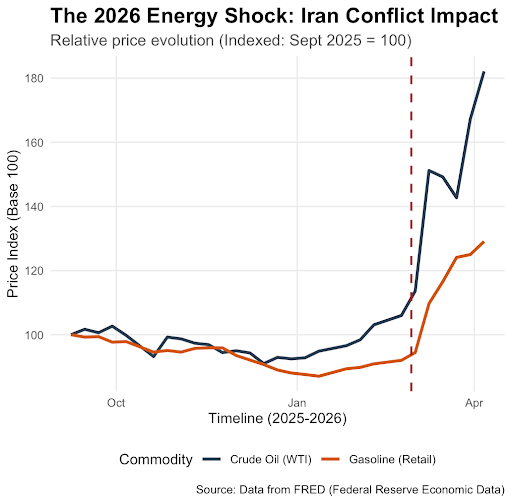
Graph depicting the relationship between crude oil prices and gasoline prices.
Pakistan’s “Unlikely” Role in Mediating the U.S.-Israeli War with Iran
As the Iran war continues, Pakistan has stepped forward with an unexpected offer: to serve as a mediator between these long-standing adversaries. Through a series of diplomatic meetings and backchannel communications, Islamabad has attempted to facilitate dialogue and explore pathways toward deescalation. Whether Pakistan can translate its diplomatic positioning into meaningful negotiations remains an open question.
In late March, foreign ministers from Pakistan, Saudi Arabia, Egypt, and Turkey met in Islamabad to prevent further escalation and negotiate a ceasefire in the U.S.-Israeli war with Iran. The meeting marks the second time regional leaders had gathered to discuss deescalation, following the earlier discussions in Riyadh in March.
Pakistan’s officials have reportedly been in communication with both the United States and Iran and have carried messages between the two sides. Islamabad has also offered to host direct peace talks between both nations.
The United States used Pakistan as an intermediary to present Iran with a 15 point plan to end the war. Iran reportedly rejected the proposal. Following the Islamabad meeting among regional powers, Pakistan’s Deputy Prime Minister and Foreign Minister Ishaq Dar travelled to Beijing to meet with China to further attempts at mediation. Together, these two countries announced a five point initiative focused on an immediate ceasefire, peace negotiations, and safeguarding commercial shipping routes, particularly through the Strait of Hormuz.
Although NATO and several European allies have distanced themselves from the war, Pakistan has emerged as what some observers describe as an "unlikely mediator.” Pakistan has important ties with key actors on multiple sides, including countries in the Middle East, such as Iran, and global powers, such as China. These relationships give Pakistan a potential role as an intermediary capable of communicating with actors who may not be willing to engage directly with one another.
Relations between Pakistan and the United States have also seen renewed attention during Donald Trump’s second presidential term. When President Trump claimed credit for brokering a ceasefire between India and Pakistan following conflict last May, Pakistan, unlike India, did not dispute this claim, and instead nominated President Trump for the Nobel Peace Prize for his efforts. Pakistan has also joined his Board of Peace. Such gestures reflect Pakistan’s interest in maintaining constructive relations with Washington at a time when diplomatic cooperation could prove useful.
Pakistan’s previous experience with mediation may indicate how these talks will progress.
Pakistan’s role in mediation between adversaries has Cold War roots. In 1969, President Richard Nixon approached Pakistan’s President Yahya Khan to help the United States normalize relations with China. Pakistan, having relations with both the United States and China, carried messages between Washington and Beijing for two years before helping facilitate Secretary of State Henry Kissinger’s secret visit to China in 1971, an event that paved the way for the normalization of U.S.-China relations.
Pakistan needs this war to end.
Like many other countries, Pakistan is reliant on the safe passage of oil through the Strait of Hormuz. The initial meeting in Islamabad led to an Iranian agreement to allow two Pakistani ships a day to cross the Strait of Hormuz, but this has not been enough to offset the country’s rising energy crisis from the start of the war.
Beyond economic concerns, the war in Iran has the potential to further regional instability. Pakistan’s role as a peace mediator comes at a time when it is already in conflict with two of its other neighbors, Afghanistan and India. There are also concerns that Pakistan could be pulled into the conflict. In September 2025, Pakistan signed a defense pact with Saudi Arabia under which an attack on one country could be treated as an attack on both. If Saudi Arabia were to enter the war alongside the United States and Israel, Pakistan could face pressure to become involved as well.
At the same time, successful mediation between the United States and Iran could significantly enhance Pakistan’s diplomatic standing and potentially bolster its positioning in South Asia. While there are many reasons why attempts at a ceasefire and peace negotiations may fail, these reasons are largely out of Pakistan’s control. The United States and Iran have both been unclear and contradictory in signaling a desire for an end to this conflict. President Trump has set deadlines for Iran to fully reopen the Strait of Hormuz while also threatening attacks on critical energy and civilian infrastructure. Iran has promised to increase attacks across the region in response, and negotiations have yet to be made to prevent this escalation.
Pakistan’s diplomatic outreach reflects both its strategic interests and its aspiration to play a larger role in regional diplomacy. Whether those efforts succeed will depend on decisions made in Washington and Tehran. For now, Pakistan remains an intermediary waiting to see whether the parties to the conflict are willing to pursue peace.
The Other Thing (Not?) Coming Down The Strait of Hormuz
The US-Iran War has thrown global fertilizer prices into chaos. It may be too late to contain the effects.
Most discussion of the economic impacts of the US war with Iran has been focused on oil. After all, gasoline prices are publicly displayed at every gas station, and people purchase it on a regular basis. Additionally, the Middle East is widely recognized as the world center of petroleum production, with a large number of so-called “petrostates.” The amount of attention placed on oil, however, conceals the fact that the closure of the Strait of Hormuz also caused massive price increases in another, equally important commodity: fertilizer.
The importance of the Middle East to world fertilizer production often goes overlooked, but the nations of the Arabian peninsula are major players in both nitrogen and phosphorus based fertilizers. The reason is a byproduct of their reserves in oil and gas: The chemical reactions that create nitrate fertilizers, such as urea and ammonia, require both large amounts of power and large amounts of hydrogen. Both of those things are generally provided by natural gas. Phosphate based fertilizers, by contrast, require large amounts of elemental sulfur to produce. Most elemental sulfur is created as a byproduct of oil refining.
The Iranian shutting down of the Strait of Hormuz stopped the supply of these goods in the same way it stopped the movement of Middle Eastern oil. In March, the American Farm Bureau Federation, a lobbying group for American farmers, wrote to President Trump asking him to “protect fertilizer supplies”, while farmers planted less corn and more soybeans, which require less nitrogen. China, a major fertilizer producer that had already restricted exports before the conflict, further constrained exports in response to the reduction in sulfur imports from Saudi Arabia. International groups warned of catastrophic consequences across the global South, with some comparing the situation to increases in food prices before the Arab Spring.
Now the Strait of Hormuz may be reopened for two weeks, and oil and fertilizer would be able to move again. That doesn’t mean it will. Oil tankers largely have not returned to crossing the strait for reasons like high insurance costs. Oil is more valuable than fertilizer, meaning increases in insurance and transport costs would hit the latter even harder. Unlike oil, the use of fertilizer is time sensitive: Most fertilizer is used during the spring, making that season the most critical time for supplying it. In the words of Noah Gordon and Lucy Corthell of the Carnegie Endowment for International Peace, “most farmers order fertilizer in March, to apply in April and May.” The war shut down the strait through March, and, if the ceasefire holds, there could be a window in April. Given the weeks it may take to transport that fertilizer, however, it may already be too late.
Additionally, because of the interconnected nature of fertilizer production, even non-Gulf nations that produce fertilizer sometimes require materials from the Middle East. As mentioned before, more than half of the sulfur China uses to produce fertilizer comes from Saudi Arabia. India has already reduced its production of fertilizer due to shortages of the natural gas needed to produce it, which it imports mostly from the Gulf. Even if all the fertilizer in the Middle East can be transported in time, these reductions in production will have an effect.
The crisis is not totally unprecedented. Russia is also a major exporter of fertilizers, and its February 2022 invasion of Ukraine touched off a crisis as fertilizer prices spiked, exacerbated by the fact that Ukraine is a major wheat producer and the war kept it from exporting. Ukrainian grain began moving again by the end of 2022 due to the Black Sea Grain Initiative, which the UN has already cited as an example of how fertilizer can be moved from the strait for humanitarian purposes. There was no mass famine then, and there will probably not be mass famine now, but shortages can have effects short of famine. Price increases in fertilizer from the Ukraine War are estimated to have driven twenty-seven million people into poverty. Any effects of the Iran War will be on top of this prior increase in prices, caused by the reduction in Russian supply.
In the hours after the ceasefire was declared, the cost of oil futures plunged by thirteen percent. The prices of the critical ingredients in fertilizers, however, haven’t moved.
Philippines Declares Energy Emergency
The Philippines has become the first country in the world to declare an energy emergency since the Iran war broke out. The war has resulted in increasing oil prices, air travel disruptions and financial volatility, leading to street protests over slow governmental proactiveness and anticipation of the situation. The blockade of the Strait of Hormuz was the final straw, since 98% of the country’s oil is imported from the Middle East.
Initial governmental responses included shifting to four-day workweeks to conserve fuel, giving cash subsidies to public transportation drivers, and lowering fuel quality standards to increase supply. But, feeling the brunt of the emergency are transportation workers, such as taxi drivers. Their reliance on fuel means that they now face decreased daily earnings, and are forced to work longer for less. Recently, these workers went on a two-day strike against the government to demand for price controls on petrol and diesel and more rigid governmental regulation on fuel. Due to the Oil Industry Deregulation Law of 1998, oil companies were allowed to set their own prices without governmental control. This law is frequently cited by Philippine citizens as to what has led to the dire situation today, since small oil price adjustments can have drastic impacts on the mostly poor population. Protestors have been calling on President Marcos to repeal or amend the law.
For now, the energy emergency declaration will stay in place for a year, and will allow the government to obtain fuel and petroleum products to feed their diminishing supply in a timely manner. They are currently trying to acquire oil from other countries such as Russia, India and Malaysia and are working to get oil from U.S. sanctioned countries as well. But, there is only so much that this temporary solution can provide. Since 95% of Philippines crude oil is imported, the government might be further exacerbating this problem by buying oil from other countries. The economy of the Philippines is becoming weak and vulnerable, and the total debt is expected to exceed 19 trillion pesos. By relying on foreign nations and continuously spending money, there is a high probability that the country will be pushed further into debt. Overall, this is a prime example of the detrimental influence of a country’s primary reliance on imported fuel, which is seen in the Philippines’ susceptibility to global energy shocks. The instability of the economy is troublesome for citizen job security and their trust in the government has effectively been eroded. The road to not only overcoming this fuel crisis but also reestablishing trust in the government is questionable, and it could take some time before any successful progressions are made in either issue.

Can Orbán be stopped? Hungary's Upcoming Election, and what it means for Europe

A demonstration at Fidesz headquarters in 2018.
Photo by Atlatszo.hu/Tremmel Márk.

Since 2010, Viktor Orbán and his Fidesz party have governed Hungary through arguably the most turbulent time in Europe since the end of the Cold War. The country has gone through refugee crises, public health emergencies, and economic crises under the leadership of Orbán. The country has accepted over 60,000 refugees from Ukraine, mostly women and children, whilst also rejecting calls from EU leaders to take in refugees from Syria and other Muslim nations. Orbán’s negative opinion towards the European Union, greater European cooperation, and warmth towards the Russian Federation have made the country a pariah within the European Union. Orbán’s domestic reforms within Hungary are arguably cause for even greater concern. After winning the 2010 election in a landslide, Orbán embarked on domestic reforms that have been widely condemned throughout the EU as anti-democratic, transforming the country into an ‘electoral autocracy.’
The reign of Viktor Orbán and the Fidesz in Hungary has seemed unbeatable until recently. The party has won every election through the most recent 2022 Parliamentary elections with an absolute majority. However, Orbán has become increasingly unpopular due to a struggling Hungarian economy and similar cost of living crises affecting many European countries, as well as corruption scandals that have woven distrust in the ruling Fidesz party and Orbán himself. The leading opposition figure to Orbán is Peter Mágyr, a former Fidesz party member turned opposition leader. He rebranded the existing Tisza party in 2024, and is currently leading in the polls heading into the election on Sunday, April 12th. Tisza is a conservative yet pro-EU party that supports realigning its foreign policy to work with, not against, the EU. Mágyr will also likely have to attempt to undo the various anti-democratic reforms made under Orbán’s 16-year rule. A more cooperative and democratic Hungary means greater progress on almost all fronts for the European Union and NATO, which still often make decisions on a unanimous basis.
However, the election outcome is far from certain. The aforementioned lead in polling is strong, roughly 10 points. That being said, Russia has both been investing in election interference on online platforms and amping up ‘security threats’ against Orbán, hoping to potentially have a rally around the flag effect as seen in the U.S. after the attempted assasination on Donald Trump in July of 2024. Further, in the 2022 Parliamentary election, Fidesz was able to win in part due to gerrymandering and slightly outperforming the polling expectations. The future of Hungary’s democracy as well as their future within the European Union is still very unsettled, as increased global instability coupled with the rise of the far-right will all likely help more than hurt the incumbent party. This election may mark a turning point in Hungary’s democracy, or on the contrary, another step in the democratic backsliding of the country.
The European Union Moves Towards a Unified Market
As the European Union continues to seek strategic autonomy, they have proposed new initiatives hoping to spur domestic growth and support homegrown startup companies. The EU Commission, moving forward in their implementation of what they’ve nicknamed ‘EU Inc’, is showing a commitment to increasing domestic innovation through more business-friendly regulatory procedures in order to keep European companies from relocating abroad. In Europe today, bureaucratic procedures have made it difficult for startups to gain traction in the global market, causing these businesses to uproot from Europe and establish headquarters abroad. The commission’s proposal aims to increase efficiency in business registration procedures across the EU’s 27 member states and ultimately strengthen European market unification.
EU Inc is the manifestation of the European Commission's grand 28th Regime unification strategy, which hopes to create an EU-wide framework for the European market. The directive has the potential to reduce the barriers for expansion that many European startups currently face by standardizing a 48 hour, fully digital registration process for new businesses across all 27 member states.
The bureaucratic barriers to entry the EU commission are attempting to solve have caused European startups to transfer commercial activities abroad, preferring the ease of expansion and access to capital provided by unified foreign markets rather than dealing with the disjointed business procedures of EU member states. The United States has become a premier destination for European startups, offering an especially tempting option for companies seeking easier growth potential. 85% of European startups that choose to relocate move to America, highlighting the United States’ successful promotion of “business-friendly regulations that facilitate investment and growth” such as flexible and unified regulations.
The streamlined process proposed in EU Inc not only creates more incentive for European entrepreneurs to position themselves within the Union, but also increases the ease of access to investment within the EU and encourages companies to continue their commercial operations within the Union. If implemented correctly, these frameworks could establish Europe as a more viable option for businesses to scale effectively and reduce the pressure to relocate abroad.
The European Commission's focus on a unified European market is certainly a step forward in ensuring that domestic startups are able to stay afloat within Europe. However, their proposal is flawed. The language used in the EU Commission's draft presents the plan as a ‘28th option’ to rival the current splintered system of regulations held by each of the individual 27 member states. Offering EU Inc as an optional framework could weaken its effectiveness, as some member states continue to favor stronger national sovereignty over a unified European market.
As the EU continues towards securing more prominence on the global stage, a more heavy hand may be necessary in order to create a more unified supragovernmental policy. Optional frameworks such as the 28th regime provide the necessary foundation for increasing European competitiveness in the global market, but without a reinforcement of the EU commission's power, fragmentation will persist.