

The Journal of Foreign Affairs at Carolina
Formerly known as The Internationalist
Get the latest from our Undergraduates at
The International Relations Column
International Humanitarian Law For Thee, Not For Me
From a U.S. point of view, we sit atop the liberal world order. We dominate culturally, economically, militarily, and morally. Got a problem? Perhaps an armed conflict with non-state actors? The U.S. has your back. This role as world superpower has been shaped by years of involvement in foreign wars, highly influential diplomacy, and a deeply entrenched reliance on the U.S. Dollar as the global reserve currency of choice – without much of a legitimate challenge since WWII. But the ongoing conflict in the Middle East has brought to light, at least to the rest of the world, that the strength of our alliances is more important to us than upholding the rules-based system. U.S. selective enforcement of international law, particularly regarding Israel, might be undermining our legitimacy as global hegemon.
After WWII ended, the U.S. played a key role in establishing the new international order. The general consensus was that another global conflict would be undesirable, and if the U.S. could be the one leading the charge for world peace, all the better. Important to the development of this world order, specifically with concern to international humanitarian law, are the Geneva Conventions, which protect non-combatants. The U.S. is a traditional defender of these values, enforcing IHL on states all over the world who commit genocide, harbor terrorism, and violate the human rights of their citizens in any respect.
However, looking back on our record as judge, jury, and executioner of IHL, it’s clear that we often turn a blind eye if it means advancing U.S. interests. To be clear: American interests are inextricably linked to economic and political health abroad. That is why we participate on the world stage, through a system of alliances and international institutions, including international law. But often, our interests have been pursued simply under the guise of upholding the order, with actual motivations being far more self-centered. The means of securing these interests? Much worse than the motivations. Take Iraq for example. Did Saddam Hussein blatantly violate human rights? Absolutely. But according to the ICJ, this “does not by itself provide a legal basis for resort to war.” Without going too far down the rabbit hole of potential motivations, there was little to no evidence of weapons of mass destruction and the link between the Iraqi government and Al-Qaeda was questionable at best. By process of elimination, the remaining potential motivations for war are not the most morally-upstanding.
The case of Israel’s war in Gaza constitutes an obvious double standard. The preliminary ruling by the ICJ determined that Israel’s occupation and annexation of both the Gaza Strip and the West Bank are unlawful. A UN independent commission confirmed that Israeli authorities are responsible for war crimes and crimes against humanity. What does the U.S. do? Unconditional military and diplomatic support. They may be our ally, and crucial to security efforts in the Middle East, but the law must still apply to them.
The implications for this could be severe. The U.S. is already not a popular actor in the Middle East. Invasions, coups, assassinations, occupations, and a particularly faulty withdrawal from Afghanistan do not give the U.S. the best reputation. Support for Israel, especially during an ongoing genocide, is not helping. The most powerful ideological foe in the region is Iran, who funds militant groups in support of Hamas and the Palestinian cause. They are also part of the “new axis powers” (China, Iran, Russia, and North Korea), an alliance of authoritarians with growing influence around the world. China’s business dealings and investments through the Belt Road Initiative provide them with significant leverage over many countries it considers strategic, and also provides the framework for potential overseas military bases. North Korea has shipped 1,500 special forces troops to Russia's Far East for training and acclimatizing at military bases and they are likely to be deployed for combat in Ukraine. 10,000 more troops could be ready to deploy by November 1st. As for Iran themselves, the absence of a nuclear deal could mean trouble as the conflict in the Middle East continues to escalate.
The international rules based order is under threat, and the U.S. simply does not have the legitimacy to defend it. Defense of genocide is eroding our international authority to uphold the order that we claim to lead, and our enemies, some of whom seek to challenge U.S. hegemony, know it. If we can intervene on behalf of international law when we disagree with the perpetrator, then we can do it in Israel.
COP - Out
The Crude Irony of Azerbaijan Hosting the Next United Nations Climate Conference
In 2022, Egypt exported around $9.53 billion in petroleum gas and a combined $6.25 billion of crude and refined petroleum, making hydrocarbon production the single largest industrial activity in the country. The United Arab Emirates (UAE), an OPEC member since 1967, derives 30% of its GDP from oil and gas production. Their national company, the Abu Dhabi National Oil Company, has pledged to increase its crude oil production from three million to 5 million barrels a day by 2027. A whopping 90% of Azerbaijan’s export revenues come from oil and natural gas.
What do all these petrostates have in common? All will or have hosted the Conference of the Parties or COP, the United Nations Conference on Climate Change. COP is the supreme decision-making body of the United Nations Framework Convention on Climate Change, where 197 countries plus the EU convene to assess climate progress (or lack thereof), share scientific and market technologies, and make collective decisions promoting global greenhouse gas reductions. The Kyoto Protocol and the Paris Agreement are arguably some of the most famous products of past COPS.
The host country is more than just a venue. The COP President, a representative from said country, sets the agenda and lays out the key initiatives of the summit. The UAE COP prioritized water security, agriculture methods, and carbon capture and storage technologies (climate activists often view it as a band-aid solution), over the promotion of renewables. That's not to say there weren’t some victories. The 21-page “Global Stocktake,” the document that outlines the pathways that nations must take to limit global warming to below 2°, finally includes the language acknowledging that countries need to “transition away” from fossil fuels.
It's also worth noting there's a little irony in all COPs, petrostate or not. Tens of thousands fly in from across the globe, many on private jets or government planes. COP 26, held in Glasgow, yielded a carbon footprint of around 102,500 tons of CO2.
Before the COP began in Baku, Azerbaijan on November 11th, there were already concerns that environmental progress would be stunted. A report from Human Rights Watch and Freedom Now claims that Azerbaijan is carrying out a crackdown on activists and government critics. This includes the arrest this April of human rights and climate justice advocate Anar Mammadli.
President of Azerbaijan, Ilham Aliyev, laid out his vision for COP 29 during the preparatory meeting this April Called the Petersburg Climate Dialogue. He emphasized the key role fossil fuel-producing countries play in global development, (calling Azerbaijani reserves a “gift from God”) and noted that countries with fossil fuels should be “among those demonstrating solidarity with respect to issues related to climate change.” To Aliyev, solidarity seems to mean ramping up renewable energy development alongside fossil fuel production. Azerbaijan declared 2024 “Green World Solidarity Year”and has put in place the framework for 1300 MW of solar and wind. This upcoming COP has also been dubbed “The Finance COP.” A new Climate Finance Action Fund is on the table, aiming to draw on voluntary contributions from wealthier, high-polluting countries to support climate mitigation and adaptation projects in developing countries.
President Biden has supported Azerbaijan as the next pick, hailing the country as “a significant pillar of global energy security” in a letter written to Ilham Aliyev. Biden is referring to the EU and US’s reliance on Azerbaijani natural gas as a replacement for the Russian supply. However, in the EU, decoupling from Russian natural gas has been messy. Russian gas was never officially sanctioned, and the Bear still accounts for around 15% of the EU’s total gas supply( albeit down from 40% before the invasion of Ukraine). Some countries are still woefully dependent, including Austria that receives around 95% of its gas directly from Russia (keyword directly).
That being said, the EU is still continuing to wean itself off, and doubling gas exports from Azerbaijan to the bloc has been a priority for both parties. A transit deal, allowing the flow of Gazprom (Russia’s state-owned natural gas company) gas through Ukraine, will expire at the end of this year. Ukraine (understandably) has no intentions of renewing the deal with Moscow. Hence, EU and Ukrainian officials have suggested Azerbaijan take advantage of this vacancy to funnel in its gas.
The irony here is that Azerbaijan and Russia have cozied up along energy policy lines. Russian exports of oil and natural gas to Azerbaijan have skyrocketed since Russia lost some customers on the European market and had a surplus of cheaper products. Between November 2022 and March 2023, Gazprom supplied Azerbaijan’s state natural gas company with almost a billion cubic meters of the stuff. Russian oil exports to Azerbaijan nearly quadrupled in 2023. Critics fear that Azerbaijan will simply use Russian gas to meet its own domestic energy needs, while exporting domestically produced gas to the EU, essentially laundering the gas and circumventing the effects of the EU reductions.
Fears of performative environmental policy making, backsliding, and COP 29 being beholden to Russian interests, are not the only controversies surrounding Azerbaijan as the next host. Human rights concerns also lay in the balance. Azerbaijan may be using the climate conference to “greenwash” away the grief and blood of the 120,000 Armenians who have been forced to flee from the Armenian ethnic enclave of Nagorno-Karabakh. Azerbaijan only won the bid to host the conference after Armenia agreed to withdraw its own application for the summit in exchange for 32 Armenian prisoners of war captured in the region in September 2023.
Congressional leaders have urged the Biden Administration to utilize COP to hold Azerbaijan accountable for the ethnic cleansing in Nagorno-Karabakh and its authoritarian crackdown. Sixty House and Senate members penned a letter to Secretary of State Anthony Blinken urging him to take decisive action against these human rights abuses before the global summit.
Weaponizing environmentalism to cover up or even pursue ulterior motives is not new to Azerbaijan. Starting in December 2022, and lasting almost 5 months. “Eco-activists,” affiliated with Ilham Aliyev’s regime, blockaded the only highway that connected the people of Nagorno-Karabakh with the outside world. The activists were allegedly protesting the environmental impacts of illegal ore mining within the region, even after the mining operations had ceased. On Feb 22, 2023, the International Court of Justice ordered Azerbaijan to halt the blockade, but the damage had been done and potatoes had become a luxury.
A global conference aimed at protecting the resources and rights of future generations, led by an administration that has been stripping a population of their homes and heritage almost seems satirical. A summit on reducing climate change led by one of the most fossil fuel-dependent nations certainly raises eyebrows. However, much remains to be seen. Perhaps the parties can come together and hold Azerbaijan accountable for its violations of international law. Perhaps the parties can make real progress towards reducing global greenhouse gas emissions. Perhaps through diplomatic negotiations, we can create a world where energy progress and security do not come at the cost of livelihoods.
COP16 and the Climate Crisis
Editor’s note: This article was written by the author on October 27th, as COP16 was underway in Cali. It has been published in its original form.
The 16th Conference of the Parties (COP16) to the UN Convention on Biological Diversity is currently underway in Cali, Colombia, bringing together world leaders, scientists, and environmental advocates to address the pressing issue of biodiversity loss. This crucial gathering, taking place from October 21 to November 1, 2024, is a critical opportunity to address one of the most pressing issues of our time: the alarming loss of biodiversity.
At the heart of COP16 is the implementation of the Kunming-Montreal Global Biodiversity Framework (GBF), a landmark agreement adopted in 2022. This framework outlines ambitious goals to halt and reverse nature loss by 2030, including protecting 30% of the world's land and sea areas and reducing harmful subsidies by at least $500 billion annually. The goals are ambitious: protect 30% of our planet's land and sea areas and drastically reduce harmful subsidies. Yet, as we look at the current state of progress, it’s clear we have a long way to go. Reports show that less than 3% of our oceans are effectively protected, and harmful subsidies continue to rise. It’s concerning, to say the least.
One major topic on the agenda is the question of equity. Just like in the climate crisis, some countries contribute more to biodiversity loss than others while facing varying degrees of impact. This raises important questions about responsibility and fairness. How do we hold those who pollute more accountable while supporting those who are most affected?
Funding, or the lack thereof, is another critical issue being discussed at COP16. There’s a significant gap in resources needed for effective conservation efforts. Countries are grappling with how to mobilize financial support from both the public and private sectors to ensure that vital initiatives can be implemented.
As COP16 unfolds, it's essential for us to pay attention, but also to reflect critically on our approach to environmental protection. While these conferences represent pivotal moments for global cooperation, we must ask ourselves: Is meeting every few years to make promises and sign agreements enough?
The harsh reality is that many of these commitments fall short in implementation, and we're running out of time to rely solely on diplomatic formalities. As a society, we need to do more, much more, to protect our environment. It's not just about protecting cute animals or landscapes; it's about ensuring a livable planet for everyone, including generations yet to come. The decisions made at COP16 could shape our planet's future, but only if they're backed by concrete actions from all countries in the world. We may be able to get away with half-measures and unfulfilled promises now, but the clock is ticking. Our children and grandchildren will rightfully hold us accountable for the state of the world we leave them.
What Israel Can Learn from October 7th
The war in the Gaza strip has left 43,000 people–Palestinians and Israelis–dead and over 100,000 wounded. Much of the Gaza strip is destroyed and the war has escalated into a regional standoff between Israel and Iran with Lebanon caught in the crossfire. While talks of ceasefire ebb and flow, a pause in the fighting seems unlikely anytime in the near future. However, as brutal as what happened on October 7th is, it shouldn’t be surprising. The Gaza Strip is perfect ground for extremism and terrorism to develop, with a long history of military conflict, deeply religious population, poor economic development, and oppression from both Israel and Hamas. Rather than addressing the many plights and historical grievances of the Palestinian people, Israel has consistently chosen to ignore one historical narrative in favor of its own. Such hamfisted policy has created greater economic and political disparities between both Israelis and Palestinians and exacerbated a lack of common historical understanding, creating a dangerous cycle of violence against itself and its neighbors.
The modern history of Israel and Palestine begins with the Nakba, when over 700,000 Palestinians were forced from their homes during the 1948 Arab-Israeli war and the birth of the state of Israel. Scores of Palestinians and Jewish people were killed, villages razed, and the region remade. The brutal attacks conducted by Hamas on October 7th and the current war are directly linked to this history and Israel’s refusal to acknowledge its role in it. Since 1948 the majority of the global Palestinian population has lived in abysmal conditions with high unemployment, malnutrition, difficulty accessing basic necessities such as clean water and electricity, with many Palestinians living as stateless peoples with little to no legal rights. In refugee camps outside of Israel and Palestine, violence, extortion, and exploitation are common, inflamed by the refugees’ lack of legal standing. Inside Israel, Palestianians face a sweeping system of discrimination, including checkpoints, restrictions on Palestinian movement, destruction of homes, and the expansion of Israeli settlements in the West Bank–a practice considered illegal under international law. In many instances, Palestinians cannot use the same roads as Israelis, a small piece emblematic of the larger system meant to disrupt Palestinian freedom of movement between Gaza, the West Bank, and East Jerusalem.
For a moment, let’s ignore the humanitarian implications of these policies. Doing that, it’s possible to see why such policies make sense from a short-term security perspective for Israel. Disrupting movement and heavily regulating the import of dual-use goods can prevent terrorist organizations like Hamas and Palestinian Jihad from conducting wide-ranging attacks on Israel or Israeli troops inside the West Bank. However, these policies also speak to a lack of forethought about a sustainable future for both Israelis and Palestinians. By codifying and enforcing this system, the Israeli government provides for its short-term security while creating greater radicalism in the Palestinian population who hold legitimate historical and current-day grievances against the Israeli state. From the Palestinian perspective, Israel has slowly but surely clamped down on Palestinian rights, neglected Palestinian quality of life, and conducted itself in a manner antithetical to advancing peace. Rather than co-opting the dynamics that foster extremism–poverty, violence, oppression, and the absence of hope–to create a safer, more humanitarian state, Israel has refused to acknowledge Palestinian history and thus, vital motivating factors for groups like Hamas.
As the predominant power in the conflict, it is the responsibility of Israel to prioritize the peace process–even in the face of violent resistance. This does not mean Israel cannot defend itself, but it must do so in a manner consistent with international law that will prevent greater radicalization and conflict in the region. Continued stubborn refusal to change course from policies that strangle the Palestinian people will only create more extremism and perpetuate violence in the region. If Israel truly wants to live in peace and safeguard its national security, the Israeli government and Israeli society must acknowledge their modern-day roots and create policy vis-à-vis Palestine that takes history and humanity into account.
Italian Prime Minister Giorgia Meloni Visits Lebanon
Italian Prime Minister Giorgia Meloni made headlines this week for traveling to Lebanon amidst the ongoing crisis there following Israel's recent invasion. Beginning in late September, Israel launched a series of deadly airstrikes across southern Lebanon, killing over 500 people and displacing thousands of others from their homes as they fled the attacks. Though the majority of those wounded and killed were civilians, the target of these attacks is Hezbollah, the Shia Muslim political and militant group. This group has maintained great significance in Lebanon, and has now become significant in the war with Israel citing the reason for its attacks as a means to help displaced citizens return north; however, Hezbollah has also been tied with aiding Hamas.
Israeli airstrikes have increased over the last three weeks with at least ten having been carried out since the start of the conflict, and with the civilian death toll simultaneously increasing. Currently, over 2,000 civilians have been killed, and thousands of others have been seriously injured. Among those injured were five United Nations Peacekeepers, which is what prompted Meloni’s visit to Lebanon as Italy contributes greatly to the peacekeeping forces there. Upon her arrival, she met with Lebanese Prime Minister Najib Mikati and Parliamentary Speaker Nabih Berri in a press conference to discuss the critical ongoing situation in Lebanon. During this press conference, Meloni took the opportunity to make quite clear of her position against Israel’s attacks on UN peacekeeping forces: "I consider targeting UNIFIL unacceptable, and I ask once again that all parties strive to ensure at all times that the safety of each of these soldiers is guaranteed."
Meloni’s visit to Lebanon and press conference with the Lebanese prime minister and parliamentary speaker are intriguing, especially considering that she has spent the majority of the past year maintaining a position of political support for Israel in its ongoing war against Hamas. In other ways, Meloni has made quite the name for herself in the scene of international politics. She is the most far-right leader that Italy has had since World War II, in the age of Mussolini and his famed fascist dictatorship. However, Meloni and the political party that she hails from, called Brothers of Italy, have been accused of neo-fascism themselves. She has adamantly promoted her extremely conservative policies, such as her anti-LGBTQ+, anti-abortion, anti-immigration, and anti-Islamist violence policies that have taken many aback.
Meloni’s visit to Lebanon, however, reveals how truly escalated the conflict in the Middle East has become. It is intriguing indeed, that someone so widely known for her far-right policies to the point that she has been accused of fascism, and that someone who previously showed political support for Israel, has now come out against Israeli airstrikes in Lebanon after visiting the country herself, the first world leader to do so. That a political figure such as Giorgia Meloni could stand up against recent actions taken by Israel in the ongoing conflict in an effort to prevent further war from ensuing is truly groundbreaking; perhaps other world leaders will finally formally recognize, for once and for all, that the conflict in the Middle East has gone too far.
Understanding and Addressing China’s Fear of Parenthood
In recent years, China has faced a sharp decline in birth rates, causing concern about its aging population and the potential economic consequences. This has led the Chinese government to launch a survey aimed at understanding the fears and anxieties people have about having children. The findings will inform policies to encourage higher birth rates, a pressing issue as China’s previous one-child policy has left lasting effects on family planning attitudes.
Globally, fear of having children stems from several factors, including economic insecurity, career concerns, environmental anxieties, and personal freedom. This reluctance is not limited to China; many developed countries have seen declining fertility rates, leading governments to offer incentives like tax breaks, paid parental leave, or even cash bonuses. In China, specifically, the lasting effects of the one-child policy have contributed to this hesitation, as it “created a mindset of small families” and “reinforced the idea that having fewer children was better economically.”
In China, the costs of raising a child, competitive schooling, and the pressure to provide a good future are key concerns for potential parents. Housing prices, childcare, and educational expenses often overshadow the perceived rewards of parenthood. Additionally, cultural shifts, especially among younger generations, have changed traditional views on marriage and family. Many young couples, particularly in urban areas, are choosing not to have children due to the high costs associated with raising them in a fast-paced, economically driven society.
This situation reflects a larger global trend where younger generations feel that the economic and social pressures outweigh the benefits of having children. Women, in particular, face career setbacks and reduced personal freedoms, and many people are hesitant to bring children into a world facing climate change and political instability.
Fear of parenthood also intersects with gender roles. In many societies, including China, women bear the brunt of childrearing responsibilities, and the fear of having children often comes from the recognition that they may be expected to sacrifice careers and personal ambitions. Thus, while economic concerns are significant, changing social expectations regarding gender roles and family structures also contribute to the fear of parenthood.
In response, China’s survey aims to understand these underlying concerns and craft policies that might alleviate them. Some suggestions include improving parental leave, reducing education costs, and promoting gender equality in parenting, according to Reuters. However, without addressing the broader societal and economic shifts, these solutions may only partially resolve the issue.
As China and other nations grapple with declining birth rates, it is clear that the fear of having children is a complex issue that won't be resolved quickly. China, in particular, faces a challenge in reversing the effects of past policies. Young people should recognize the influence they hold in shaping society and understand that building a family is a fundamental part of human life, one that should not be overlooked. Encouraging open discussions and supporting family-oriented policies will be crucial in addressing these concerns.
Global Econ-Insights #2: Bank of Japan in Limbo
Japan is perhaps one of the world’s most beloved nations. Japan, where neon jungles and electric metropolises flourish. Japan, where rich cultural practices blend with modern influences. Japan, ultramodern and futuristic on one hand, tranquil and traditional on another. So when recent decisions by the country’s central financial hub, the very Bank of Japan, yielded negative economic impacts, the nation began to lose its effervescent luster.
The main problem? Inflation. Inflation is one of the deadliest economic curses that a country could face. Low interest rates cause an increase in inflation, which reduces the value of a nation’s own currency relative to other currencies across the globe. This makes imported items from other countries more expensive to the host nation, and items become even less accessible to the native populations, as the New York Times explains. In particular, low interest rates have recently contributed to huge Japanese inflation of the Yen relative to the Dollar.
The Bank of Japan is responsible for interventions in the economy. Per Japanese guidelines, it is the bank’s duty and obligation to interfere when necessary and implement monetary policy to maximize price stability and combat the harmful effects of phenomena such as inflation. These economic details bring us to the crux of the current problem: the Bank of Japan is currently refusing to intervene and take action to combat the low interest rates and high inflation that the nation of Japan is currently faced with. Why is this the case? Because Bank of Japan Governor Kazuo Ueda believes that the bank “could afford to spend time eyeing the fallout from global economic uncertainties” and is “in no rush to raise borrowing costs further.”
Though the Bank of Japan has previously voiced a desire to raise interest rates to engage in inflation reduction and achieve its target inflation rate of 2%, the chances of this actually coming to fruition currently seem quite minimal. Governor Ueda and the bank are now claiming that the best decision is for the bank to simply maintain its short-term interest rates at a steady amount of 0.25%, which is exceptionally low and conducive to higher inflation rates. The governor also rationalizes his approach by stating that though the Yen’s value is recently decreasing against the Dollar, this has in turn eased the prices of import costs and significantly reduced the risk of excessive domestic inflation within Japanese boundaries and jurisdictions. Consequently, the governor believes that the Bank of Japan “can afford to spend some time in making a policy decision,” cutting down on current monetary policy interventions and instead investing more into potential future ones. This sounds even more dubious considering the fact that the Bank of Japan’s set interest rates have historically been negative, only being hiked to a positive quantity in July of 2024 when the bank started facing maximal pressure to combat inflation by the public Japanese population of individuals.
Therefore, my take on the matter is that the Bank of Japan may not be the most credible institution, and the best course of action is for the public to continue to try and persuade leading economic and governmental officials, such as the Governor Ueda himself, to do what is in the best interest for the Japanese population and thus hike interest rates to combat inflation rates. There is evidence that hiking interest rates is what is best for the Japanese population. When the Bank of Japan previously raised its interest rates from a negative value to 0.25% in July, the Yen finally gained value relative to the dollar. Whereas up until now, the Bank of Japan has been maintaining low interest rates so as to increase inflation within the deflationary Japanese economy, the time has finally come at which the harms of this inflation have begun to outweigh the benefits, and the only rational solution is to hike interest rates to reduce inflation altogether, despite the deflationary nature of the Japanese economy. Doing so is the key to maintaining a healthy and strong Japanese economy in a world where several national economies have become completely downtrodden due to inflationary concerns.

K-Pop, K-Dramas, and the Rise of Korean Soft Power

“[South Korea’s] cultural dominance might seem sudden, but it represents decades of careful planning and strategic investment by the South Korean government.”
Photo by Salma Mourad
From the Academy Awards to Saturday Night Live Korean culture has become a recurring part of U.S. mainstream media—whether it's a K-pop group performing their latest hit or celebrities discussing the newest Netflix K-drama sensation. This cultural dominance might seem sudden, but it represents decades of careful planning and strategic investment by the South Korean government. Milestones such as PSY's "Gangnam Style" reaching 1 billion views in 159 days; BTS charting over two dozen songs on the Billboard Hot 100 (with six reaching #1); and Squid Game amassing 1.65 billion viewing hours in its first month, becoming Netflix's most-watched series across 94 countries, are all a result of one of the most successful soft power strategies ever established on the global stage and might transform diplomacy for years to come.
The "Korean Wave"—or Hallyu (한류), a term coined by China's Beijing Youth Daily in 1999—marks South Korea's transformation from a manufacturing powerhouse to a global cultural influencer. It's one of the most successful examples of cultural diplomacy and soft power in recent history.
Political scientist Joseph Nye Jr. coined "soft power" to describe a country's ability to influence others through attraction rather than coercion. A classic example of this approach is America's Cold War strategy, where the U.S. deployed jazz legends like Louis Armstrong, Duke Ellington, and Dizzy Gillespie to regions deemed as susceptible to communism, using their musical diplomacy to improve America's image abroad.
South Korea’s shift began with a pivotal realization: a presidential advisory board discovered that Spielberg's Jurassic Park generated revenue equivalent to 1.5 million Hyundai cars, sparking a reimagining of the country's economic strategy. Under President Kim Dae-jung, the cultural industry budget surged from USD 14 million in 1998 to USD 84 million by 2001. This investment has grown exponentially, with contemporary budgets reaching billions. The returns have been staggering: The Korea Foundation for International Culture Exchange reported that South Korean cultural exports exceeded $10 billion in 2020, a nearly 9% increase from 2019. Additionally, Netflix's South Korean content contributed $1.9 billion to the economy in 2021. While these figures are smaller than major industries like semiconductors, cultural exports now outperform sectors such as cosmetics and home appliances.
This cultural offensive evolved through three distinct phases. Hallyu 1.0 (1995-2005) focused on television dramas and basic cultural exports primarily to the rest of the Asian continent, laying the groundwork for what was to come. Hallyu 2.0 (2006-2015) saw K-pop’s global expansion through social media, supported by heavy government investment and the establishment of 24 Korean Cultural Centers worldwide. The current Hallyu 3.0 (2016-present) represents full cultural investments paying off with genre-diversification and its spread all over the world, with BTS alone contributing $4.9 billion to the South Korean economy in what some have been calling the “BTS Effect.”
Including the impact they’ve made on the economy, BTS also has found a new role as more than K-pop idols but also diplomatic actors. Their appearances at the United Nations General Assembly in 2018, 2020, and 2021 were not just musical performances. In 2021, BTS delivered a speech on climate change and COVID-19 vaccination, watched by over 1 million people on the UN’s YouTube channel. Appointed by President Moon Jae-in as "Special Presidential Envoys for Future Generations and Culture," BTS shows how K-pop is strategically deployed for diplomacy, engaging global youth on critical issues.
BTS's political influence has been significant. Their UN speeches garnered more social media engagement than any prior UN event, and their participation in diplomatic events has facilitated dialogues between South Korea and nations, particularly in Southeast Asia. Their advocacy in UNICEF’s "Love Myself" campaign raised over $3.6 million for violence prevention, while Korean cultural centers worldwide have become de facto diplomatic outposts.
The Korean Wave has also sparked global interest in travel to South Korea. Korean language learning 76% in the UK and a 40% rise in the United States on Duolingo within two weeks of Squid Game's release. South Korea's tourism industry saw a transformation: In 2023, the country welcomed 11 million tourists, with nearly 32% of younger visitors motivated primarily by Hallyu content; these "Hallyu tourists" spent an average of $1,007 per person in 2019. Tourism spending also reached $17.5 billion in 2023, driven by the increasing global popularity of Korean pop culture. Projections for 2024 estimate a further boost, with the travel and tourism sector contributing $69.5 billion to the national economy and employment in the industry exceeding 1.4 million jobs.
The education sector has seen similar growth, with international student numbers rising from 85,923 in 2013 to 181,842 in 2023. This is also nearly ten times higher than the 16,832 students in 2004 when the Education Ministry first started compiling such statistics. To support this interest, the Korean government has established 234 King Sejong Institutes across 82 countries to promote Korean language and culture.
Behind this cultural juggernaut is a well-oiled machine: The Ministry of Culture, Sports, and Tourism operates a dedicated Hallyu department, managing everything from K-pop concert permissions to drama export licenses. Cultural attachés at Korean embassies organize events, while organizations like the Korea Foundation promote language and cultural education globally.
However, this success has a darker side. South Korea’s polished cultural exports often obscure entrenched social hierarchies within the country. Conglomerates like Samsung dominate not only the economy but also societal structures, contrasting with the progressive image presented through K-pop and K-dramas. The rapid modernization and global appeal of Korean culture frequently overshadow pressing domestic issues, such as rigid class divisions and rising income inequality. Moreover, the high-pressure environment of the Korean entertainment industry has led to troubling trends, including exploitative contracts, a rise in mental health issues, and the promotion of unrealistic beauty standards.
The Korean Wave is a masterclass in cultural diplomacy, transforming soft power from smaller initiatives into a tool for reshaping a nation’s global image. This calculated use of soft power has changed how the world sees South Korea and revolutionized how nations approach cultural diplomacy. Yet, questions remain about the sustainability of this model and the human cost in an industry known for its relentless pursuit of perfection.
Deterrence in Disarray
The Shifting Dynamics of Middle Eastern Conflict
In recent times, the Middle East has been teetering on the edge of major conflict, driven by the assassinations of Hezbollah leader Hassan Nasrallah and Hamas chief Yaya Sinwar. These events have triggered an alarming escalation in violence, with Israel intensifying its airstrikes across Lebanon and Gaza. Meanwhile, retaliatory missile launches from Hezbollah, Hamas, and even Iran have created a dangerous spiral bloodshed. Amid rising tensions, the European Union’s top diplomat, Josep Borrell, is calling for an immediate ceasefire, hoping that Sinwar’s death may offer a chance for de-escalation.
However, beneath the calls for peace lies a more troubling reality: the near-total collapse of deterrence in the region. Deterrence, a strategy aimed at preventing an adversary from taking an unwanted action through the threat of significant retaliation, was once crucial for maintaining fragile stability. Now, with deterrence almost entirely disintegrated, both sides are locked in a cycle of escalating violence, increasing the risk of a full-scale war. Understanding why deterrence has broken down and how to restore it is essential for navigating out of this volatile situation. Without addressing this core issue, any diplomatic efforts may prove to be short-lived.
The recent of assassination of Hezbollah leader Hassan Nasrallah by Israeli airstrikes marked a major turning point. Nasrallah, who led Hezbollah for over 30 years, was killed in an air attack on Beirut. Israel’s decision to target Nasrallah reflects a broader strategy of dismantling Hezbollah’s leadership in order to weaken the group’s operational capabilities and send a clear message to Iran, its chief backer. Instead of restoring deterrence, this assassination escalated tensions. Hezbollah responded with missile strikes, and Iran deepened its involvement in the conflict to retaliate for its ally’s death. These traditional deterrence mechanisms that were once designed to limit the scale of conflict, are now rapidly falling apart. And while the Hezbollah leader may be gone, the group’s capacity to strike back remains intact, raising fears of prolonged instability across Lebanon and the broader region.
In response to these developments the United States has increased its military presence in the region, deploying aircraft carriers and missile-capable submarines to deter further escalation. This show of force aimed to prevent Hezbollah from launching more attacks against Israel and to send a clear signal to Iran. Hezbollah's leadership has dismissed these U.S. deployments, with Nasrallah stating before his death that their fleets do not scare them. Despite U.S. warnings, pro-Iran militias in Syria and Iraq have continued their assaults on American forces in the area. Washington’s retaliatory strikes have failed to deter these groups, highlighting that deterrence—whether through military presence or targeted killings—has not succeeded in stabilizing the situation.
Yahya Sinwar, the leader of Hamas in Gaza, was also killed by Israeli forces. Sinwar became a high-priority target for Israel after the October 7, 2023, Hamas attack that resulted in casualties and hostages. Sinwar was reportedly killed by chance during a firefight in Rafah, Gaza when Israeli soldiers stumbled upon him. Sinwar’s death was intended to disrupt Hamas leadership and weaken its resistance coordination. Despite this, Hamas continues its activities. Israel faces ongoing challenges from Gaza, and groups from Lebanon launch attacks. The effectiveness of targeted killings on restoring deterrence remains uncertain, as the removal of leaders has often led to intensified conflict. This ongoing instability displays the complexity of using targeted killings as a strategy, as it often fails to achieve long-term peace and may instead fuel further violence.
In the wake of this escalating violence with the deaths of Nasrallah and Sinwar, Joseph Borell, the EU’s foreign policy chief has called for an immediate ceasefire. Borrell sees this moment as a crucial way to stop the violence and start peace talks, stressing the importance for diplomacy over military actions. His effort shows the EU’s commitment to preventing a broader conflict and restoring stability through dialogue. By prioritizing diplomacy, the EU aims to mitigate the humanitarian crisis and foster long-term peace in a region plagued by instability.
Meanwhile, the United Nations Interim Force in Lebanon (UNIFIL) is facing considerable difficulties. UNIFIL recently intercepted a drone near the southern coast of Lebanon, and its peacekeepers have been caught in the crossfire between Hezbollah and Israel, resulting in injuries and damage to UN positions. Despite these dangers, UNIFIL remains essential for maintaining the fragile peace along the Lebanon-Israel border. There are growing demands to strengthen their mandate to better protect both peacekeepers and civilians. Borrell’s focus on diplomacy and the continued presence of UNIFIL showcase the vital importance of international efforts to prevent further escalation. However, without increased support for these diplomatic initiatives, the region risks descending further into conflict.
The U.S. has increased its military presence in the Middle East to counter Iranian-backed militias and Hezbollah, conducting airstrikes against ISIS in Syria and aiming to deter further escalations. This is crucial because attacks on U.S. troops complicate stabilization efforts, highlighting the volatile nature of the region and the potential for wider conflict. Diplomatically, Secretary of State Antony Blinken’s Middle East tour aims to prevent regional conflict by engaging with Egypt, Jordan, and Saudi Arabia, showcasing the U.S.'s role as a key mediator between Israel and Arab neighbors. This is important for maintaining regional stability and preventing a broader war, which could have global repercussions. The U.S. also collaborates with the EU and UN for diplomatic solutions, recognizing that lasting peace requires a united international front. The Abraham Accords which highlights U.S. peace brokering, has had recent escalations hindered progress, showcasing the delicate balance needed for diplomacy. Iran’s support for groups like Hezbollah and Hamas challenges U.S. diplomacy, as does Israel’s military actions in Gaza, complicating peace talks with Arab nations.
These obstacles highlight the complex interplay of military and diplomatic efforts needed to achieve stability. The implications of failing to navigate these challenges are significant, as it could lead to increased violence, humanitarian crises, and a destabilized region that affects global security and economic interests. Therefore, the U.S.'s actions in the Middle East are not just about regional stability but are crucial for global peace and security.
The Middle East is now at a turning point, with intensified military actions pushing the region towards major conflict. The collapse of deterrence has heightened the risk of war, and without a meaningful ceasefire brokered by international actors like the U.S., EU, and UN, the danger of a broader conflict will grow. The EU’s diplomatic initiatives, spearheaded by Josep Borrell, along with the UN’s peacekeeping efforts through UNIFIL, are crucial for de-escalation. However, these initiatives require stronger backing from regional actors, particularly those with influence over Hezbollah and Hamas. Furthermore, the U.S. needs to extend its strategic role beyond mere military deterrence to promote long-term peace negotiations. Although military presence is crucial for deterring Iran and its allies, lasting peace depends on diplomacy.
Building Bridges: How Germany and India Are Redefining Their Relationship
This week German Chancellor Olaf Scholz traveled to New Delhi to meet with Indian Prime Minister Narendra Modi to discuss strengthening the partnership between the two nations. While these two countries have not been particularly close in the past, recent global changes have pushed for a growing bond between the two. In fact, earlier this month Germany unveiled the “Focus on India” strategy working to increase the partnership and cooperation with India, deemed a critical player in the Indo-Pacific. This strategy demonstrates how important Germany believes relations with India to be and highlights the increasing global influence the south asian country holds on the world stage. The two countries discussed strengthening military ties, cooperation in renewable energy, and increasing trade partnership. However, most notably, this meeting highlights a push for a shift in the geopolitical sphere. The west is seeking out this partnership in order to limit its economic dependence on China. Meanwhile India is working to strengthen its defense capabilities outside of Russia.
The topic of defense is becoming increasingly critical as the world continues to see numerous conflicts. Germany and Europe are particularly concerned about the continuing war in Ukraine. India, who has a long diplomatic history and dependence on Russia for arms and oil, has avoided condemning Russia throughout the war, much to the West’s frustration. Germany, as one of Ukraine’s biggest allies in the world, wanted to ensure that India continued to work towards peace between the two nations. Therefore, the push for strengthening the military is two fold. Germany hopes that with India less dependent on Russia for arms then perhaps it will bring India closer to the west. However, India has a long history of relations with Russia making it unlikely that relations will be severed in the near future. Additionally, India has proven that it will not always act in alliance with the West's policies, but rather on its own accord. Therefore it remains unclear whether the increased defense cooperation will sway India one way or another or if they will continue to walk their fine line of diplomacy.
Furthermore, Germany has increased the number of visas for skilled Indian workers and students, prompting more flow of people between the two nations. The countries also discussed cooperation in transitioning towards renewable energy sources. Yet one thing that Chancellor Schulz was a big proponent of during these discussions was the swift approval of an India-EU free trade agreement. Schulz believes that the free trade agreement will be incredibly beneficial for both parties. The EU is India’s third largest trade partner and offers tremendous potential for economic growth. This agreement will also help to decrease the EU’s reliance on China economically.
However, there are some barriers to this agreement. On India’s side, Indian Commerce Minister Piyush Goyal believes the trade agreement can be highly beneficial but there must be a respect for “sensitivities” and if these “sensitivities” are met, then there can be a swift approval of the trade agreement. Meanwhile on the EU side, German Minister Robert HaBeck said that the agricultural sector was a very challenging area in these negotiations, given the discrepancies in the amount of laborers in this sector in Germany compared to India. Both sides keep expressing optimism and hope for the trade agreement, but negotiations that were set to conclude in 2023 have continued to drag on into 2024. Therefore, despite the optimism from both sides, an FTA does not appear likely anytime soon.
Germany and India’s push for closer relations highlights the new shift in global dynamics. As the Indo-Pacific becomes increasingly important, Western countries have begun to focus more attention. India has emerged as a viable alternative as Europe and the West look for ways to decrease China’s economic influence. On the flip side, as India rises on the global world stage, it can further leverage these global partnerships to continue its development. As these two unlikely partners deepen their relationship, only time will tell how this will impact the global geopolitical sphere.
Sudan and Red Sea Maritime “Mayhem”
Sudan is no stranger to civil war, humanitarian crises, or external meddling.
But that doesn’t mean we should avert our gaze.
Since Sudan gained sovereignty in 1956, the conflict between the country’s wealthier, Muslim-majority northern region, and the less developed Christian-majority southern region ultimately divided the country into Sudan and South Sudan in 2011. In 2003, the Darfur war, condemned later on by the International Criminal Court and the US State Department as genocide, haunted the people of Darfur, and the whole world had eyes on Sudan.
Over the past two decades, less media attention has been brought to Sudan, despite the confusing power struggle following multiple coups resulting in a civil war between the Sudanese Armed Forces (SAF) and the Rapid Support Forces (RSF), a powerful paramilitary group. With the final resignation of Prime Minister Abdalla Hamdock, the country no longer has civilian control, and has erupted into chaos. On September 26, the Sudanese government forces shelled RSF bases in the capital of Khartoum. Practicing leader General Abdel Fattah al-Burhan wishes for an end to the war, but wants no concession to the RSF. The SAF is in need of weapons and spare parts to continue fighting the RSF.
The current conflict began in April of 2023 and has already displaced over 11 million people, who are fleeing to other unstable bordering states. The UN Human Rights Chief Volker Turk commented on the “high risk of ethnically targeted violations and abuses” by the RSF. Antony Blinken has pointed to the war crimes committed by both sides in this conflict. Acute hunger is rampant, with around 25 million people, or half the country, suffering from severe hunger, hinting at a possible famine. Along with that, a cholera epidemic is raging throughout the country.
Humanitarian support for the Sudanese people has been dismal, with many NGOs no longer operating in the country, and international media referencing it as the “forgotten war” waged against civilians. Funding is hard to obtain, with very little of the requested funding actually received. Largely, this conflict is considered the “forgotten war” both because reporting within Sudan is extremely dangerous, and because the country has been in shambles for so long now, the international community has grown tired. Further, global attention is elsewhere, mostly on the wars raging in Gaza and Ukraine.
With the widening Middle East conflict and tensions with Russia, and out of genuine concern for the people of Sudan, it is critical for the West and the US to pay attention to the events unfolding in Sudan, and to do something to try and relieve the Sudanese people suffering from this power struggle and from the greed of other countries.
The political violence and state fragmentation that resulted in the rise of the Houthis in Yemen is a broader trend of the Middle East and the Horn of Africa, particularly in Sudan. The conflicts in the Middle East and Sudan may spread to total chaos in the Red Sea, disrupting the flow of maritime traffic and accelerating instability. With the outbreak of Sudan’s conflict, shipping firms refuse to stop at Port Sudan. The economy is slow, development sluggish, governance virtually nonexistent, only fueling the humanitarian crisis and allowing for other actors to step in. Iran, for one, has been seeking to build a naval base, giving military support to the SAF, which should be cause of concern to the US and could possibly worsen attacks on shipping by the Houthis.
Similarly, RSF’s influence over Sudan’s gold mining industry has attracted the United Arab Emirates, another country that has wished to implement a $6 billion port and an agricultural project on the Red Sea coast in Sudan. The UAE has given military aid to the RSF, and on September 30, blamed the SAF for bombing the residence of the UAE ambassador in the capital. In response, the SAF blamed the RSF. The finger pointing and foreign interference by a powerful Gulf State such as the UAE only adds fuel to the fire.
External actors, such as Russia, find strategic value in involving themselves in Sudan, taking advantage of the tense situation. Some Russians are looking to expand their operations in Africa, indirectly funding the RSF through the Wagner Group. On the other side, Moscow has been giving military support to the SAF in exchange for Red Sea naval bases. A Russian presence in the Red Sea would potentially disrupt US and other NATO allies from trade, and if run-ins were to occur in the region, tensions would only escalate. With Russia desperate for access to a warm-water port located near a strategic trade route following its war in Ukraine, Moscow continues with its attempts to implement the agreement, originally signed with then-President Bashir in 2017, to build a naval base.
Recently, at the UN General Assembly held in New York, Sudan’s army chief General Al-Burhan urged an end to the fighting, questioning the international community’s silence. The RSF is strong, arguably stronger than the of the SAF, meaning that if not stopped by the international community, the war will continue to rampage and destroy the livelihoods of the Sudanese.

The 2024 Presidential Election: Implications for the Middle East
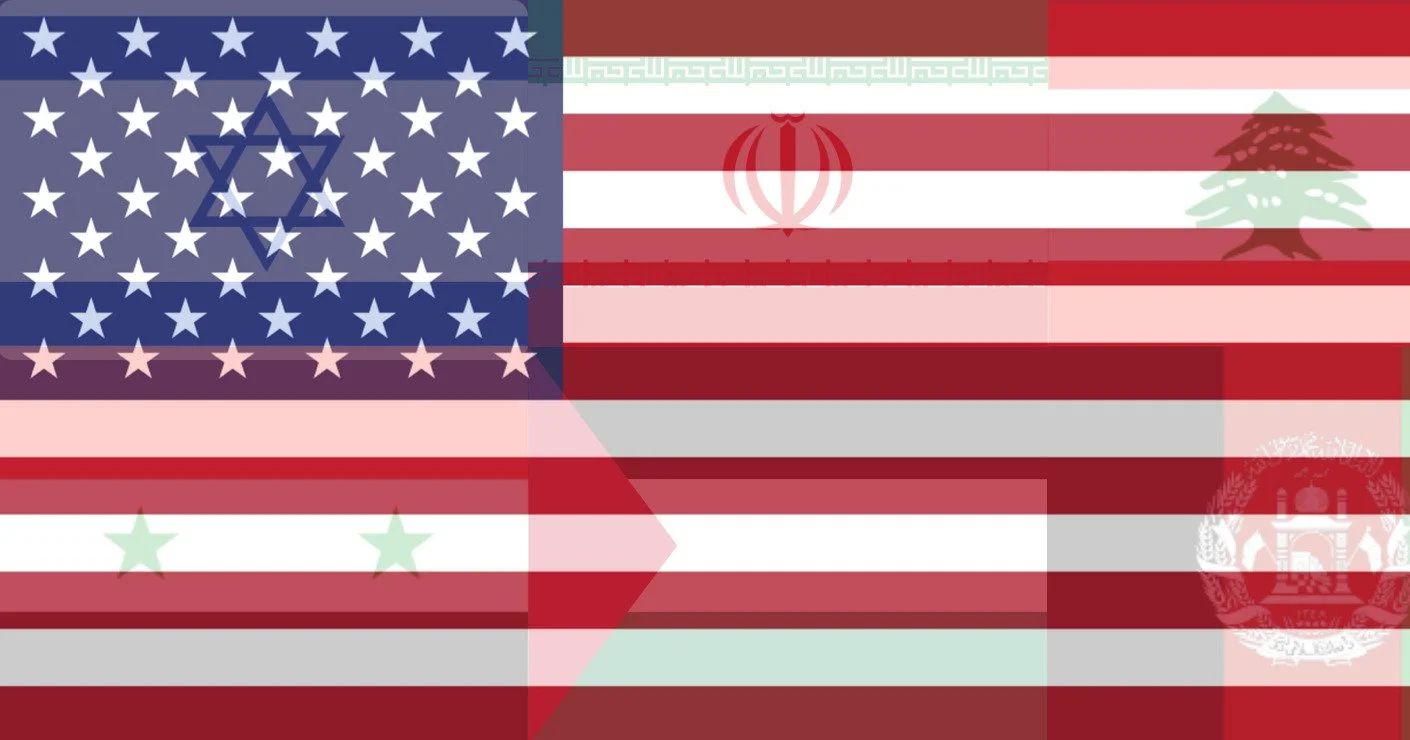
Graphic by Miles Kershner.
Millions of Americans will go to the polls over the coming weeks with a number of crucial domestic issues in mind, as the fate of the country seems to hang in the balance. Elsewhere, millions of others have their own preferred candidate, too. What would a Harris-Walz administration mean for escalating violence in the Middle East? Or perhaps Trump-Vance? Foreign policy issues aren’t always a priority for the average American voter, but in this election year, as a new crisis develops seemingly every other day in Gaza, Lebanon, Israel, and around the region, our choice at the ballot box will have implications for far more than just ourselves.
As it stands, conflict has continued to escalate and the humanitarian situation has worsened. Israel’s rocket attacks against Hezbollah have only increased, as the total death toll in Lebanon since October of last year has reached over 2,100, with the Lebanese Health Ministry reporting that most of these have come in the last two weeks. In response, rocket attacks against Israel in cities like Haifa have also increased. Despite the escalation in its war against Hezbollah, Israel continues to fight on two fronts as there is increasing political pressure to wipe out Hamas, an objective considered to be optimistic at best.
In Gaza, the healthcare system has essentially collapsed. Hospitals have been bombed, supplies destroyed or blocked from entering the area, and doctors targeted by the IDF. Hunger is rampant, and a majority of Palestinians are in desperate need of medical attention due to disease or injury.
Those skeptical of Harris’ qualifications to be commander-in-chief are quick to point out the recent escalations between Israel and Hezbollah as proof of her foreign policy incompetence. It’s also worth noting that she was in full support of President Biden’s less than perfect withdrawal of American troops from Afghanistan, which allowed the Taliban to ultimately regain control.
Despite these criticisms, it's important to consider Harris's actual role and responsibilities in the current administration. As Vice-President, she has little control over any policy decisions, least of all those pertaining to foreign affairs. Kamala Harris is also not Joe Biden, and therefore should not be judged as such. So what can be expected from a Harris administration? In addition to being endorsed by prominent Republicans such as Dick Cheney, Harris has also been endorsed by over 700 national security officials. Why? Because according to Retired Army Maj. Gen. Randy Manner, “she relies on the competence of the experts to try to find a balanced way to best approach a problem and then to make the final decision.”
This approach of relying on expert advice could lead to more nuanced and informed decisions in complex Middle East situations. Her actual platform, which includes working towards a ceasefire in Gaza and ultimately a two-state solution, addressing the Palestinian humanitarian crisis more vocally, taking a firm stance on reining in Iran's nuclear program, and prioritizing intelligence and special forces approaches to neutralize threats from regions like Afghanistan, Yemen, and across Africa, makes her potentially a more stable choice for the Middle East when combined with her competent approach to decision making.
But while there’s comfort in predictability, her strategy might simply follow the status quo. She has consistently reaffirmed her support for Israel, and will likely be unwilling or unable to force any major concessions out of Netanyahu in the search for a ceasefire deal. While she can be trusted not to make things even worse, they might not get better under a Harris administration – at least not right away.
While Harris is confident in the judgments of foreign policy experts and advisors, Donald Trump believes himself to actually be the expert. It’s been seen before and it will undoubtedly be seen again: anyone who does not agree with Trump will not last long in his administration. He’s also unpredictable, which makes it harder to guess what his policies might be towards the Middle East should he take office again. Assuming the war against Hamas and Hezbollah is still ongoing, Israel can expect Trump’s full-throated endorsement, more so than with Harris.
Neither candidate is at all likely to suspend military aid to Israel, but Trump might not even pursue a ceasefire deal as urgently, based on his advice to Netanyahu to “get your victory and get it over with.” While he did call for the violence to end, not pursuing a ceasefire is not going to achieve that, especially given the difficulty Israel has had with eliminating Hamas and now having to fight on two fronts. On Iran, he’s already infamous for pulling the U.S. out of the 2015 nuclear deal. Now, he supports even harsher sanctions (which were lifted in exchange for Iran dismantling their nuclear program as part of the deal) that mainly affect civilians, while the Iranian government and its proxies still remain a threat.
The Biden administration has been unsuccessful at reaching an agreement with the Iranians on a new deal, but you can be sure that Trump won’t even try. Trump is also likely to continue to encourage Arab countries to normalize ties with Israel, regardless of the creation of a Palestinian state. This will only embolden Israel to continue denying all Palestinian rights, as they face less pressure within the region.
Governments in the Middle East – especially autocracies, monarchies, dictatorships, and of course Israel – are more likely to prefer Trump, as he generally turns a blind eye to human rights violations and won’t pressure democratization. Netanyahu is certainly hoping for a Trump victory as well, as a Harris administration would be much more likely to condition military aid to Israel and would be less enthusiastic about forking over billions to protect Israeli airspace. As for Harris, there’s no doubt she would be a more calculated decision maker, focusing on diplomacy while also putting pressure on abusers of human rights. But while she may be a better guarantee of U.S. domestic safety, there’s no guarantee that conditions in the Middle East would actually improve, continuing in the same trajectory from the Biden administration. The bottom line? While neither are perfect, Harris is the more trustworthy candidate to take the wheel of U.S. foreign policy.
Closing the Darién Gap
Can it Really Stop the Flow of Migrants?
The recent agreement between Panama and the United States to close the notorious Darién Gap has ignited a fierce debate in the international community. This dense jungle corridor that connects North and South America, long considered a treacherous route for migrants seeking entry into the US, has seen an unprecedented surge in crossings in recent years. Under the new deal, Panama's President José Raúl Mulino has vowed to shut down this dangerous pathway, with the US agreeing to cover the costs of repatriating migrants who enter Panama unlawfully. While proponents argue that this measure will disrupt smuggling operations and deter irregular migration, the reality may be far more complex and troubling.
By closing the Darién Gap, the agreement effectively places the burden on other countries, particularly Colombia and Panama, to manage the influx of migrants. With Colombia already grappling with millions of Venezuelan refugees, this additional pressure could lead to a humanitarian crisis of unprecedented proportions. Moreover, there's a real concern that sealing off the Darién Gap might push desperate migrants to seek even more dangerous routes, potentially leading to a greater loss of life. The jungle has already claimed countless lives, and forcing people to find alternative paths could exacerbate these risks.
On the one hand, closing the gap could alleviate some of the immediate challenges faced by Panama and the US in dealing with the dangers associated with crossings, including deaths, crime, and environmental degradation. However, this approach fails to address the root causes driving migration and may simply redirect the flow rather than stemming it. The most troubling aspect of this policy is its impact on the migrants themselves. These individuals, often fleeing violence, economic hardship, or environmental disasters, are the ones who will bear the brunt of these changes.
The Darién Gap closure highlights the complexities of managing international migration. While it may provide a temporary solution for Panama and the US, it raises serious questions about regional cooperation, human rights, and the long-term effectiveness of such measures. As this policy unfolds, it's crucial to monitor its impacts carefully. Will it truly reduce illegal immigration to the US, or will it simply shift the problem elsewhere? More importantly, how can we address the underlying issues driving mass migration in a way that respects human dignity and international law?
European Decline
The inability of European nations to increase their defense production in order to both uphold NATO commitments and support Ukraine in its defense against Russia has been covered immensely. It has also been underscored that the typical European powers, namely Germany, France, and the UK, face increasing political polarization as the establishment left-wing parties face a growing threat from insurgent right-wing isolationist factions.
It could be argued that these phenomena are both closely connected and fueled by a realist worldview in which Russia cannot be defeated in Ukraine. It will merely settle into a war of attrition that will drain European and American resources until eventually a settlement is reached. The issues of the East are not relevant to those in the West. This sentiment is mirrored in the current populist movement in the US. However, it is actually the consequence of this worldview that European nations are facing the problem of ineffective government. Without unanimous acknowledgement of an existential threat, it is impossible for governing coalitions to agree on policy even on domestic issues, of which there are plenty in Europe.
For instance, Germany now has seven different governing political parties, including the new far-right AfD, and Macron’s government in France must cater to the new far-right National Rally party. It is no wonder that western European economies face sluggish growth, largely due to excessive regulation. For example, European countries have devoted extensive resources and funding to transition from fossil fuels, but European companies cannot even reap these benefits.
According to an article in the Wall Street Journal, many reserves of lithium cannot even be mined in the EU because of environmental regulations. Current European governments are simply unable to make necessary revisions to these regulations. Then, of course, there is the issue of arms production and maintaining commitments to NATO and Ukraine. With problems including high housing and energy costs as well as a massive migrant problem, it is naive to think there is even a chance of those being upheld.
Considering this context, it would help European leaders to adopt a new perspective on the war in Ukraine that would galvanize political unity, and that is by more closely examining the respective political situation in Russia. In a podcast from the Reagan Institute, Dr. Leon Aron, an expert on US-Russia relations at American Enterprise, reminds that Putin also does not enjoy unanimous patriotic support of the war, but rather enjoys “indifference” so long as well-off Russians have access to goods from China. In the mind of the current European political leader, a war of attrition will have to inevitably result in a peace settlement with Russia, as Ukraine will be unable to regain any of its previous territory. Yet, clearly, Ukraine will not settle. In this situation, it is NATO that Putin will have to directly confront in order to gain any sort of leverage in a settlement. Ironically enough, a direct confrontation with Russia would force some level of political unity within Europe to confront an existential threat and alleviate the ineffectiveness of its current governments. Nevertheless, while they have the option to face that threat now, it is more likely that they will merely further their decline until that threat becomes reality.
Does Britain Still Have an African “Colony?”
Despite an international agreement that aims to end the dispute around the Chagos archipelago, Britain has not ensured reparations for the displacement of Chagossians and still pledges the island to the US as a military base.
The Chagos Islands are located in the Indian Ocean, northeast of the island nation of Mauritius. Mauritius gained its independence in 1968, yet the country maintained at the International Court of Justice that it was coerced into exchanging the Chagos Archipelago for its freedom. The UK also forcibly expelled around 1,500 to 2,000 native islanders in order to use the land as a shared military base known as Diego Garcia. They also falsely declared that the islands had no permanent population to avoid compensating the local people and continue colonial actions without needing to report to the UN.
After centuries of work in French and British-owned coconut plantations, the Chagossian people had developed their own Creole language, music, and culture. One native Chagossian shared his experience in an article by Human Rights Watch, saying, “Life was easy, it was like Paradise… My mother cried and said to us ‘Now we will live a very different life’ And that’s when the nightmare started.” The Chagossian people suffered after their expulsion from their homeland and lived in abject poverty in Mauritius or Seychelles. Some of the population, including children, died from the extreme destitution or “sagren” meaning “ a mix of nostalgia, desperation and overwhelming sorrow – a sickness for home so intense it can be lethal.”
The Mauritian government and the owners of the coconut plantation companies received financial compensation from the UK for the loss of their land. Yet, the native Chagossian islanders only received small sums after years of demonstration and litigation. The UK gave Mauritius’s government money which was eventually distributed to some of the Chagossians. Yet, the British government demanded that the islanders sign or thumbprint an English document that acknowledged they would never return to Chagos. The meager compensation and papers, written in complex legal terms in a language that most Chaggossians did not understand, shattered their right to return home.
The United States, despite little interaction with the Chagossian people, is not absolved of blame for this situation. The US gave the UK a substantial reduction in the price of nuclear weapons in exchange for the strategic military location offered by the archipelago. For example, the UK was given a $14 million discount on Polaris missile systems consisting of nuclear-armed submarine-launched ballistic missiles. Furthermore, their operation of the base, Diego Garcia, prevents native Chagossians from returning due to “cost” and “security” issues. As drafters of the 1945 Charter which outlined crimes against humanity, including “deportation,” the United States and the UK have much to answer for in terms of reparation and restitution for the Chagossian people. This newest deal allows Mauritius to allow Chagossians back to certain islands, yet not the largest island which is home to Diego Garcia. It also involves an undisclosed financial sum and a trust fund to “support the economy” and support Chagossian descendants. Yet, US interests have not been affected and the military base could continue operations for the next 99 years.
Addressing Chad's Struggle to Support Sudanese Refugees Through Global Aid
In the heart of Sudan, conflict has displaced millions, forcing families to leave behind their homes, dreams, and futures. The official date of the Sudanese refugee crisis is April 15, 2023, when chaos between the Sudanese Armed Forces (SAF) and Rapid Support Forces (RSF) in Sudan broke out. More than 10 million Sudanese individuals have been forced out of their homes and the nation as a whole, unable to continue life in the corrupt, infectious land that their home has increasingly become. The refugee crisis has driven countless across the border into neighboring Chad, overwhelming the nation’s already exhausted resources as it attempts to provide safety and shelter for Sudanese refugees escaping violence and instability.
Chad, a country already battling its own socioeconomic challenges, has received the highest number of refugees, over 600,000. While the country can provide safety from immediate threats, it does not currently have the resources or government funding to provide for the care such a large number of refugees require. As of June, Chadinian authorities, with the help of the United Nations High Commissioner for Refugees (the UNHCR), had “relocated 60 percent of refugees to established camps”, the UNHCR states. However, the organization has reported only receiving 10% of the required funding to address the humanitarian refugee crisis Chad currently faces. Common problems that host countries face when dealing with mass waves of refugees include adequate shelter options, accessibility to proper healthcare, and strains on the country’s economy.
Despite Chad’s strenuous efforts to support Sudanese refugees fleeing the conflict, the country cannot address this humanitarian crisis alone. And for the UNHCR to provide the required resources to address the crisis, it needs the money. The organization is primarily funded by donor governments, most notably the U.S., Germany, and the European Union. These donor governments, and not just these three alone, must increase funding for humanitarian efforts in Chad, ensuring access to basic necessities like food, clean water, medicine, and proper education. In addition, investments in infrastructure and economic development will help control the long-term impacts of the crisis and foster coexistence between refugees and Chadinians.
What will it take for the global community to take action, and how can we change the narrative of one of the most urgent humanitarian crises of our time? Now is the time for global spectators to act, to alleviate suffering and to reaffirm our shared commitment to humanity.
China’s Involvement in Latin America Isn’t Necessarily Good or Bad—It’s Tricky
It is well known that China and the U.S. have been competing for years now militarily, economically, politically, technologically, and more. This competition comes about as China’s economy has evolved past a point of low-tech production and manufacturing, to now directly competing with Western countries in the production of highly advanced goods and technology. Since the 1960s, China has experienced rapid GDP growth and has become a relatively rich country.
With their relatively new power and wealth, China has implemented various strategies to showcase, exercise, and spread its power. While news outlets, think tanks, and government agencies frequently report on blatant Chinese aggression in the Pacific, China’s involvement in Latin America has been somewhat overlooked.
Launched in 2013, China’s Belt and Road Initiative (BRI) is a global collection of China-led infrastructure, development, investment projects that aims to augment China’s economic and political influence. Examples include a railway in Kenya, a port in Peru, and recent mining endeavors in Nicaragua, among many more. While many in the West criticize it, China’s growing presence provides Latin America with an alternative after historically being under Western dominance.
U.S. involvement in the affairs of its southern neighbors extends back over 200 years to the signing of the Monroe Doctrine. This document prohibited European powers from engaging in the Western hemisphere, which the U.S. then saw as their own sphere of influence. Though this document is no longer valid, its inherently imperialist and interventionist sentiments and desire to influence LATAM persisted, as demonstrated by the U.S. acquisition of Puerto Rico (1898), the occupation of The Dominican Republic (1916-1924), the U.S.-backed coup in Guatemala (1963), and the U.S.-backed overthrow of President Allende in Chile (1973), among many more instances. Western hegemony also manifested economically, in the form of structural adjustment programs by development banks like the IMF and World Bank.
China as a trading partner and investor offers these countries the opportunity to further develop their economy after facing economic struggles in past decades from failed protectionist economics policies, as well as the lasting poverty and inequality from the era of colonialism.
Yet the convenient opportunities that China offers for Latin American countries come at the cost of proper environmental standards and labor rights. China’s BRI has been criticized for lacking environmental and safety standards, not meeting international standards for sustainability, and for leading the partner countries into unsustainable development. This also extends to China’s labor standards for projects of the BRI, as there is often a lack of transparency. Further, China’s frequent and extensive importation of Chinese nationals for some of its projects (though some projects utilize local labor), is characterized by a lack of rights for these workers: The CFR reports that workers have their passports seized, wages withheld, and live in company-built housing. Such conditions strip workers of potential resources for self-advocacy.
As the title suggests, it’s tricky. On one hand, China's investments provide Latin American countries with alternatives to Western-dominated policies. On the other hand, these partnerships come with significant concerns over labor rights, environmental standards, and the sustainability of the projects taking place. As China continues to assert its global influence, Latin American countries are faced with having to balance the potential benefits of these investments against the long-term consequences of becoming more aligned with China's geopolitical strategy. Ultimately, Latin America’s future may depend on how its leaders can navigate their relationships with China and the U.S.
Lastly, it is important to note that each project of the BRI greatly varies, especially regionally, and that no topic as complex as the BRI and China’s geopolitical goals can be entirely accurately summarized in a single article.
North Korea - The Fight for Relevance on a Crowded World Stage
It’s been a while since North Korea has been a top news headliner.
With the war in Gaza and subsequent escalation in the Middle East, the war in Ukraine, and the continued rise and threat of China and Iran to the US, North Korea has seemingly been on the back of people’s minds when it comes to immediate outside threats to the US and the West.
However, within the past month, two events have marked North Korea’s determination to play its hand and place a stake in global politics, despite the self-isolationist tendencies and belligerent nature of Kim Jong Un.
One incident is that of increasing bad relations between North Korea and its neighbor, South Korea, and the other, the reported North Korean forces fighting on behalf of Russia in Ukraine.
On Wednesday, October 9th, the North Korean army announced the completeness of the fortification of its armed border and the complete cut off of rail and road links to South Korea. The gradual fortification of defenses by Pyongyang also came with another nuclear threat against South Korea, coming after South Korea demonstrated it could hold its own following several military exercises, US strategic visits, and South Korean President Yoon Suk Yeol’s recent display of its missiles and weapon arsenal. Along with the destruction of infrastructure connecting the two countries is the increasing frequency of Supreme Leader Kim Jong Un’s “fiery rhetoric,” against its southern neighbor. In response to Kim’s actions, South Korea mentioned North Korea’s desperation as “stemming from the insecurity of the failed Kim Jong Un regime.” This comment demonstrates that North Korean credibility has diminished, and that even aggressive actions are perceived as another form of Kim’s self-isolationist policies.
Following these incidents, inter-Korean relations grew even more tense with the North Korean claim that South Korea sent over drones to scatter anti-North Korea propaganda leaflets, an action that South Korea has not yet confirmed nor denied. In response to the drones, Kim Jong Un’s sister, Kim Yo Jong, warned Seoul that continuing to send these drones would culminate in a “horrible disaster.” These drones aren’t a completely novel phenomenon, with South Koreans previously sent over balloons full of propaganda material in clear criticism of Kim, but also included USB sticks exposing South Korean popular culture, such as K-pop songs and K-dramas.
On their own, these actions by North Korea may not be enough to warrant concern, particularly due to their small military might in comparison with that of the combined efforts of South Korea and the US, but in conjunction with their behavior towards other authoritarian powers, it is apparent that North Korea is craving some spotlight, which is unsettling.
This spotlight has shifted from the Korean Peninsula and remarks by Kim within the confines of North Korea to an area of the world everyone is watching closely—Ukraine and Russia.
This past June, Putin and Kim had a summit focused on strengthening their alliance against the US and its allies, discussed arms cooperation despite the G7’s warning, and signed a Cold War era-esque “strategic partnership” based on their opposition to the Western liberal world order. Russia again demonstrated its commitment to North Korea in its March veto of a UN resolution reviewing UN sanctions on North Korea.
The bond between Russia and North Korea only increased with recent reports by Ukrainian military intelligence that North Korean soldiers are now fighting with Russian troops on the ground. This marks a shift in North Korean tactics from merely being a supplier of weapons to Russia, to being a supplier of personnel. North Koreans reportedly have been killed in this war of attrition, despite both Pyongyang’s and Moscow’s staunch denial. The aforementioned “strategic partnership” between Russia and North Korea means that, according to Seoul’s defense minister, “the issue of deploying regular troops is highly likely.” The West shows concern about what exactly North Korea will get in return for its sacrifice, beyond allowing North Korea to test weapons, gain combat experience, and bolster its relations with a powerful actor.
Along with a strengthening Russia-North Korea relationship is the increasingly concerning swap of weapons, supplies, and information between the “quartet of chaos,” composed of China, Iran, North Korea, and Russia, countries openly against the liberal Western order. Within this quartet, North Korea appears the weakest, with little to offer the others strategically, unlike Iran, China, and Russia. In the past, North Korea has supplied weapons to groups such as Hamas and the Houthis, but it is supported more than it supports, particularly in its unequal economic relationship with China.
“The slow and irreversible breakdown of the Kim dynasty” is what Kim is trying to prevent with his increasingly hostile actions towards South Korea, and in his buddying-up with major powers who have issues with the West. Internal strife within North Korea and global attention focused elsewhere has placed Kim’s actions and words at the bottom of the newsfeed.
It is critical to monitor the moves of North Korea and hope that Kim’s fight for relevance on a crowded world stage doesn’t lead to a hasty decision for which the international order isn’t properly prepared.
Rohingya Refugees
The Path Toward Repatriation
This past August marked the seventh anniversary of the targeted and escalating violence against the Rohingya by the Myanmar military. Such abuses against the Rohingya have a long history, but 2017 saw a dramatic change. Following attacks on police and army posts by the Arakan Rohingya Salvation Army, Myanmar’s military began launching indiscriminate attacks on Rohingya communities in the Rakhine State. Seven years have passed, and there is no end in sight to the violence.
The anniversary of the large-scale fleeing of Rohingya refugees to Bangladesh is marked as “Rohingya Genocide Remembrance Day,” and this August 25th, tens of thousands of refugees in Bangladesh gathered and demanded the ability to safely return to Myanmar. However, the continued violence has made it impossible for safe return.
A little background on the Rohingya: they are the largest stateless group in the world. Despite representing one of the largest ethnic groups in the Rakhine State, the Rohingya are not considered a formal ethnic group and are denied citizenship in their own country.
The initial wave of violence caused over 742,000 Rohingya to flee. As of the end of 2023, more than 2.6 million Rohingya are internally displaced and over 1.3 million are refugees. The UN fact-finding mission found that the Myanmar government was systematically targeting civilians and showed “genocidal intent” against the Rohingya in 2018. Other countries have tried to hold the Myanmar government accountable in international legal systems such as the International Court of Justice and International Criminal Court, but these cases have had little impact on the ground.
These refugees are predominantly fleeing to Bangladesh given the proximity of the Rakhine State to Bangladesh’s border. But crossing the border has not ensured their safety. Refugees are still at risk in Bangladesh as killings, abductions, and torture, among other forms of violence, are being committed against Rohingya in refugee camps. At least twice since 2017 the Bangladesh government under former Prime Minister Sheikh Hasina tried sending Rohingya refugees back to Myanmar and urged the international community to intervene to make Myanmar safe for their return. So far, repatriation has been almost entirely unsuccessful.
Bangladesh’s political scene, however, is changing. In August, large-scale protests against the government forced Hasina to resign and flee the country, resulting in the appointment of Nobel laureate Muhammad Yunus as interim leader. But what will this mean for the Rohingya?
So far, it has been a mixed result. Around 18,000 Rohingya refugees have arrived in Bangladesh in the past couple of months and around 10,000 are currently waiting at the border, with thousands being sent back since early August.
The interim government has made clear its stance on continued resettlement. In early September, Yunus called for a fast-tracked third-country resettlement of Rohingya Muslims. Bangladesh’s de facto foreign minister, Mohammad Touhid Hossain, stated that the country can no longer accept more Rohingya refugees and has called on other countries to take in refugees and pressure the Myanmar military to stop attacks against the Rohingya. Recently, Yunus met with Malaysian Prime Minister Anwar Ibrahim to garner support from other nations in the region on working toward repatriation. Next year, Malaysia becomes chair of the Association of Southeast Asian Nations and could raise Rohingya repatriation as an issue of focus.
While there have been international efforts toward repatriation and holding the government of Myanmar accountable for widespread atrocities, both have been largely unsuccessful. As Yunus looks to other countries for action, the international community must put significant pressure on the government of Myanmar to end the violence and help promote Rohingya resettlement in the meantime—only then will repatriation be a viable option.
Shrimps and Power Breaks
How Droughts and Outages Are Rocking Ecuador’s Crustacean Industry
As the Ecuadorian economy continues to develop, supporting growing industries is one of the government’s key responsibilities.
Providing the necessary support to businesses generates jobs, increases GDP and provides the country an opportunity to become a world leader.
Currently, Ecuador is one of the global powerhouses in the shrimp and crustacean industry. Ecuador exports the most shrimp globally and crustaceans are the second most exported good from the country. Crustaceans bring in almost eight billion dollars annually for the country.
However, recent power outages in Ecuador are rocking the industry’s opportunity to continue growing and maintain production.
Roughly 80% of Ecuador’s electricity comes from hydropower, but the country is facing the worst drought it has seen in over 60 years. Typically, Ecuador receives between 30 to 240 inches of rain. But since 2023, there’s been a major dry spell. This year, the country hasn’t received significant rainfall since June.
While the departure of El Niño accounts for some of the decreased rainfall, the drought is still significant and devastating to the country.
Since energy production is largely dependent upon water, the Ecuadorian government mandates power outages across the country to preserve energy during times of drought. This year, the government has issued many outages, ranging from 1 to 12 hours long.
In September, the Ecuadorian government mandated overnight power outages. Overnight power outages begin at 10 p.m. and last until 6 a.m. the next morning.
The shift to overnight power outages follows previous outages from the spring that had disproportionate impacts across Ecuadorian industries. During the last few months, randomized power outages throughout the day caused some companies to lose critical operating hours, thus severely impacting the companies’ total revenue.
While the overnight outages are now relatively consistent and generally preferable to the previous outage schedule, the government still implements impromptu power outages that negatively affect businesses across the country.
The primary cause of Ecuador’s current drought is the El Niño weather pattern. Last year, El Niño brought significant rainfall across the country. However, now that El Niño is headed out, the inconsistent and little rainfall Ecuador sees harms the country as a whole.
An April update on the state of the economy in Ecuador said that recent economic activity in Ecuador has slowed. Furthermore, the update evaluated that Ecuador’s economy is largely susceptible to the effects of climate change, such as drastic impacts from weather patterns.
The shrimp industry loses 5 million dollars from each outage. While many processing facilities maintain production with generators, losing power makes operating equipment harder to restart. The additional labor required to restart operating equipment alters daily production and creates internal complications to the workflow.
Furthermore, the ponds where the shrimp grow rely on electricity to regulate the temperature of ponds. Shrimp are unable to maintain their internal body temperature so the ponds in which they grow are vital to their development. Cooler pond temperatures create higher mortality rates within the shrimp industry.
On top of the struggles the industry faces as a result of the power crisis, the shrimp industry is facing additional production issues. With steady global demand but a smaller supply, shrimp producers struggle to keep up with industry needs.
Unstable temperatures in ponds also affect growth rate, resulting in smaller shrimp across the board, which are less desirable in global markets.
Without the shrimp industry, the broader Ecuadorian economy would suffer. While the power outages are somewhat unavoidable, government officials in Ecuador must communicate and find ways to preserve energy that continue to protect industries.