
The Journal of Foreign Affairs at Carolina
Formerly known as The Internationalist
Get the latest from our Undergraduates at
The International Relations Column

Russian Interference and Disinformation: Implications of a Pro-EU Parliamentary Victory in Moldova

Leaders of Moldova’s pro-EU party, Party of Action and Solidarity, rally at Chisinau in August. Image by Vladislav Culiomza.
“Today, dear Moldovans, you have given a lesson in democracy, worthy of being written in history books.” – Maia Sandu, President of Moldova
With the victory of the pro-European Party of Action and Solidarity (PAS) against the Patriotic Electoral Bloc (BEP) in Moldova’s most recent parliamentary elections held on September 28th, many are reminded of the fragility of democratic institutions—and the unpredictability that accompanies them. This is especially true among former Soviet republics trying to veer away from Russian spheres of influence as they navigate internal and external obstacles in solidifying their path towards European integration.
Debates surrounding corruption, judicial reforms, energy security, and persistent economic hardship dominated the campaign period. The PAS positioned itself as the party of transparent governance and European engagement, pledging to curb Russian influence in state institutions and accelerate integration with the European Union. By contrast, pro-Russian parties such as the BEP capitalized on economic uncertainty and skepticism toward the EU, advocating for closer ties with Moscow and reaffirming Moldova’s posture of “neutrality” in foreign affairs.
The ruling pro-European Party of Action and Solidarity (PAS), led by President Maia Sandu and parliamentary leader Igor Grosu, won a clear majority with approximately 50.16–50.2% of the vote. This gave PAS around 55 of the 101 parliamentary seats, securing a stable single-party majority government. Meanwhile, the main opposition was the pro-Russian Patriotic Electoral Bloc (BEP), which received about 24.2% of the vote and won 26 seats.
Yet in the months leading up to the national elections, Moldovan authorities reported waves of Russian cyberattacks, AI-generated content, and other forms of disinformation on social media platforms such as Telegram, TikTok, Instagram, among others. NewsGuard, an organization responsible for tracking the spread of misinformation, documented 39 fabricated stories alone originating from the Russian group “Matryoshka,” all of which focused on the pro-European President Maia Sandu and the PAS.
These strategies are consistent with Russia’s broader strategy of “hybrid warfare,” which centers on diminishing trust in democratic institutions through creating a sense of disorientation in the information environment. To be clear, these campaigns are not concerned with getting others to subscribe to a certain belief, but rather, the goal is to push the idea that nothing is true.
In addition to virtual campaigns, reports indicate illegal financing of pro-Russian parties and violent destabilization plots in the form of bomb threats by those sympathetic to pro-Russian causes. In one case, Moldovan police detained three men from the breakaway region of Transnistria—a territory which the Council of Europe formally designated as being “under military occupation by Russia” in 2022—who attempted to supply groups involved in election destabilization.
The securing of a parliamentary majority for the PAS marks a critical juncture in Moldova’s pursuit of integration with the European Union—an aspiration widely galvanized by Russia’s invasion of Ukraine in 2022. A national referendum in October of 2024 which codified support for EU accession within the Moldovan Constitution affirmed this trend. While this election marks another step forward, Moldova’s pro-European path remains far from guaranteed.
The challenges facing Moldova extend beyond the country, however. The risks of unrestricted AI-generated content and social media in spurring extremism and disinformation is a trend which transcends borders, no matter how robust a state's democracy might appear to be. Understanding the power of these tools in shaping the political consciousness, Russian disinformation efforts capitalize on exploiting political institutions throughout Europe and the United States from within.
As hybrid threats continue to evolve, the success of pro-European coalitions will depend not just on electoral victories, but on their ability to deliver tangible reforms and maintain public trust amid a volatile information landscape.
As seen in Moldova, elections alone do not guarantee the strength of democratic institutions; vigilance, transparency, and accountability must follow.

From Apollo to Artemis: A Second Space Race or Race for Humanity?

Graphic by Isabella Garcia.
What the world has deemed the “second space race" appears aptly named. In August, NASA fast-tracked its goal of landing a reactor on the moon by late 2029. As stated in The Wall Street Journal, this land-based reactor would contain a 100-kilowatt system that would not only have enough power to supply a modest neighborhood, but also be of unprecedented capacity for its size.
However, NASA will be racing against China and Russia, who have also been exploring the idea of jointly deploying nuclear energy to the moon, with their estimated timeframe being around 2030. Clearly, NASA’s goal is to arrive just ahead of Russia and China.
The permanent nuclear reactor NASA hopes to stabilize on the moon would open up a world of new possibilities, including those that Hollywood has continuously tried to pursue, such as tourism, research, and more. A nuclear reactor would offer a sense of consistency that solar power, charged with batteries, simply can’t manage. To put this reactor into perspective, a two-week lunar night would generate a decade's worth of energy. It is no surprise that the US and China are racing for dominance and assertion authority on the moon once again.
Not only would this reactor enable an array of new scientific and economic activities, but fission energy would also allow governmental and private companies to develop permanent settlements on this lunar territory.
In addition to obstacles associated with the infrastructure of this reactor, lack of international regulation could pose problems. On Earth, there are norms regarding safety zones around reactors. These do not exist on the moon, and the political implications surrounding this issue have led to several concerns within NASA. In 2019, President Trump signed the 1967 Outer Space Treaty into law, which was additionally signed by China, Russia, and other nations. This treaty included a memorandum outlining how a reactor in space would be licensed. Needless to say, the process has yet to be attempted since the signing, leaving political actors currently in a “wait-and-see” stance.
But what is making this a second space race? According to the acting head of NASA, China and Russia have a similar plan to the US: to build a permanent base for humans to live on the lunar surface. NASA fears that China and Russia “could potentially declare a keep-out zone” on the Moon, raising questions tied to the 1967 Outer Space Treaty. Planetary science specialist Dr. Barber observed, "If you build a nuclear reactor or any kind of base on the moon, you can then start claiming that you have a safety zone around it, because you have equipment there."
Although the symbolism of red, white, and blue is often perceived as American hegemony, Dr. Barber raised an insightful point that this “flash from the past” is disappointing and, quite honestly, concerning from the scientific perspective. He contends, "Competition can create innovation, but if there's a narrower focus on national interest and on establishing ownership, then you can lose sight of the bigger picture, which is exploring the solar system and beyond."
It would appear that the innate human instinct for survival of the fittest proceeds beyond Earth's atmosphere. Nevertheless, Jeremy Hansen, an astronaut from the Canadian Space Agency, raised a point humanity should consider applying beyond this “space race”:
“Collaboration needs to be the ultimate goal if eight billion of us are going to have a bright future on this planet…As we come around the far side, just having humanity stop for a moment and say, ‘Wow, look at what we can do when we work together,’ let’s just set goals to do a better job of that on this planet today,” Mr. Hansen said.
Whether we want to accept it or not, a more efficient energy source is needed, and as noted by Dr. Sungwoo Lim,
"Nuclear energy is not just desirable, it is inevitable."
Rather than approaching this lunar issue through a lens of nationalistic competition, humanity should be reminded of the ultimate goal: providing a bright future for the eight billion people who call Earth home. This approach opens the door to how humanity could function and thrive to life on a lunar landscape. The eight billion who hope to continue the existence of humanity should pursue the image Mr. Hansen painted, of coming around the far side of the moon, gazing upon the earth, and thinking, “Wow, look at what we can do when we work together.”

The Possibility of Renewed US Presence in Afghanistan
Graphic by Miles Kershner.
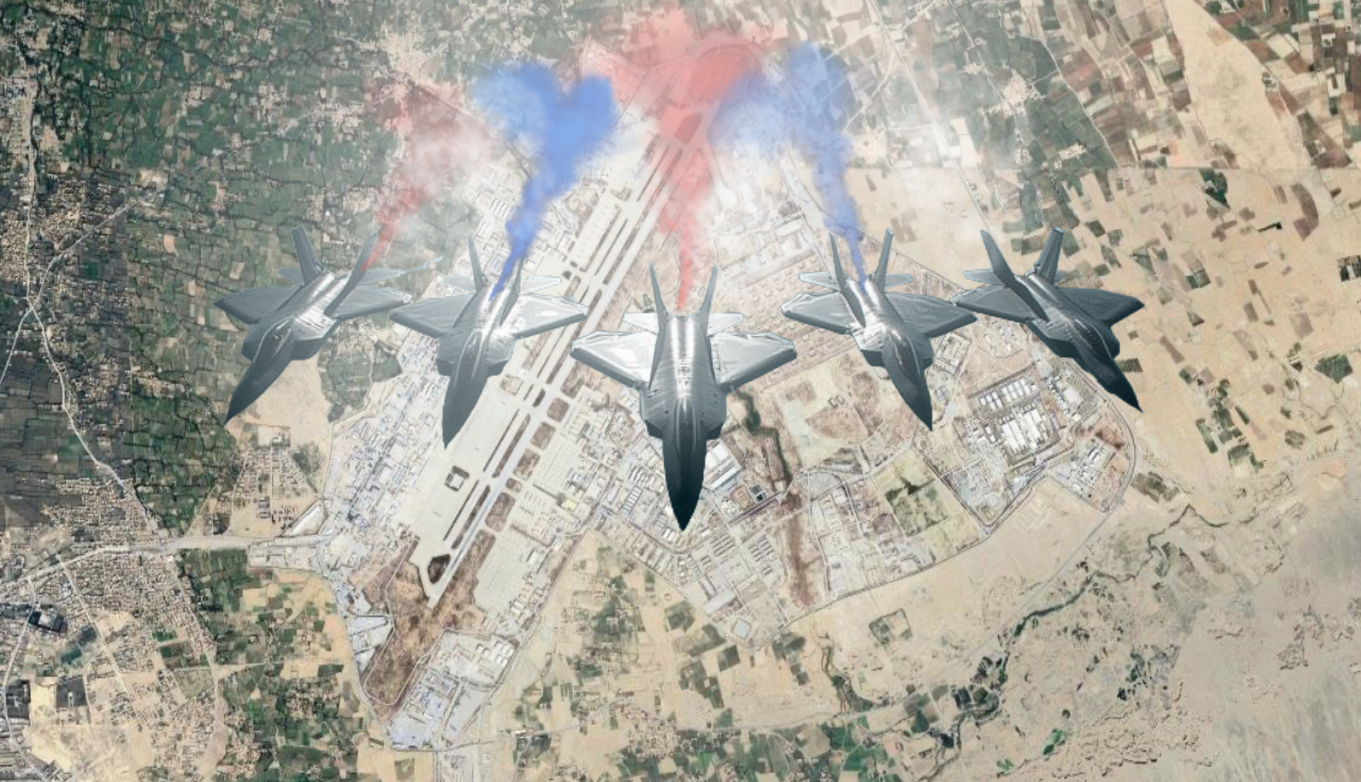
When the US withdrew from Afghanistan in July of 2021, it left behind Bagram Airfield, a strategic stronghold 30 miles outside of Kabul that once hosted US and NATO forces, a prison complex, and a fully functioning hospital. It served as the logistics and operations hub for the 20 year war in Afghanistan. Now it sits deserted, with the majority of its supplies and equipment having been either destroyed in the wake of the US evacuation or looted by the Taliban.
In recent weeks, however, US president Donald Trump has expressed desire to regain control of the base. In a September Truth Social post, Trump warned that “bad things are going to happen” if the Taliban does not “give Bagram Airbase back to those that built it.” The statement is highly ironic for multiple reasons. For one, Bagram was built by the Soviet Union in the 1950s, not the US. For another, during his first term, Trump himself signed the very agreement with the Taliban that set the stage for the eventual withdrawal. “The US pledged that ‘it will not use or threaten force against the territorial integrity or political independence of Afghanistan, nor interfere in its internal affairs,” said a Taliban spokesperson. Retaking the base would certainly be in violation.
So why does Trump want it back? While the base is a strategic location for running counterterrorism operations, Trump seems more concerned about competition with China. The Chinese have been accelerating their engagement in Afghanistan since the US withdrawal by pursuing the country’s deposits of rare earth minerals and embedding itself in Afghanistan’s critical infrastructure. Trump also claimed that the base sits “an hour away from where China makes its nuclear weapons.” This is only partially true—China tests nuclear weapons at a site a little over 1,200 miles away, reachable in an hour via F-16 fighter jet. It would also simply be a projection of US power in the region, aligning with Trump’s supposed “peace through strength” model.
To be fair to the President, retaking Bagram is not a pipe dream. While the Taliban have publicly rejected the idea of US military presence in Afghanistan, internal divisions within the group may leave the door open for that conversation. There are backdoor diplomatic channels at Trump’s disposal, such as using Qatar or the UAE as intermediaries, should the Taliban be willing to negotiate.
The question is not one of feasibility, but rather cost-benefit. Powers such as China, Russia, and Iran, who also seek to assert power in the region, would see the move as a threat, heightening tensions amidst an already fraught geopolitical situation. The open-ended threat from Trump that “bad things are going to happen” suggests that the US may be willing to take Bagram by force should negotiations with the Taliban fail (or fail to occur at all). This puts the US at a high risk for mission creep—history shows that “limited” engagements often do not stay limited. Practically, getting the base back to operational standards would be a costly logistical nightmare given the security situation on the ground in Afghanistan.
The US withdrawal from Afghanistan was a chaotic, messy disaster, but the motivations for doing so should not be ignored: two decades, trillions spent, and thousands of lives lost with no stable democracy achieved. The US should not ignore its regional history and risk another potentially lengthy, deadly, and costly entanglement.
Why a U.S. Golden Dome Won’t Work
On May 20th, President Trump, joined by Defense Secretary Pete Hegseth in the Oval Office, announced plans for a $25B investment in a space-based missile defense system dubbed the “Golden Dome” after Israel’s notedly successful Iron Dome. The full estimated costs at the time were around $175 billion, and the promise was to upgrade a national defense system in dire need of an update. Space-based nuclear defense systems are not a new concept; they are simply the modern iteration of President Reagan’s Strategic Defense Initiative (famously dubbed “Star Wars”) and its direct descendant, the “Brilliant Pebbles” program, both of which were largely unsuccessful. However, despite modern advances in technology, the “Golden Dome” initiative is still a distant fantasy, one that is doomed to fail due to insurmountable flaws in physics, economics, and vulnerabilities.
The logic of a space-based shield is to hit and destroy a missile when it is at its weakest point. For most intercontinental ballistic missiles, that point comes during its “boost phase”, which are the first few minutes after launch when the engines are still burning. In this phase, the missile is a large, hot, slow-moving target with a bright rocket trail that is easy to track. The appeal of this strategy, known as boost-phase intercepting, is that it neutralizes the threat before it can release its multiple warheads and cloud of decoys, which confuse defenses. According to nuclear arms experts, modern missiles remain in their boost phase for less than three minutes. Therefore, after accounting for the 45-60 seconds required to detect a launch, the actual time available to make an intercept is a fleeting moment.
Since this window is so small, in order to hit that target, the defense mechanism must already be nearby. The only way to guarantee this is to place the interceptors in space—the key trait of the Star Wars and Brilliant Pebbles programs, and now the Golden Dome initiative. These interceptors, called Space-Based Interceptors (SBIs), are launched into orbit and designed to detect the bright plume of a launched missile, calculate a path, and fly at it, destroying it through a high-speed, meteor-like direct collision. However, it is obviously impossible to keep objects stationary in space, meaning that the SBIs are constantly orbiting around Earth at over 17,000 miles per hour. This constant motion means that the vast majority of interceptors will, by sheer chance, be in the wrong place at the wrong time and will be unable to reach their missile target before it exits the boost phase. This introduces what is known as the “absentee ratio”, which measures the number of interceptors that are needed in orbit for every missile that is launched, in order to ensure that interceptors are in the proper place at the proper time. Today, experts estimate that the requirement is between 500 and 1,000 interceptors in orbit just to ensure one or two are positioned for a reliable defense against a single missile. The inescapable conclusion is that to guarantee coverage over one of the world’s largest countries by land mass, a constellation of these interceptors is required.
Deploying and maintaining a fleet like this comes with a staggering cost. Creating a network that fits in the White House’s $175 billion funding constraint would be sloppy, time-consuming, and reach nowhere near the levels of interceptors that would be required to defend a legitimate attack from the growing arsenals of our adversaries. Reports from the Congressional Budget Office estimated an initial price tag of nearly $542 billion. However, this cost could be upped even higher, as adversaries could overwhelm the investment by simply building more missiles, whose per unit cost is drastically lower than that of another interceptor. This has led many to realize that the U.S. cannot simply outspend its opponents, as a logical adversary will recognize that they hold the cost advantage and utilize that against the U.S.
The “Golden Dome” is therefore an unworkable concept, defeated by illogical physics, a disastrous cost-benefit ratio, and simple and effective countermeasures. A smarter path would be to invest more in ground-based defenses, which are both more practical and more cost-effective when compared to space-based defense mechanisms. While thousands of space-based interceptors are required to diffuse a single missile, that same work can be done with just 2 to 4 ground-based interceptors. A ground-centric defense mechanism, therefore, could provide similar strategic protection for just a fraction of the cost of a Golden Dome. Ultimately, the idea of Star Wars, though fun, is drastically far-fetched, inefficient, and costly.
Bad Bunny and Cultural Politics Perform at Super Bowl LX
Hours after finishing his third night touring in Santiago, Chile, on February 7, 2026, Latin superstar Bad Bunny will travel north to perform at the Super Bowl LX halftime show in Santa Clara, CA. The NFL’s annual Super Bowl is the biggest entertainment event in the United States, and the choice of Bad Bunny has only heightened attention around the show. Since the joint NFL–Apple Music–Roc Nation announcement on September 28th, praise and criticism of the decision have inundated social media sites, comment sections, and online forums. Some fans celebrate the performance as representation for Latinos on America’s biggest stage, while others critique it as a hollow gesture towards Latino solidarity at a time when Latinos and immigrants are facing heightened backlash and attacks under the current administration.
For the small share of people unfamiliar with him: 31-year-old Puerto Rican Bad Bunny is Benito Antonio Martínez Ocasio—or simply “Benito” to his most devoted fans. He is a singer who first rose to fame in Puerto Rico’s Latin trap and reggaetón scene in the mid-2010s and quickly became a global star. His 2022 album, Un Verano Sin Ti, garnered global attention, and his 2025 album, DeBí TiRAR MáS FOToS (DtMF), cemented his mainstream dominance, both for fans inside and outside of the reggaetón scene. Outside of the studio, Bad Bunny is also known for fashion experiments, acting roles, and his activism. Alongside his catchy reggaetón flows, nostalgic hits, and overall fun beats, Bad Bunny’s music frequently comments on themes of colonialism, migration, and violence. Tracks like “El Apagón,” “Andrea,” and “LO QUE LE PASÓ A HAWAii” highlight Puerto Rican struggles, gender-based violence, and broader Latin American issues, making his art both a personal expression and a political statement.
For his fans, Bad Bunny’s Super Bowl appearance represents a seismic cultural and linguistic shift. Incorporating non-English language elements and lyrics to the Superbowl is not new, though. During the 2020 halftime show, Shakira and Jennifer Lopez sang pieces in Spanish, but in February, Bad Bunny will perform entirely in Spanish. His music will be a powerful statement that challenges Anglo hegemony in US media and affirms the message that Latinos and Latino immigrants can be themselves without having to translate or assimilate. Moreover, at a time when Latinos and Latino immigrants face increased attacks and scapegoating, Bad Bunny’s Superbowl presence signals advocacy for and solidarity with Latinos living inside and outside of the US. It also indicates cross-border cultural unity among the Latino diaspora, even if individual governments are at odds with each other. For Puerto Rican fans especially, his performance elevates the island’s struggles onto the world’s biggest stage. In the words of Jay-Z, who helped secure the performance through his Roc Nation, “What Benito has done and continues to do for Puerto Rico is truly inspiring.”
Despite praise of the announcement, social media and online posts, comments, and messages demonstrate pushback from those from inside and outside of the Latino community. The upcoming tour of his DtMF album has notably excluded US cities due to Benito’s concern of I.C.E. agents potentially targeting his concerts for immigration deportations. This decision initially earned praise, but after the Superbowl announcement where a Trump advisor warned that I.C.E. will be present, he was criticized for being a sellout to the NFL. Skeptics pose the question that if he skipped touring to protect immigrants, why is he willing to headline the halftime show- an event far more policed and surveilled? They also argue that even activist artists can “sell out” when offered the biggest stage. Furthermore, MAGA-aligned critics have already begun mobilizing online, framing Bad Bunny as “anti-American.” The possibility that the Trump administration might even attempt to censor or interfere with the show also looms. Such commentary echoes the current climate where speaking Spanish in public can spark harassment, where immigrants are vilified, and where Puerto Rico’s suffering is dismissed.
Whether celebrated as visibility or condemned as hypocrisy, Bad Bunny’s halftime show reflects more than a single performance. The performance symbolizes the NFL’s ongoing attempt to look inclusive while remaining a profit-driven enterprise (note previous performers like Kendrick Lamar, Shakira, and The Weekend). Additionally, it highlights the fraught terrain of Latino identity and immigrant politics in America, and it shows the limits of celebrity activism, where artists risk becoming both icons of resistance and instruments of the very institutions they critique. Ultimately, Bad Bunny’s halftime show may embody subversive complicity: both reinforcing the oppressive structures of power by performing and resisting by singing compelling songs and using his platform to do good. Yet we must resist the temptation to idolize celebrities and remember that the NFL, Apple Music, and Roc Nation control the stage. What is certain is that Bad Bunny’s show will be visually and musically stunning, and it will remind us how culture, politics, and identity collide in moments as large as the Super Bowl.
Echoes of History: Navy SEALs Killed North Korean Civilians in 2019
On September 5th, 2025, The New York Times broke the story that in 2019, members of SEAL Team Six killed North Korean fishermen while attempting to plant a listening device on North Korean soil. On a mission in unfriendly territory that required absolute secrecy, the Navy SEALs were confronted by a boat. The SEALs did not know whether it was a “security patrol on the hunt for them” or a fishing boat, so they opened fire on the vessel, killing everyone on board. Team Six immediately left the shoreline without having planted the device that was the reason for their presence on North Korean soil, as the plan required the SEALs to abort immediately if they encountered anyone. The entire mission was a bust, with the main objective left unaccomplished and the only result being dead civilians. Strangely enough, something extremely similar happened almost exactly fifty years earlier.
On February 25th, 1969, members of SEAL Team One’s Delta Platoon entered the Vietnamese hamlet of Thanh Phong with the objective of capturing a local leader of the Viet Cong. When they left Thanh Phong, they had killed almost twenty Vietnamese civilians. The exact details of what happened in Thanh Phong are still disputed: most of the SEALs claim that a majority of the civilians died when the SEALs reacted to what they believed was enemy fire, only to discover when they stopped shooting that “‘we had killed only women, children, and old men.” One of the SEALs, Gerhard Klann, alongside a Vietnamese witness, said that the SEALs actually rounded up the civilians in the hamlet and massacred them. The reasoning Klann gave for this action was that “if they let them go the villagers might alert the enemy.” It is impossible to work out exactly what happened in Thanh Phong because the SEALs who were there did not talk about it for almost thirty years. The only reason why it ever came to media attention was because the SEAL commander at Thanh Phong, Bob Kerrey, went on to have a political career which included stints as a Governor, Senator, and as a credible candidate for President of the United States.
In both cases, while on a mission in the dead of night in unfriendly territory in Southeast Asia, Navy SEALS killed civilians in what may have been cases of mistaken identity. Past the surface-level similarities of the circumstances of these killings, there are also similarities in the disparities between the reported reasons why the SEALs may have opened fire, both in North Korea and Vietnam. The main disagreement between members of the North Korea operation, as described by the New York Times, was precisely how close the fishing boat was: “Mini sub pilots” reportedly said that “the boat seemed a safe distance away” and that “they doubted the mini-subs had been spotted,” while “the SEALs on the shore saw it differently… the boat seemed to be practically on top of the mini-subs.” After they discovered that they had fired upon unarmed fishermen, rather than a North Korean patrol, the SEALs “pulled the bodies into the water to hide them from North Korean authorities.” Additionally, “one added that the SEALs punctured the boat crews’ lungs to make sure their bodies would sink.” The SEALs fired to make sure whoever was on that boat would not cause a “surge of military action in the area” by exposing their presence to the North Korean military, like the kind of surge the US detected after the SEALs left. This reasoning is very similar to the explanation Klann gave for why Delta Platoon “deliberately executed the unarmed women and children for fear they would reveal the team's position to the Viet Cong.” These actions beg the question of what might have happened if the SEALS did not err on the side of caution as they did in Thanh Pong and in North Korea, and instead made the oppsite decision to leave the civilians alive.
In June 2005, four Navy SEALs entered the Hindu Kush Mountains of Afghanistan in search of a local anti-American militia leader, in what was referred to as Operation Red Wings. They were ambushed by local militia, and three of the four SEALs were killed, alongside six more SEALs and ten members of the United States Army, who died when their helicopter was shot down trying to assist the ambushed SEALs on the ground, in what the US Navy describes as “the single largest loss of life for Naval Special Warfare since World War II.” The US Navy page on Michael P. Murphy, one of the SEALs who died, and who received the Medal of Honor for his actions posthumously, claims that the “The SEAL mission was compromised when the team was spotted by local nationals, who presumably reported its presence and location to the Taliban.” This is in reference to a couple of goat herds who discovered the SEALs. After deliberating amongst themselves, the SEALs ultimately decided to let them go despite their fears that the goatherds would alert the Taliban, which the goatherds promptly did. Therefore, the decision to let them go caused all the deaths that occurred that day. Marcus Luttrell, the only surviving SEAL from the initial four man team, claims to have cast the deciding vote to free the goat herders, and that it was “the stupidest, most Southern-fried, lame brained decision I ever made in my life.”
It is not known for certain that Operation Red Wings failed because those goat herds told the Taliban about the SEALs position: others have pointed out that the SEAL’s position could have been revealed any number of other ways. Nor can any causative relationship be drawn between Operation Red Wings and what took place in either Thanh Phong (on account of the latter having taken place 35 years earlier) or North Korea (since the SEALs there did not initially know if they were firing on civilians or not). However, the US Navy does claim on its Medal of Honor page for Michael P. Murphy that Operation Red Wings was compromised by “local nationals.” There are US Naval Academy lessons on it as part of “the moral dilemmas of modern warfare” and whose “Questions for Discussion” include “Did the Navy SEALs make the right decision to let the Afghan goatherds go free?” To the US Navy, the decision by the SEALs to let the goat herds go probably resulted in the deaths of all the SEALs except Luttrell, and the question of whether the SEALs should have killed them instead is a legitimate “moral dilemma.”
The Thanh Phong killings, Operation Red Wings, and the 2019 SEAL landing in North Korea are all publicly known for reasons unrelated to the decisions to shoot or not shoot civilians who could have endangered the SEALs’ positions. At Thanh Phong, it was the future war heroism and political career of Bob Kerrey, who commanded Delta Platoon. In Operation Red Wings, it was the heavy casualties sustained by the SEALs, the high awards received by some of those involved, including a posthumous Medal of Honor for Michael P. Murphy, and a NYT bestseller about it written by the only surviving SEAL, Marcus Luttrell. For the North Korea landing, it was the special significance of US-North Korea negotiations around nuclear weapons. There are likely innumerable other instances of Navy SEALs, not to mention other American special operations units, firing on civilians, intentionally or otherwise, in an attempt to prevent the enemy from learning their positions. The way American special operations units handle future instances of these moral dilemmas will continue to shape foreign perceptions of America going forward, as they shed light on the value that American soldiers place on the lives of non-Americans in comparison to their own.
Is China Changing its Nuclear Strategy?
In a recent article for Foreign Policy Magazine, Tong Zhao, a senior fellow in the Nuclear Policy Program and China Center at the Carnegie Endowment for International Peace, argued that in spite of its passive diplomatic posture regarding nuclear weapons (which was recently reemphasized in May during Chinese President Xi Jinping’s meeting with his Russian counterpart Vladimir Putin), some of China’s recent military behaviors indicate that it is changing its nuclear strategy in subtle ways. Primarily, he argued that its “Launch Under Attack” (LUA) strategy is showing signs of moving towards a more aggressive deterrent stance.
China tested its first nuclear bomb in 1964, and its first thermonuclear weapon three years later. But ever since, China has adopted a remarkably passive policy regarding nuclear weapons. It is party to the nuclear Non-Proliferation Treaty, and acclimated to both the Convention on Biological Weapons and Chemical Weapons. While Cold War suspicions between Russia and the United States edged generals and policymakers towards the construction of sophisticated first-strike capabilities, China has long held an explicit no-first-use policy—in fact, China does not even attach its nuclear warheads to missile delivery systems during times of peace. Chinese diplomats have thus demonstrated resistance to a LUA strategy in toto, even though it would only be used if China was under imminent nuclear attack.
But recent trends suggest that Chinese policymakers are reexamining the value of deterrence. Zhao begins by observing that China is building a comprehensive early warning system of “infrared satellites and large ground-based radars, to detect potential attacks.” He then suggests that those working in the People’s Liberation Army (PLA) “increasingly endorse the LUA concept,” and are “presenting detailed discussions of LUA design and execution.” Such a buildup of early warning and detection systems implies some anticipation or anxiety about missile incursions over China, and gradual endorsement of LUA could indicate the direction in which Chinese leaders feel the winds of tension are blowing through the Indo-Pacific.
These developments have several implications, first among which is that increased nuclear posturing, or opaque discussions about said posturing, are overwhelmingly likely to stimulate anxiety among neighboring states. Those countries could come to anticipatory aggression or proliferation as defensive options. The recent Israel-Iran war has informed the world of the potential costs of nuclear procurement, and though China is already a nuclear power, any further advancements it makes in procurement and posturing could shift the balance closer to conflict.
China’s present security situation makes things riskier for decisionmakers, as Zhao writes. When weighing the decision to respond, China will have to take into account the missile facilities that North Korea and Russia are presumed to maintain near the Chinese border: if the United States were to launch an attack on these sites, Chinese military leaders would have to determine both whether the missile was carrying a nuclear warhead and whether the missile was directed towards China or to one of these border facilities. The world has never come as close to the brink of nuclear war as it has when such ambiguity or risk of misidentification are at play: in one instance, the world had only the choice of one man, Stanislav Petrov, to thank for the avoidance of all-out nuclear war between the Soviet Union and the United States.
The international community and nuclear watchdog organizations will have to monitor this phenomenon very closely to ensure that the risk of heightened nuclear proliferation in the Indo-Pacific is mitigated, especially as tensions between the United States and China rise over dominance in the region. Technology is fallible, and where the destructive power of a nuclear weapon is involved, the consequences of a bad decision could mean life or death for entire nations. Analysts must also consider the possibility that these initial developments, though strictly defensive in nature, could be the opening moves of a China that is increasingly willing to brandish its nuclear weapons as tools of coercion while simultaneously allowing its historical passivity to be eroded by opaque decisionmaking. China faces the choice between disavowing the “Cold War mentality and zero-sum games” it warned against last May and increasing its strength amid rising tensions in the region; whatever it chooses, the consequences will be monumental.
Syrian President’s Historic Trip to Washington
Syria has undergone dramatic changes in recent months, beginning with the fall of former president Bashar al-Assad’s regime in December and the establishment of an interim government in March. Since then, the interim government has sought to establish Syria’s place in the global community.
In September, for the first time in 25 years, Syrian Foreign Minister Asaad al-Shibani visited the United States to meet with lawmakers and discuss the lifting of the remaining sanctions on Syria. Later that month, interim president Ahmad al-Sharaa addressed the United Nations in New York, marking the first time a Syrian head of state had spoken before the United Nations since 1967. In his speech, al-Sharaa highlighted his government’s efforts at establishing fact-finding missions within the country so that the United Nations can investigate the killings that have occurred since the new government’s takeover. The interim government also affirmed Syria's commitment to returning to the global stage after decades of isolation and stressed the importance of lifting sanctions on his country to support stability and reform.
Following a meeting with al-Sharaa in May, U.S. President Trump signed a June executive order which lifted most sanctions on Syria and called for the reevaluation of the Caesar Syria Civilian Protection Act. While most restrictions have been eased, the Caesar Act continues to impact the country, and al-Sharaa stated that Syrian progress will remain inhibited until the sanctions under the Caesar Act are fully lifted. Supporters of keeping the Caesar Act in effect state that it allows the U.S. to continue pushing Syria to address the serious problems continuing to plague the country, especially ethnic tension and violence. They cite the massacres of 1,500 members of the minority Alawite community in coastal Syria in March, which were followed by violent clashes between Bedouin and Druze communities in Suweida in July 2025.
These visits mark a growing effort by the interim government to establish international connections, particularly with the United States, after years of isolation. However, with growing progress toward global cooperation comes internal issues that continue to plague the Syrian people. These trips take place against the backdrop of serious political concerns and ethnic tensions in Syria. As seen with demonstrations outside the United Nations during al-Sharaa’s visit, opinions about the interim government are divided. Some Syrians see al-Sharaa’s government as a necessary change from the tyranny of Assad rule, while others question the government’s ability, or commitment, to prevent the violence that continues against minority communities in Syria.
Despite these challenges, Syria’s engagement with the international community provides hope for continued change. Reopening diplomatic channels brings not only external assistance but also increased oversight and monitoring by the international community, which may help drive progress toward peace and accountability.
Malawi’s Former President Wins Election
Malawi, an east African country, has just reelected Peter Mutharika as President, defeating incumbent Lazarus Chakwera with 56.8% of the vote. Mutharika was the former president of Malawi from 2014-2020, but was ousted after corruption allegations and subsequent protests. Despite his shaky track record, he has been reelected, with many citizens hoping that his former achievements of lowering inflation to single digits and improving infrastructure during his first term will repeat themselves during his next presidency.
Malawi has one of the poorest economies in the world, and is plagued with climate disasters, agricultural decline and drought—disastrous threats for their agrarian-focused economy. It has yet to fully recover from the COVID-19 pandemic, and many citizens who lost their jobs have yet to find work. These factors were key issues for voters considering presidential candidates. Many people were outraged during Chawera’s presidency starting in 2020. While he oversaw numerous issues like economic crises and the goods shortage, there has been limited improvement in numerous aspects. Since his election, Malawi has continued to suffer from economic stagnation, with inflation reaching 33%. 3/4ths of the people live below the poverty line. Because of this, many people suffer from hunger and don’t have the means or resources to get adequate nutrition. Despite promising to weed out corruption, Mutharika seems to have not made a significant effort, furthering public dispute.
Domestically, Malawi is clearly facing both governmental and social issues. This re-election is a determining factor in pushing the country towards or away from progress. Mutharika has already been elected and failed to make meaningful change, but this second chance provides an opportunity to create real change that aligns with the needs of the people. The public is tired of facing the same issues over and over again and is looking forward to a president who fixes the longstanding issues that have afflicted the country for so long, including unemployment and food shortages. During a tumultuous global political environment, Malawi must achieve stable domestic politics, or they could face the consequences on the international stage.
Are We on the Brink of World War Three?
In short, no, but if Russia continues on its current path, the possibility cannot be dismissed entirely.
When news broke that Poland had invoked Article 4 of the NATO treaty, the world quickly erupted with questions about how this would affect global security and international relations. According to CNN, Poland called for a NATO meeting after Russian drones entered into Polish airspace on September 9, 2025.
To clarify, according to NATO, Article 4 of its founding treaty states that “The Parties will consult together whenever, in the opinion of any of them, the territorial integrity, political independence or security of any of the Parties is threatened.” Invoking Article 4 does not mean war: it is simply a meeting where NATO members decide collectively what to do about a situation or threat. While it remains unclear whether the drone incident was deliberate or accidental, NATO is not taking any chances.
According to Newsweek, allies have rallied behind Poland, declaring their solidarity. If another incident occurs, Article 5 could be invoked or NATO could consider retaliatory measures. NATO’s Article 5 states that an armed attack on one NATO ally is considered an attack against all, requiring assistance from every member state. If triggered, this clause could set the stage for direct conflict with Russia, potentially igniting the very war that the world currently fears.
This is not the first time that Poland has invoked Article 4. In 2022, Poland invoked Article 4 in response to Russia’s invasion, along with six other NATO members bordering Ukraine. It is important to know that invoking Article 4 does not automatically lead to Article 5’s collective defense stipulation. In fact, CBC News states, Article 4 has been used several times throughout NATO’s history without leading to escalation of the conflict.
The stakes remain high, but the real question is whether Russia would risk attacking a NATO member knowing that it has the backing of all 31 member countries. At the same time, there is no guarantee on how NATO itself will act: consultation does not always equal confrontation. What is certain is that if NATO determines that the threat is real and imminent, it will act to protect its members, especially if Russia carries out further attacks on Poland or neighboring NATO countries. Whether this incident fades into the background or escalates into something larger doesn’t just depend on Russia or NATO but on the international community as a whole. For now, our best hope to prevent another world war lies in diplomacy, unity, and restraint.
No Flood Control, Just a Flood of Protests: Philippines Erupts Over Corruption Scandal
These past weeks have seen a wave of protests erupting around the world, all largely driven by frustration over corruption. In Indonesia, protests over the increase of lawmakers' housing stipend led to violent clashes and the death of a young taxi driver that only fueled the nation’s rage. Following violent demonstrations in Indonesia and Nepal, the Philippines has become the latest hotspot, with citizens taking to the streets to voice their anger.
On September 21, tens of thousands of protesters marched through Manila and cities across the nation to demand accountability over a massive corruption scandal tied to flood control projects. The controversy has been building since July, when President Ferdinand Marcos Jr. highlighted the so-called “ghost projects” in his annual State of the Nation address.
Corruption has long been an issue in the Philippines, but these protests focus on one particular problem: the mismanagement of flood control contracts. Reports suggest that many of these projects were used by lawmakers to funnel funds into personal or political interests, while critical infrastructure either remained incomplete or never materialized. Estimates suggest the Philippine economy could have lost as much as £1.48 billion ($1.8 billion) due to corruption in these contracts. Recent investigations have highlighted that for the past 6 years, most flood control projects were overpriced or substandard to give large kickbacks to politicians. The implications of these corrupt flood projects goes beyond money. The Philippines is especially susceptible to typhoons which lead to widespread flooding. In July, a typhoon hit the country, causing massive floods and landslides, killing at least 25 people, and affecting millions. Therefore it is understandable that upon hearing of mass corruption in the project for flood control, people are angry. After all, as quoted by Philippine Representative Elajiah San Fernando, “When flood control fails, the ordinary Filipino gets to be hurt first”.
While most demonstrations were peaceful, some escalated into violence, with protesters throwing rocks and Molotov cocktails at police. Videos showed police getting into clashes with demonstrators. Similar to Indonesia, the “One-Piece” Jolly Roger Flag, which has become a Gen-Z symbol for resistance, was seen in the streets.
There’s also a historical layer to these protests. Over fifty years ago, on the same date in 1972, Ferdinand Marcos Sr., the late president and Marcos Jr.’s father, declared martial law, beginning an authoritarian regime that lasted until 1986. Despite calls for resignation, Marcos Jr. has expressed support for the protesters’ right to voice their anger. He stated, “Of course, they are enraged. Of course, they are angry. I’m angry. We should all be angry. Because what’s happening is not right.”
Corruption is an issue that continues to persist in Southeast Asia. Yet these protests have highlighted that citizens are not accepting these trends and are demanding change. With three countries experiencing protests, albeit for slightly different reasons, leaders in the region must step up in order to preserve the trust in political institutions and appease their populations.
Nepal’s Turning Point
In early September 2025, Nepal’s government banned 26 major social media platforms, including Facebook, Instagram, and YouTube, claiming that the platforms had failed to comply with new speech and data laws. This act of censorship was widely seen as an attempt to suppress growing online criticism of the country’s political elite, who had been the subject of a viral “#NepoKids” campaign spotlighting allegations of corruption and privilege.
Within days, the streets of Kathmandu were filled with protestors, many of whom belong to Gen Z, demanding systemic reform. What began as outrage over censorship quickly escalated into a broader anti-government movement. Over 50 civilians were killed in clashes with police, the parliament was set on fire, and the Prime Minister resigned. This wasn’t just another protest; it was the collapse of political credibility in real time. The speed and intensity of the response revealed just how fragile the relationship between the Nepali state and its citizens had become.
The trust in their government had already been eroded; the social media ban simply exposed the depth of that disconnect.
But this disillusionment didn’t lead to disengagement; it led to action. On September 12, 2025, the first female interim prime minister was appointed via Discord. The public’s choice to back Sushila Karki as interim Prime Minister was important not just because of who she is, but because of what her appointment represents. Karki is a former Chief Justice with a track record of standing up to political interference and a reputation for integrity. Her past includes pushing back against some of the same elites who were now being called out in the protests. Choosing her was not just a call for leadership; it was a rejection of the status quo.
What makes this moment politically significant is that Karki wasn’t elevated through party politics or electoral campaigning. She was brought forward through public consensus, shaped by both on-the-ground mobilisation and digital coordination. Her appointment reflects a shift away from traditional party structures and toward a new kind of legitimacy, one that is built through public trust, not institutional affiliation. This change also signaled how power is being renegotiated in real time. In Nepal’s case, the people didn’t just remove a leader. They influenced the selection of the next one. That shows a level of political engagement that goes beyond protest. It challenges the idea that political authority must always be handed down from within formal systems. Instead, it shows how quickly authority can be created from outside them when the public decides to act.
On a broader level, this raises questions about the durability of traditional political institutions in a digital age. As trust in parties and parliaments declines globally, examples like Nepal suggest that new pathways to power are forming, pathways where public sentiment, amplified through technology, can shape outcomes directly. That doesn’t mean structure and process are irrelevant. But it does mean they can no longer operate independently of the people they are meant to serve.
Looking To The Right: The Rise of Populist Politics in Germany
The term populism is derived from the Latin word populus, which translates to "the people". It is a controversial term, but broadly, it is a concept that emphasizes “the people” versus the perceived elite. Essentially, it divides people into two camps: “the people” and “the others”. “The people” can refer to different groups in different contexts, so populism can relate to left or right-wing politics.
Established in 2013, the Alternative für Deutschland (AfD) is a relatively new and rapidly growing right-wing populist party in Germany. Originally founded in opposition to policies of the Eurozone, since the 2015 European Migrant Crisis the AfD has embraced a platform of nationalism, anti-immigration, Islamophobia, and nativism. In early May, the AfD was classified by Germany’s domestic intelligence agency as an extremist organization because the "ethnicity-and ancestry-based conception of the people that predominates within the party is not compatible with the free democratic order." However, this classification was deferred as a result of a lawsuit filed by the AfD.
The growth in popularity of the AfD is evident in the 2025 federal election that occurred in February because the previous governing coalition collapsed in November 2024. The AfD gained 20.8% of the total vote, earning 152 seats in the Bundestag. It was the second winningest party, trailing behind the Christlich Demokratische Union (CDU), which is a centre-right party.
In the last decade, the AfD’s primary stronghold was in districts that were formerly members of the Deutsche Demokratische Republik (DDR)—the former communist state in East Germany. However, a recent local election held in Western Germany demonstrates the continued growth in support of the German far-right. On September 14th, local elections were held in the North Rhine-Westphalia, which is the most populous state in Germany. While Chancellor Friedrich Merz’s party, the CDU, maintained the majority in this election, the AfD tripled its votes from 2020, receiving 16.5 % of the vote compared to 5.1% in 2020.
The AfD ascension reflects Western Europe’s trend towards populism and the right. Similar patterns are evident with Italy’s election of Giorga Meloni, who founded the Brothers of Italy, a far-right populist party in 2012. Like the AfD, the Brothers of Italy started with a platform of Euroscepticism, and both the AfD and Brothers of Italy have become more politically mainstream.
The AfD’s growing influence marks an important shift within Germany’s political landscape. Despite the AfD receiving the second-most votes in the 2025 federal election, the other parties refused to form a coalition with them because of their extremism. This is referred to as a “firewall”, which is “a direct result of the country’s post-World War II efforts to suppress parties and voices labeled extreme.” Even with this pushback from the opposition, the AfD is likely to shape debates and exert pressure on the Bundestag. Whether this firewall holds will be a defining factor of Germany’s political trajectory and democracy.
Political Polarization Topples the French Government: A Call to Accept the Gray
On September 8th, the French Prime Minister, Francois Bayrou, was ousted, collapsing the French government. The Guardian reports that due to rising tensions concerning the 2026 French budget, Bayrou called for this motion himself, hoping to receive a signal of support from his parliament. Instead, he was answered with 364 votes of no confidence to 194 votes of support, requiring him to submit his resignation to President Emmanuel Macron. Bayrou's failure requires Macron to appoint his fifth PM in the last two years — signally an overall dismal second term for Macron, states the BBC.
As reported in The Guardian and NBC News, Bayrou began losing support from his parliament after pushing a radical budget—including the dissolution of two national holidays—in an effort to minimize the country’s 44 billion Euro (+51 billion USD) national debt. It wasn’t purely the love of Easter Monday that caused the toppling of the government; their issues began much earlier than that. Bayrou was appointed by Macron after former PM, Michel Barnie, was also ousted with a vote of no confidence, according to NBC News. Bayrou and Barnie were both members of Macron’s minority moderate party, one that has struggled to maintain support in parliament. In fact, maintaining support in the parliament during Macron’s term is seemingly impossible. A majority party in the parliament hasn’t existed since Macron called for a snap election in June of 2024, reported on by AP News. He called for the dissolution of parliament and new elections in the middle of the term with the goal of snatching more seats for his moderate party. To Macron’s disappointment, the far-right and far-left parties won an overwhelming majority of the seats, leaving France with an ever more divided country, states NBC News. Macron’s second term is quickly becoming shorthand for an era of political polarization.
This tune of division is not unfamiliar to people outside of France, with polarization and political vitriol on the rise around the globe. When presented with a culture that stakes its identity so starkly around politics, the implications and causes must be evaluated. Why is it that the parties we once viewed as malleable vectors for our own beliefs are being transformed into stagnant dictionaries by which we define ourselves? The rise of the us/them mentality is a mechanism we employ to cope with an ever changing world. In our current state of rapid expansion (technology, global connectedness, information, etc.), the identities we once knew are beginning to come apart at the seams. We are being forced to either accept the diversity within ourselves, or grasp for a new stable identity, often in the form of a polarized political party.
Our world is one of binaries: left or right, new or old, right or wrong, us or them. As children we were fed on the black and white, and taught to fear the gray. In the gray things are complicated, we are asked to question, forced to accept confusion, and implored to love multiplicity. Knowledge in a binary is simple, making it perfect to dominate our society. As people, we do a decent job of ignoring this dualism when the world is calm. On steady seas we are more likely to sail into that aforementioned gray.
But as the storms begin, we rush to what we know — and quite frankly, the skies are darkening. The climate crisis, Covid-19, the prevalence of AI, and more are impacting the world in unprecedented amounts. In the midst of the complicated issues we are faced with a question: do you cling to the life-rafts of black and white or do you wade into that gray?
This issue is reflected in French politics, as political loyalty and extremism weaken the strength of their government. Parliamentarians will refuse to budge on issues like the budget, while vindicating their stubbornness by believing the absolute evil of the “other”. This is most visible as French citizens are migrating outward, to the far-left and far-right, but is as equally present in the cemented center. In a time when defining your personal identity and political beliefs seems impossible, people instead choose to define what they are not. They create a monolith of antithesis; one of corruption, evil, and disaster. They craft an idea that is so starkly not them, that they are better able to understand who they might be. This construction of an “other” then gets applied to ones’ political opposite, regardless of the commonalities their beliefs truthfully contain. Due to the complex issues at hand, having an answer to what is right and wrong seems impossible. To avoid accepting gray, we create a duality that doesn’t exist. A right and wrong, black and white, far-left and far-right; a substitute for the dualism we were raised on.
As we look to the future of France, it’s simple to hope for the return of the peace guaranteed under a majority party. Issues may not stagnate in parliament, budgets may pass without the toppling of whole governments, but we will have conceded the fight against our binary. When we choose the easy answer of polarization we abandon the hope for a world that accepts its multifariousness. Instead of vying for a majority party to someday rule again, we should hope for a France that accepts the impossible challenge of identifying its beliefs on our world’s most complex issues; one that abandons the black and white for the veracity of the gray.
Israel’s Invasion of Gaza City: Does the US Have a Red Line?
The Israeli military has begun its ground offensive on Gaza City, further intensifying a conflict which has resulted in the death of over 64,000 Palestinians, according to the Gaza Health Ministry. Since the Hamas terror attack on October 7th, 2023, the population of Gaza City has swelled from 450,000 to 1.2 million, as the rest of the territory has come under heavy siege. Now, the city’s residents are at risk of being forcibly displaced as well, with few viable areas left to seek refuge.
Israel’s conduct has drawn considerable condemnation from international bodies, with the UN recently joining the world’s leading experts and even Israeli rights groups in accusing Israel of committing genocide in Gaza. The Israeli foreign ministry rejected this claim, which was the result of a United Nations commission of inquiry. But even statements made by Israeli military and government officials themselves over the course of the conflict have made the accusation of genocide hard to deny. "I have ordered a complete siege on the Gaza Strip. There will be no electricity, no food, no fuel, everything is closed. We are fighting human animals and we are acting accordingly,” said Yoav Gallant, the former Israeli Defense Minister. "We are now rolling out the Gaza Nakba. Gaza Nakba 2023. That's how it'll end,” said Avi Dichter, Israel's Agriculture Minister. Nakba, or “catastrophe” in Arabic, refers to the forcible displacement of over half of the Palestinian population by Israeli forces during the 1948 Arab-Israeli war.
Many countries, including US allies, have publicly taken similar stances to that of the UN. Recently, the United Kingdom, Canada, and Australia joined the list of more than 140 UN member states to formally recognize Palestinian statehood. While this is mostly symbolic, it is evident of growing international disapproval of Israel’s perpetration of the catastrophic humanitarian crisis in Gaza.
The posture of the US stands in stark contrast to the global coalition. The State Department joined Israel’s foreign ministry in rejecting the UN’s conclusion of genocide in Gaza, stating that “this kind of equivocation by the UN is further evidence of its moral bankruptcy.” Contempt for international authorities and the rules-based order is nothing new for the Trump administration, which imposed sanctions on the International Criminal Court following the issue of arrest warrants for top Israeli officials. These kinds of actions are in no way performative or symbolic — they only embolden an increasingly aggressive Benjamin Netanyahu, Israel’s Prime Minister. From a US perspective, there is no red line.
While Trump’s rhetoric and generally unwavering support for Netanyahu and his far-right government have offered little resistance, it would be a mistake to suggest that the drawing of a red line would even matter anyway. In 2024, then President Joe Biden declared that an assault on the southern city of Rafah would constitute the crossing of a red line. But ultimately, the administration just moved the goalposts, going to great lengths to avoid condemning the attacks on the city which displaced nearly 1 million Palestinians over the course of a three week assault. The conflict raged on, and Israel faced no significant repercussions.
Regardless of administration or party, the US response to the crisis in Gaza has been representative of the flaws in the international order. UN declarations, international court rulings, and even arrest warrants for Netanyahu himself carry little weight when there is no mechanism to enforce them. For better or for worse, that mechanism has historically been the US, whether militarily or diplomatically. Israel can operate with impunity, knowing that condemnation abroad will not translate into material consequences. If the United States is the linchpin of the system but refuses to act, even when its own red lines are openly crossed, then the entire framework collapses under the weight of its contradictions. The question that remains is not whether the world will condemn the tragedy, as many have done, but whether it will ever have the power and political will to stop it.

Testing NATO’s Resolve: Russia’s Drone Incursions and the Future of European Security

Prime Minister of Poland Donald Tusk speaks at a cabinet meeting following Russia’s drone incursions on September 10th, 2025.
Image by Aleksander Kalka.
“It’s time for the leadership of Russia to understand that the attempt to rebuild Europe’s last empire is doomed to fail.”
These were the words delivered during a national statement by Polish Minister of Foreign Affairs Radosław Sikorski, following a series of airspace violations by the Russian Federation on the morning of September 9th.
According to NATO secretary-general Mark Rutte, 19 of the 415 Russian drones directed at Ukraine that day were identified in Polish airspace. This unprecedented breach triggered a coordinated NATO response involving Polish F-16s, Dutch F-35s, German Patriot missile systems, and Italian AWACS surveillance aircraft.
Russian drone incursions over the Polish border are not a new occurrence. So, what distinguishes this moment?
Poland’s response on September 9th marks the first time Russian drones were intercepted in NATO airspace as enemy targets. Within hours, Polish Prime Minister Donald Tusk invoked Article IV, pressing allies to address what no longer looks like an accident, but a deliberate test of the alliance’s resolve. Soon, images surfaced of NATO representatives surrounding Tusk, evaluating the extent to which Russia had threatened Poland’s security – and whether a military response should follow.
Two days later, Mark Rutte announced the launch of “Eastern Sentry,” an operation to bolster defenses along the alliance’s eastern flank, though the full scope of this initiative remains evolving.
Data from the Institute of the Study of War clearly shows an increase in Russian missile and drone attacks on Ukraine beginning in mid-2025. The trespassing into Polish territory, in addition to the three Russian fighter jets identified in Estonian airspace on September 19th, all reflect an emboldened Russia testing the limits of NATO’s surface unity.
This is a reminder that assertive rhetoric without concrete action only reinforces perceptions of Europe’s weakening resolve. The crucial question now is whether NATO can translate words of condemnation and symbolic military maneuvers into credible deterrence. Without clear, unified, and forceful action, Russian incursions over NATO territory risk becoming routine provocations rather than triggers for a decisive response.
When faced between the choice of a direct confrontation with NATO and capitalizing on transatlantic tensions, Russia will choose the latter. After all, this very idea makes up the backbone of Russia’s hybrid warfare doctrine. As the Russian government takes note of the growing transatlantic rifts, with Donald Trump’s consistent remarks that the war in Ukraine is a European—not an American—responsibility, these incursions are likely a test of NATO strength as it lacks confident support from its traditional American counterpart.
To say that these recent sightings of Russian drones and fighter jets in NATO skies is an inflection point might seem an overstatement to some. But how Europe responds to these incursions, and the degree to which Operation Eastern Sentry deters future Russian aggressions, will undeniably shape the credibility of NATO’s deterrence posture and set the tone for European security in the coming decade.
This moment, if mishandled, risks confirming to the Kremlin that NATO’s red lines are flexible, rather than firm.

The Ever-Shifting Pendulum Between Israel and Hamas: Implications of Qatar

Graphic by Isabella Garcia.
On Tuesday, September 9, 2025, Prime Minister Benjamin Netanyahu gave the green light to move forward in a targeted attack against Hamas in the northern suburbs of Doha, Qatar. Although this attack was targeted at senior Hamas leaders, Hamas stated that Israel failed to kill senior officials of the group and instead killed the son of Hamas’s chief negotiator, his office manager, a member of Qatar’s international security forces, and three others affiliated with Hamas.
Israel has promised to track down and kill every Hamas member involved in the events of October 7 and return the 200+ hostages home. Despite the continuous backing and support Israel has received from the US, Israel’s undenying desire to kill Hamas has surpassed the rule of law, further dismissing international law by attacking on Qatari soil, striking not only a primary meditator in ending the war in Gaza, but also a U.S. ally.
This is by no coincidence the same place where Hamas maliciously executed their attack on October 7, 2023. It should not go without mention that although these events are nearly two years apart, the devastations resulting from October 7 have propagated into conflict in lieu of serving Hamas the revenge Israel sees so fit.
Following Israel's attack on Tuesday, President Trump responded by relaying to the media he did not make the decision to attack Qatar and was not notified in time to change the minds of Israeli forces. Trump further stated,
“Unilaterally bombing inside Qatar, a Sovereign Nation and close Ally of the United States, that is working very hard and bravely taking risks with us to broker Peace, does not advance Israel or America’s goals,” he wrote.
“However, eliminating Hamas, who have profited off the misery of those living in Gaza, is a worthy goal.”
In response to the attack, Hamas released a statement that Hamas officials were in the process of discussing a cease-fire proposal by the Trump administration when Israel fired strikes on Qatari soil. Nonetheless, the prime minister of Qatar, Sheikh Mohammed, later stated that Qatar would continue to serve as a mediator in the war, but that the country’s government had also formed a legal team determined to follow through with a response to Israel’s attack.
The controversy surrounding Qatar lies in the fact that it not only hosts two major U.S. military bases, but also provides Hamas $30 million a month. Although Israel has defended their attack on Qatar as justified, Qatar, a pragmatic nation in the conflict, believes Israel has been engaged in “state terrorism.” Trump, after receiving a $400 million ex-Qatari jet as an “unconditional donation,” has assured Qatar on a recent phone call that, "such a thing will not happen again on their soil."
The issue dominating public conversation following the airstrike, is where Hamas and Israel still stand in a cease-fire. The complexity of the conflict between Israel and Hamas is rooted in the tension between the two nations' visions that are competing against coexistence.
Israel relies on two premises: self defense and self-determination. Needless to say, this is in direct tension with the two military objectives of Hamas: establishing an Islamic state and opposing the existence of the state of Israel. Setting aside all of the thorny and incendiary comments regarding the conflict, the real question remains: How will peace be achieved?
The most significant area of conflict is rooted in the mutual perception of injustice, as each side regards the other as fundamentally wrong. Israel views Hamas as a terrorist group leveraging human shields in order to gain military advantage by using logistic lines of communication and military operations located in civilian buildings. This has in no way stopped Israel from unleashing an unproportionately devastating attack on Gaza. Aside from the derogatory reiterations of this conflict, outside perspectives should aim to focus on the fact that Hamas has been using human shields as bargaining chips in the negotiation process, and Israel has chosen to respond by dismissing international law and unproportionately unleashing vast devastation.
In order to establish negotiation as a pathway to peace, we must suspend our own ideas of morality and pragmatically search for the answer as to how these two nations can engage in peace. This pathway is tainted by the hollow implications of a political bandaid, which is precisely what a ceasefire represents in this situation. Reaching a status quo - where both entities agree to suspend acts of violence against one another - offers only the illusion of peace, engraving deeper divisions festering in Middle Eastern soil, but still temporarily freezing hostilities.
It is strategically beneficial for Hamas to work towards the proposed ceasefire, as their currency in negotiation slims as the fury of Israel intensifies. Hamas no longer benefits from the backing of its “big brother” Iran. To make matters worse, Israel has made it clear they are not ready to make peace, leaving Israel’s currency sheer firepower. Israel is searching for any means of commitment from Hamas that they are going to stop an attack and it is in the best interest of Hamas to do so before Israel chooses “self-defense” once again. While a ceasefire is the best option available for both states, Israel will not concede, and neither will Hamas. This ceasefire is rather a political bandaid on the moral cancer existing within Israel and Hamas.
Striking a Dam Good Deal: Rising Tensions Between Ethiopia and its Downstream Neighbors
On September 9th, under a sea of Ethiopian flags and in the shadow of a concrete giant, Prime Minister Abiy Ahmed officially inaugurated the Grant Ethiopian Renaissance Dam (GERD). Standing nearly 500 feet tall and stretching over a mile across, GERD cinches the Blue Nile, a tributary of the greater Nile River. The $5 billion project will generate around 6 gigawatts of electricity: enough to both meet the country’s domestic demand by lighting the homes of around 60 million people who currently lack power access and create a surplus for export, assuming transmission infrastructure can keep pace.
With a reservoir the size of Greater London, GERD has become a symbol of unity and national pride for Ethiopia. However, it has deepened rifts with its downstream neighbors, particularly Egypt.
Egypt, a nation already strained by drought, views the structure as a threat to its water access during increasingly dry seasons. Cairo also contends that the dam counters a colonial era-ruling: in 1929, the British government (then ruling Sudan), granted Egypt the lion’s share of Nile waters and placed a block on upstream dams. This framework was later reinforced through a treaty between Egypt and independent Sudan. Ethiopia, however, was never a party to either treaty and has long rejected their legitimacy.
Construction began in 2011, launched under former Prime Minister Meles Zenawi, who unveiled the ambiguously-named “Project X” amid Egypt’s internal upheaval during the Arab Spring. In 2015, Egypt, Ethiopia, and Sudan met in Khartoum to draft a Declaration of Principles on GERD. Instead of fostering cooperation, the agreement further entrenched mistrust. Ethiopia interpreted Egypt’s silence on its historic rights as a green light to proceed, while Egypt and Sudan accused Ethiopia of acting unilaterally without a legally binding agreement.
Ethiopian officials maintain that the dam will not cause significant harm to its downstream neighbors, citing independent studies showing no major disruptions since filing began in 2020 (aided, admittedly, by favorable rainfall). Egypt counters that even a 2% reduction in the flow of water could devastate over 200,000 acres of farmland. Egyptian geologist Dr. Abbas Mohamed Sharaky has warned of seismic risks from the massive reservoir situated along the active East African rift and suggested that Ethiopia could even use the dam to exert force over Sudan without “weapons or planes.”
Tensions could escalate dangerously if Egypt’s water supplies are at all compromised. Military action has been openly threatened, although any strike on the dam would devastate Sudan, which lies just downstream. Broader ripple effects are also possible: climate diplomacy experts have pointed to Egypt’s new military base in Somalia and Ethiopia’s controversial offer to recognize Somaliland in exchange for a coastline lease as another bubbling tension that could spill into a proxy conflict.
Negotiation is paramount, and luckily, that door is still ajar. Aspects of possible positive-sum solutions include Ethiopia selling surplus to Egypt and Sudan at favorable rates, expanding transmission capacity in the region, and highlighting benefits like sediment-entrapment that will reduce siltation at Lake Nasser. Ethiopia could also agree to release additional water flow during dry seasons and allow for more transparency, joint monitoring, and shared modeling of water resources. Mediation by the African Union or other neutral parties may help rebuild trust.
The dam is built, and now strong cooperative frameworks, allowing everyone to reap the benefits, must follow. Whether the GERD becomes a greater regional good or drowns the region in conflict remains to be seen.
How U.S. Tariffs Are Forging Canadian Independence
Since World War II, America has maintained an unrivaled partnership with our neighbors to the north. The United States and Canada share not just the world’s longest undefended border, but an unrivaled partnership built on open trade and trust. That all changed on March 26th, when President Trump enacted a first of its kind, 25% tariff on Canadian auto imports, with the White House citing the “extraordinary threat posed by illegal aliens and drugs” as justification for a national emergency and, by extension, for the imposition of the tariff. For Canada, a nation whose GDP is composed of 65% trade activities, a severed relationship with its largest trade partner could cripple its economy. Furthermore, these tariffs weren’t just economic adjustments, but rather a signal that America was beginning to treat a long-time favored ally as a potential threat.
The timing of Canada's leadership change was remarkable. Just twelve days before the tariff announcement, Mark Carney, a former investment banker and central banker, took office as Prime Minister. Through a true baptism by fire, Carney has used the opportunity to create a fundamental shift in Canadian identity, serving as the catalyst to spur a more independent identity on the global stage.
Instead of capitulating, Canada has gone to work on rapidly building its way out of economic dependence. Carney’s government immediately imposed retaliatory 25% tariffs on steel, aluminum, and automotives (spurring the U.S. to raise tariffs up to 50%), and announced initiatives like the “Build Canada Homes” program, which uses federal purchasing power to guarantee demand for homegrown Canadian steel, lumber, and aluminum, lessening the blow of the U.S. tariff on these goods. A half a trillion-dollar spending package included restructuring and upgrading the Port of Churchill on Hudson Bay — a direct strategic move to bypass U.S. chokepoints and gain greater access as the closest port to European markets. Furthermore, Carney traveled last week for the first time as Prime Minister to Mexico City to negotiate new bilateral agreements to boost the already $40.5 billion USD in trade between the two nations, signaling a clear intent to build a stronger North American partnership that is no longer reliant on Washington.
Canada’s response has been one of overall strategic and successful investment. The country’s half-trillion-dollar investment serves as targeted spending, creating tangible assets that will pay economic dividends for decades to come. This has fundamentally altered the North American power balance. U.S. companies that took for granted the days of open North American borders under NAFTA are finding a less predictable partner up north, who is actively seeking (and finding) other customers and suppliers.
Ultimately, Carney has ensured that United States aggression through tariffs will result in a long-term geopolitical gift for Canada, and perhaps a massive, self-inflicted wound for the United States. Thanks to their intention to bully a dependent ally, they instead created a national mindset shift, pushing Canada to build a self-defined future with strong domestic production and greater access to the international economy. And to make matters worse, the United States’ proposed $100,000 application fee for H-1B visas, which allow foreign skilled workers to enter the U.S. workforce, furthers the allure of Canada as a player on the international scale, one who will welcome those turned away from the U.S. with open arms.
Where does North America go from here? It will all come to a head in 2026, when the United States-Mexico-Canada Agreement (USMCA) is up for its scheduled review. For the first time in modern history, Washington will not be negotiating with a drastically dependent ally, but rather with a nation that is becoming increasingly independent and wary through spending drastic amounts of money on diversifying and building its economy, simultaneously building an immunity shield against Americans. If trends continue, the U.S. appears to have lost its long-time strategic advantage and handed Ottawa all the leverage it needs in the coming negotiation.

Eurovision’s Breaking Point: Israel

Yuval Raphael, Israeli 2025 Eurovision Participant, October 7th Survivor.
Photographer: Quejaytee, https://www.quejaytee.com/
The Eurovision Song Contest has been a cultural staple throughout democratic Europe for decades. First airing in 1956 with just 7 nations, it has since expanded to over 50 countries who have competed at least once. This includes every UN recognized country in Europe (besides Liechtenstein and Vatican City), as well as non-European nations like Morocco, Australia, and most pertinently, Israel. Israel first started competing in 1973, and has won the competition 4 times, most recently in 2018. Though Israel’s participation has attracted mild backlash on occasion, it generally had been accepted as a competitor and welcomed into the competition. However, this all changed when the Israel-Hamas War started.
The Eurovision Song Contest consistently airs in May, and by the time the 2024 competition rolled around in Stockholm, the backlash against Israeli participation had grown incredibly. The Dutch participant was disqualified just hours before the final in an alleged ‘incident’ with the Israeli delegation. This sparked massive backlash from Eurovision fans, as various outspoken participants such as Ireland’s Bambie Thug reported harassment and intimidation throughout rehearsals and competition week from the Israeli delegation and media. Despite backlash, Israel ultimately placed 5th, with much of that being credited to a coordinated media and political campaign by Israeli media and many right-wing European politicians to vote for Israel, as half of the votes in the competition are made from the European public, whilst the other half from national juries, which placed Israel much lower than the public.
Some reforms were made between the 2024 and 2025 contests; however, Israel’s presence only drew more criticism as the war in Gaza raged on with accusations of genocide and ethnic cleansing mounting against Israel. In both the 2024 and 2025 contests, Israel sent songs that were vaguely referencing the Hamas attack on October 7, 2023. Israel’s original song for 2024, titled ‘October Rain’ was disqualified by the European Broadcasting Union (EBU), which runs the contest, for being too political—something strictly forbidden in Eurovision. In the 2025 contest in Basel, Switzerland, Israel achieved an even better result, placing 2nd, losing only to Austria. This result was again driven by massive support in the public vote while coming 14th out of 26 in the national jury rankings.
Following the most recent edition of the contest, many national broadcasters, which fund their respective country’s song and broadcasting fees, have made various calls on the EBU to provide transparency on the public vote. As those calls went unanswered, a myriad of countries have since threatened or confirmed their non-participation in the upcoming 2026 contest. National Broadcasters from Ireland, Slovenia, the Netherlands, and Spain have all indicated that if Israel is in, they are out. The addition of Spain to this list is especially relevant, as it is a part of the ‘Big 5’ group along with the UK, France, Italy, and Germany. These 5 countries provide a substantial amount of funding for the competition, and are granted an automatic spot in the Eurovision Grand Final. The withdrawal of Spain and three other countries could leave the EBU struggling to fund the competition. In addition to those who have already confirmed their non-participation, national broadcasters from Iceland, Finland, and Belgium have all expressed varying degrees of uncertainty when it comes to their participation. Though some countries, like Germany, have expressed their support for Israel’s participation, calls from Eurovision fans and the European public alike have made Israeli support increasingly unpopular.
There is precedent for banning countries from the Eurovision Song Contest and other EBU-related events. Following Russia's 2022 invasion of Ukraine, the EBU suspended Russian membership. In 2021, Belarus’ EBU membership was also suspended for various political reasons. However, the EBU maintains that Eurovision is still a ‘non-political music event’ and that it is ‘not a competition between governments’. Many critics and Eurovision fans alike claim a massive hypocrisy when it comes to the treatment of Russia versus Israel, as within weeks of the Ukrainian invasion, Russia was banned from Eurovision, while a war that has since been called a genocide by many European leaders has not led to any accountability for Israel. This public outrage was further fueled by reports that have emerged that the EBU has recently requested Israel to compete without a flag or fully withdraw from the competition, though the EBU publicly denies this request has been made. As pressure continues to mount from the public, and as various international and national organizations designate Israel’s actions in Gaza a genocide, the future of the Eurovision Song Contest with Israeli participation is looking increasingly bleak, as public perceptions of the nation continue to deteriorate.