
The Journal of Foreign Affairs at Carolina
Formerly known as The Internationalist
Get the latest from our Undergraduates at
The International Relations Column
A European Narcostate? Belgium’s failed war on Drugs
When one thinks of Belgium, images of waffles and dutch-french language squabbles may come to mind. Brussels, the political capital of Europe and home to the EU and NATO, amongst countless other international organizations, defines much of the country as well. However, one would seldom think that Belgium has become the epicenter for drug trafficking on the European continent. Belgian ports have surpassed historically popular ports in the Netherlands and Spain in terms of illegal drugs seized. Meanwhile, just miles away from the headquarters of EU institutions, turf wars and shootings play out in Molenbeek, a neighborhood in Brussels. Belgium’s logistical interconnectivity has made it prone to trafficking, and there has been a consequential rise in recent years that has made the port of Antwerp the EU port with the most illicit material seized in 2022 (111 tonnes) and 2023 (116 tonnes). To put it into perspective, that is well over double the entirety of cocaine seized at ports throughout the U.S. in 2023.
Historically, illicit drugs have entered Europe through Spanish and Portuguese ports. Though both are still popular destinations for trafficking, the rise in Belgium’s status is due to Antwerp’s massive port volume as well as tightening security on the Iberian Peninsula. Cocaine makes up the vast majority of drugs trafficked into Europe, accounting for 82% of total seizures. Marijuana seizures are less common, due to both relaxing laws and social attitudes towards the drug, making the drug a distant second and even less common in Dutch and Belgian ports.
Cocaine trafficking in Belgium has gotten so bad that a judge in Antwerp, who had been living in a safe house for four months, warned in an anonymous letter that “extensive mafia-like structures“ are taking hold of the judiciary in Belgium. The judge argues that organized crime has infiltrated the legal system, and is pushing for legislation that lets the judges work anonymously, amongst other reforms. This judge is not an alarmist, as many may think. Brussels is experiencing a wave of drug-related crime, most notably shootings. The issue has gotten so bad that Belgium’s Interior Minister has signaled that he wants to bring in the army to the streets of Brussels. With more than 60 shootings occurring so far in 2025, many would argue that this is a necessary step to combat the dramatic escalation in violence in Europe’s de-facto capital.
Belgium’s emergence as Europe’s new hub for drug trafficking has intensified criticisms of the country’s governance. Belgium’s famously complex political system creates chronic coordination problems that drug networks have been quick to exploit. Many argue that this fragmentation has produced a state apparatus that is often too slow, too divided, and too under-resourced to respond effectively to evolving criminal structures. The warnings from Antwerp’s judiciary, the spike in drug-related shootings in the capital, and even proposals to deploy the army all highlight a deeper sense that Belgium’s institutions are struggling to keep up. As trafficking surges and violence spreads, the country’s paralysis has become a liability that threatens both the Belgian state and Europe as a whole.
Hurricane Melissa: A test for Trump's foreign aid cuts
The Category 5 Hurricane Melissa made landfall in Jamaica on October 28th, wreaking havoc on the Caribbean throughout the following days. Widespread damage, flooding, evacuations, and fatalities were reported across the Dominican Republic, Haiti, Jamaica, Cuba, and Turks and Caicos. The US government quickly responded, pledging to provide $24 million for rescue and relief efforts. The State Department also sent Disaster Assistance Response Teams (DART) to multiple countries and deployed additional search and rescue teams to Jamaica.
In comparison to the Trump administration’s subdued response to other significant natural disasters, such as the catastrophic earthquake in Myanmar, support for Jamaica appears impressive thus far. However, real humanitarian success is determined over months and years of sustained engagement—in other words, not merely by rebuilding, but by building better. The initial $24 million proves little about US commitment. With a gutted foreign aid infrastructure, Hurricane Melissa will be a true test of whether or not that’s still possible.
Previously, the US Agency for International Development (USAID) would have run point on post-disaster relief and rebuilding. But after seeing its workforce collapse and more than $1 billion in funding terminated due to Trump’s cuts, the State Department inherited its remnants. USAID was by no means a perfect mechanism, but it could guarantee a level of consistency in humanitarian response capacity which is now frighteningly uncertain. While the initial deployment of DART proves that disaster response is still operationally intact, sustained capacity with fewer personnel and resources remains unproven.
Jamaica presents an ideal test case for other reasons, too. While the Caribbean is highly vulnerable to hurricanes and other climate-related disasters, Jamaica stands out as a model of good governance and climate preparedness. Through fiscal reform, innovation in risk financing, and climate-smart policies, Jamaica has exceeded every expectation for a developing nation. It should be able to rely on the international system that it has dutifully bought into to respond, including the United States.
The participation of the US in Jamaica’s rebuilding would not be charity work, but rather shared investment. Sustained recovery efforts could eventually attract the US private sector to fulfill massive infrastructure needs, if the proper mechanism to coordinate such efforts over time exists. US companies can help to provide sustainable development through public-private partnerships, local equity participation, and multilateral development banks.
But before any of that can happen, the basic needs of Jamaicans will need to be restored. Thousands are desperate for aid in remote and rural parts of the island where hurricane damage has destroyed the already limited infrastructure. This is where international organizations, in coordination with the US government, must step in. However, the lingering question is one of feasibility, as experts predict that the NGO response will be weaker following foreign aid cuts that left many US NGO partners with only half of their previous workforces.
If the US foreign aid system can still effectively support relief and reconstruction efforts in the long term with fewer employees and less funding, it would have to be considered a win. There is no reason that a simple cost-benefit analysis cannot be applied to our aid efforts—any lessening of the burden on the American taxpayer without a reduction in capacity is objectively a positive. However, if Melissa turns out to be too much for the US to handle, the seemingly reckless cuts will have proven to be, well, reckless.
Europe's Latin American Pivot: Strategic Autonomy in a US-China World
In the shifting structure of global power, Europe’s pivot towards Latin America represents more than a regional flirtation. It is a calculated stride toward strategic autonomy. The European Union and its Latin American counterparts have identified a shared latitude in resisting over-dependence on the dominant axes of the U.S.–China competition. Europe realises that its historical alignment with the U.S. does not guarantee permanent protection or influence anymore. A recent analysis points out that the United States is less committed to Europe’s security architecture than in previous eras, creating impetus for Europe to carve out its own path. Latin America is no longer a passive appendage to U.S. hegemony or exclusively a playground for Chinese infrastructure policies as the region itself seeks alternative partnerships and diversification.
Consequently, the Europe-Latin America axis becomes a deliberate vector of value-based cooperation. The EU’s orientation is not merely about countering China in South America, but about building a relationship based on shared values and interests rather than a zero-sum game between Washington and Beijing. The recent events of bi-regional diplomacy, for example the EU–Mercosur agreement, reflects this intention to deepen economic ties outside the immediate orbit of global forces. Yet, there is tension between this intention and structural realities. Europe remains, in many ways, institutionally and militarily embedded within the U.S. system, limiting the scope of full autonomy. Latin America, far from homogeneous, exhibits diverse alignments, internal political shifts, and lingering dependency on external capital flows, making the building of a European pivot less straightforward than the rhetoric may suggest.
Ultimately, Europe’s Latin American pivot should be seen not as a grand counter-alliance, but as a calculated sidestep: extending influence, diversifying partnerships, and hedging between global powers. Its success will depend on how deeply and transparently Europe can deliver value to Latin American countries in infrastructure, digital transition, and sustainable investment without reinscribing old patterns of dependency, and whether Latin American states embrace a partnership that is meaningful beyond symbolism. If achieved, this alignment could become a pragmatic expression of Europe’s aspiration to find a more independent role in a US–China world.
“The COP Cop-out:” The U.S. and the COP30 Convention
The United Nations’ annual climate change conference, “COP30,” opened on November 10th, and is set to finish two weeks later on November 21st. This year, the conference is in the Brazilian Amazon city of Belém and marks the 30th meeting of the parties to the UN Framework Convention on Climate Change (UNFCCC).
Things feel a little different this year. Maybe it’s the absence of some of the most prominent senior-level global leaders, who serve as representatives of some of the world’s biggest polluters, namely those of the United States, China and India.
This year is less about climate ideas and more about climate action. COP30 leaders want this summit to be one of “implementation and adaptation,” with a focus on agreeing upon climate-finance goals. At the same time, 2025 is on track to be one of the hottest years on record, and the planet is increasingly approaching the Paris Agreement’s warming threshold.
Since Trump’s first term in office, the United States has been increasingly uninvolved in climate-centered discussion unless the topic involves halting plans for climate action. Beyond pulling out of the Paris Agreement (twice), the United States has stalled talks on a plastics treaty, pressured Europe to abandon green policies, and derailed a landmark deal on international shipping.
Back in October, Trump threatened countries supporting a largely uncontroversial International Maritime Organization (IMO) measure to cut greenhouse-gas emissions from shipping. The Trump administration framed the pursuit as “misguided” and driven by “climate alarmism.” These threats, including potential visa cuts and sanctions on supporters, worked. The IMO, concerned with protecting its relationship with the United States, failed to adopt this agreement.
It wasn’t always this way.
A well-known photo of a large group of world leaders—too many to fit in one frame—shows the once-united stance of those in positions of power on combatting global warming. In the photo, Presidents Obama, Modi, Putin, and Xi stand in front of the large sign at the 2015 COP summit in Paris. That photo now feels like a relic. The new White House position is that the U.S. can leave any agreement that does not “reflect our country’s values or our contributions to the pursuit of economic and environmental objectives.”
Trump’s decision to skip COP30, along with the absence of any high-level White House figure, illustrates an utter disregard for climate change and reaffirms the administration’s negative stance on climate politics. To the Trump administration, it is all about who captures and controls the economic benefits of a green transition. China is currently the clear driver of this renewable-energy boom. Trump has attempted to get his foot in the door with fossil-fuel interests through bilateral talks with India.
The absence of any high-level official from Washington at the COP demonstrates Trump’s preference for bilateral deals and his disregard for multilateralism, including that required by the UNFCCC. It also raises questions about the effectiveness of COP. Without some of the world’s greatest financiers and emitters of fossil fuel, what exactly can COP achieve? Few countries want to risk getting on the wrong side of the United States, given the history of Trump’s tariff policies. To cut global emissions, the U.S. will need to eventually step up, as will the other G20 countries that produce 80 percent of emissions.
Out of the large shadow of the United States comes the smaller nations, particularly voices from key stakeholders and countries most impacted by climate change, such as the Alliance of Small Island States and the G77+China bloc. Still, some Americans, including about 100 state and local leaders, are in attendance, breaking with President Trump’s insistence that climate change is “the greatest con job ever perpetrated on the world.”
America’s Got Protests (And a Killer Soundtrack)
“You’re listening to Easy 182, the smoothest grooves for your commute…
[static crackle]
We interrupt this track with something you won’t find on the charts.
Today’s programming is brought to you by America’s greatest protest and its killer soundtrack.”
Politics is always playing in the background of our daily lives, sometimes with static, sometimes sharp and clear.
So when people say, "everything is political," what comes to mind? Maybe your instinct is to roll your eyes. Everything? Really? But pause. Think again. Politics isn’t just about Capitol Hill or campaign ads. It’s in the news we scroll past, the films we quote, the memes we share, and, most strikingly, the music we blast through our headphones. Politics isn’t an accessory to life; it’s a part of its everyday fabric.
And music? Music turns political pain into emotional depth. It transforms struggle into something people can not only hear but feel. It becomes a form of protest in rhythm, a resistance in melody. It cuts across lines of gender, race, class. It doesn’t shout from a podium; it tells stories, builds solidarity, and lets us breathe through the heaviness that surrounds us in moments of anguish. It shows up everywhere: in the soaring gospel choirs of the Civil Rights era, in the snarling riffs of punk rock, in the relentless beats of trap that echo through car windows and cracked phone screens.
Music and protest have always been bedfellows. Even before Spotify algorithms could slot protest songs into curated playlists, music has given voice to the moment of political change. During the Revolutionary War, protest songs borrowed church hymn melodies to ignite anti-colonial spirit. In the 19th century, abolitionists turned ballads into abolition manifestos while Civil War soldiers marched to tunes that questioned the nation’s soul.
Fast forward to the early 20th century, with union halls echoing with labor anthems demanding justice, dignity, and fair pay. Then, in the 1960s, the Civil Rights Movement gave rise to a soundtrack of resilience, from the spirituals sung on bus boycotts to the folk ballads strummed on protest stages. Music wasn’t background noise; it was armor for people who were an afterthought to the country. Those in need of being heard found a voice through music.
By the Vietnam era, protest music took a more visible, radio-ready form. Artists like Marvin Gaye and Bob Dylan weren’t just topping charts: they were questioning wars, policies, and public conscience.
Into the late 20th and 21st centuries, the genres diversified, but the mission remained. Punk screamed about institutional rot, rap narrated systemic injustice, and even pop started getting politically candid. From Kendrick Lamar to Billie Eilish, protest now lives in autotune as much as in acoustic strums.
Take country music. It's often overlooked as protest music, yet historically, it has expressed working-class frustration, rural marginalization, and distrust of elites. But something shifted after 9/11. Patriotism turned into nationalism, and the mainstream country sound followed. Songs like Toby Keith’s "Courtesy of the Red, White and Blue" and Darryl Worley’s "Have You Forgotten?" weren’t just about pride, they were about drawing lines between us and them. The drawing of these lines further exacerbated a rhetoric that was destructive as much it was divisive, one that redefined national identity not by shared values, but by exclusion, suspicion, and the silence of dissent.
According to political psychologists Li and Brewer, this is what we call "essentialist patriotism": a form of national pride that defines "American" by culture, language, and exclusion. Their research, conducted right after 9/11, found that this form of patriotism is tightly linked to lower tolerance for diversity and greater support for militaristic policies. When unity is defined by similarity, nationalism thrives, but inclusivity suffers. This brand of patriotism doesn’t invite conversation; it demands conformity. It’s the kind of nationalism that waves a flag not as a symbol of unity but as a litmus test for loyalty. And when dissent is reframed as disloyalty, protest becomes suspect, and protest music becomes subversive, not celebrated. In this environment, art that questions power isn’t just marginalized; it’s actively policed. Essentialist patriotism creates a cultural mood where discomfort with difference isn’t just tolerated, it’s endorsed. It legitimizes a political climate where policies are passed not to protect but to purify, and where “real Americans” becomes a shrinking category.
But not all genres sang in step. While country music leaned toward unity-through-pride, hip-hop emerged as a space for counter-narratives. Artists like Mos Def and Immortal Technique weren’t just criticizing U.S. foreign policy, they were redefining what it means to love your country. Love, in their lyrics, meant accountability. Justice. A refusal to accept sanitized versions of truth. Scholar Edward Clough argues that music isn’t just a vessel for protest, it is protest. It doesn’t wait for permission. It bleeds into both public squares and private earbuds, offering communities a language for grief, anger, and survival. Songs don’t just reflect politics. They predict, respond, and often outpace it. Before the mainstream media caught up, protest music was already doing triage on national trauma. It was the siren and the balm. Shaping how we see the world and how we imagine something better. Today’s time reflects a form pop activism is layered with identity politics, who you are, where you’re from, and what you carry.
Music has become both a form protest and a form of healing. So the next time the radio cuts to static, listen closely. Because that interruption? Might be the realest track you hear all day.
A Long Awaited Reform: France’s Amended Rape Law
In September of 2024, Gisele Pelicot became a global figure and women’s rights icon during her trial against her now former husband Dominique Pelicot and 50 other men. For nearly a decade during their marriage, Dominique had drugged Gisele and invited numerous men to rape her while she was unconscious. Dominique was sentenced to 20 years for aggravated rape, with 46 men guilty of rape, 2 of attempted rape, and 2 of sexual assault.
During this case, rape and sexual abuse in France was characterized as any form of sexual penetration using violence, coercion, threat or surprise. The lack of consent mentioned in the law was used as defense for Dominique and his co-defendants, as they were supposedly unaware that Gisele had not given her consent; therefore, the sexual acts could not constitute rape.
In response to this claim, France has now amended the law such that consent cannot be presumed from silence or no response. While seen as a triumph for many, this amendment also comes with many negative implications. Many fear that this could make it harder for victims to achieve justice because they would have to prove nonconsent, rather than focusing on the violence instigated by perpetrators. Nevertheless, this historic change is still touted as a step in the right direction to change a culture of taking advantage of women long steeped in French society.
France has more than 230,000 sexual violence incidents per year, but only 8,000 result in convictions. The drastically low amount of convictions highlights the inability of France’s justice system to make meaningful progress towards gender-based sexual violence justice. One could even argue that the low amount of convictions fosters rape culture, as perpetrators are aware of the low probability that they will be convicted.
In 2017, the French Supreme Court ruled that a case involving 20 emergency service workers who had repeatedly had sex with a young girl when she was between 13 and 15 years old did not constitute rape. The court concluded that Julie, the pseudonym of the girl, had a flirtatious attitude, and there was no proof she was compelled to have sex. Despite the fact that Julie had not given consent and was underage, she was not protected to any extent by French law in this case, and only three of her rapists were charged with sexual abuse. The perpetuation of harmful gender stereotypes, misogyny, and the complete inability of France to protect its youth drew outcry for an age of consent to be enshrined into law.
In order for more victims to feel comfortable speaking out and for perpetrators to receive the sentences they deserve, it is vital that France to continues to reevaluate its laws and implement more policies eradicating sexual violence as a whole. This already overdue change is an important step in the right direction, but the fact that it required the MeToo Movement and a landmark rape case for France to come to this point is concerning for many French citizens and women.
Truce in Korea Signals U.S. Capitulation After Tariff—Proof China Withstands Pressure
Early on the morning of Thursday, October 30th, President Trump and Xi Jinping met in South Korea, marking the first in-person meeting between the two in the new administration. The meeting resulted in a truce, widely seen as a massive victory for China, as the U.S. conceded a major reduction in tariffs, suspended all port fees on Chinese ships, and delayed U.S. initiatives that would have blocked Chinese firms from accessing U.S. technology. American concessions stemmed from Chinese countermeasures, which included comprehensive quotas on industries that could impair key U.S. industries. For the first time, China walked into negotiations with leverage, having proven their ability to stand up to American attacks. The truce in South Korea was a direct result of the U.S. having overestimated the impacts of its tariffs, and China expertly working around tariffs to strengthen its position in the global economy.
Despite trade tensions, the Chinese economy has flourished over the last year, experiencing a 5.3% growth in GDP, funded primarily by, shockingly, stability in exports. While the U.S. share as a whole of Chinese exports has decreased by over 30% over the course of the current Trump administration, overall Chinese exports have stayed stable. Simply put, when the U.S. reduced its purchases of Chinese goods, China looked elsewhere. The decrease of $14 billion in Chinese exports to the U.S. has seen a complementary $7 billion increase in Chinese exports to ASEAN countries (who often pass the goods on to the U.S.). This was not just a drastic reduction; it was a methodical diversification that fundamentally altered the beneficiaries of the trade war.
While exports have not had quite the negative impact that the U.S. anticipated, they have still resulted in a decrease in the acceleration rate of exports. Therefore, China has been forced to adapt and utilize domestic policy to insulate its economy from the potentially disastrous impacts of a trade war. In response to tariffs, Beijing deployed a full array of monetary and fiscal policies to allocate key resources to domestic industries, aimed at boosting domestic consumption and maintaining the stability of supply chains—a pivot from the traditional Chinese economic model of investment-fueled growth. Beijing, fueled by the trade war, is now shifting from this method and moving to technological self-sufficiency and strategic security over the old pursuit of growth at any cost.
This shift is precisely what gave China its leverage in trade talks. The transition of exports to ASEAN countries and adjustment in Chinese policy muffled the impact of American tariffs and proved that China could withstand the economic attacks. Furthermore, its dominance in refinement of the rare earth minerals essential for U.S. tech and defense provided a powerful counter-weapon, which it used to force the U.S. into concessions on technological access.
The meeting in South Korea proved less of a negotiation than framed, and more of a capitulation. American concession served as a quiet admission that their primary economic weapon could be flawed. By methodically rerouting its economy, insulating domestic markets, and sharpening counter-weapons, Beijing has so far proven that it can not only survive a trade war, but win it.
Sudan’s Forgotten Catastrophe Reignites as El Fasher Falls to RSF Forces
After more than 500 days under siege, El Fasher, the capital city of North Darfur, has fallen. Just last month, the paramilitary group Rapid Support Forces (RSF) seized control of El Fasher from the Sudanese Armed Forces (SAF). Tens of thousands of civilians endure starvation and sexual violence, with reports of mass executions emerging from the city.
With the capture of El Fasher, the RSF now controls one-third of the country.
Yale University’s Humanitarian Research Lab describes the level of violence as comparable to the first 24 hours of the Rwandan genocide. In a recent report, they stated that El Fasher “appears to be in a systematic and intentional process of ethnic cleansing of Fur, Zaghawa, and Berti Indigenous non-Arab communities through forced displacement and summary execution.” Additionally, satellite imagery shows RSF forces going door to door, committing acts of violence. The images show scenes consistent with human corpses, along with what are presumed to be blood-stained streets and fields.
Sudan’s civil war began in April 2023 between the SAF and the RSF following years of tensions after the 2019 ousting of President Omar al-Bashir, who had been in power for almost three decades. The army had seized power following large civilian demonstrations, and a new government was introduced, only to be overthrown in 2021 by the two men central to today’s conflict: the head of the SAF and de facto leader of Sudan, General Abdel Fattah al-Burhan, and the head of the RSF, General Mohamed Hamdan Dagalo. Their uneasy alliance fell apart over disagreements on the integration of RSF forces, a development that the SAF saw as a threat.
The RSF’s brutality is not new. In 2013, the RSF was formed by former President Omar al-Bashir to suppress a rebellion in the Darfur region. The initial majority of these RSF fighters were from the Janjaweed militia, who, alongside government forces in Sudan, were responsible for committing genocide against non-Arab populations, killing around 300,000 people in the early 2000s.
This is a war over control, and both the SAF and RSF stand accused of committing atrocities. Over 150,000 people have been killed since the war began, more than 14 million have been displaced, and more than 30 million are in need of humanitarian assistance.
Neither the SAF nor the RSF would be able to continue this war without the backing of international actors on each side. The SAF is supported by Russia, Turkey, Egypt, and Iran, among other nations, while the primary supplier of weapons and fuel to the RSF is the United Arab Emirates (UAE), which is also Sudan’s largest importer of gold. Sudan’s gold resources lie in areas mainly under the control of the RSF. Despite repeated denials of their involvement, the UN and other human rights organizations have found evidence of the RSF use of military supplies from the UAE. These arms are smuggled across the border from Libya and Chad, as well as through Uganda.
What is happening in El Fasher is a chilling echo of Darfur two decades ago. The atrocities in Darfur in the early 2000s shocked the world, but the global reaction to today’s developments in Sudan is not getting anywhere near the level of attention that other major global crises are receiving despite the shocking news, images, and testimony continuously coming out of this country. The atrocities being committed in Sudan are being met with indifference.
Recent diplomatic efforts to resolve the conflict have largely failed. The Quad Initiative, comprised of the United States, Egypt, Saudi Arabia, and the UAE, recently coordinated a roadmap to ending the war, but few believe that it will hold. There are also doubts that an impartial peace process is possible when individual members of the Quad have their own stake in this conflict.
The fall of El Fasher should be a global alarm bell. It marks not only another victory for a militia with a genocidal past but also another failure of international will. What the civil war in Sudan has shown, heightened by the recent seizure of El Fasher, is not just the world’s largest humanitarian crisis, but the indisputable display of mass atrocity.
France's Priceless Loss: A Glimpse at Political Fragmentation
On October 19, 2025, an event occurred at the Louvre museum that seems as though it was taken directly from a suspense novel. On Sunday morning, a team of four burglars managed to pull off a jewel heist from France's symbol of cultural might, making off with over $100 million worth of jewelry.
The team of thieves pulled this off by parking a stolen truck-mounted furniture lift at the foot of the Louvre to pose as a construction operation in an attempt to avoid attention from security. They did just that, as the lift connected to the truck took the thieves directly to the upper level of the Louvre called the Galerie d’Apollon, a room that holds the nation’s crown jewels. The burglars used angle grinders to cut through a window and display cases, allowing them to retreat with 8 French crown jewels, excluding the emerald-set imperial crown of Empress Eugénie.
The remarkable speed and execution of this heist—less than 7 minutes—has left many questioning how France could allow this to happen to their so-called emblem of national pride. The lack of security at the time of the heist begs the question of how this could happen to a museum of this caliber. However, museum budget cuts over recent years have led to fewer security guards and security cameras, though personnel are assigned more than 700,000 square feet of exhibition space. This is not the first time lack of security has resulted in harm to France's precious Louvre. In 2017, a machete attack occurred following a theft in 1911 of the Mona Lisa. As the French say, it is “lapalissade” —an obvious point—to suggest that something is clearly not as it should be for a heist of this magnitude to occur. But how did this happen?
Despite the general population's understanding, the Louvre is not managed by the city because it is not a city museum, rather one of the state. This means the city of Paris is not privy to any security details of the museum’s protocol. Furthermore, although many have questioned how Paris could allow this to happen, this legislatively is not within the realm of the city. Nonetheless, if the Louvre is considered a showcase for French culture and shared patrimony, holding priceless artifacts of the nation’s history, how could none of the jewels be privately insured? The answer lies in French law, which prohibits entities, such as the Louvre, from insuring its property that has not been moved or loaned.
Despite France’s regretful lack of precaution, the nation has mourned the loss of eight priceless jewels. Of the 8 items that were taken, there were two diadems, one with sapphires, a necklace and earrings of two 19th century French queens, an emerald necklace and earrings that belonged to Napoleon’s second wife, and 2 brooches, one of which belonged to Napoleon III’s wife. Each piece of jewelry served as a tangible relic of French history.
Andrea Friedenson, founder of La Plus Charmante, explained to Bazaar that there are certain instances where fine jewelry is created. Oftentimes materials are cheap but labor may be costly, resulting in less intricate work, or vice versa, where the material is expensive but the labor is cheap, as seen in many ornate designs. However, the crown jewels as displayed in the Louvre demonstrate the work of craftsmanship that produces an artifact through the expense of costly materials and meticulous technique. The artifacts lost to the most recent heist had been crafted for French royalty during the 18th century, and their pricelessness lies in the fact that jewelry like this cannot be replicated using advanced technology, rather it is the product of the most intricate work of the human hand and eye of the time.
The grossly misconstrued placement of priorities that allowed this act of injustice to occur serves as a symbolic demonstration of France’s vulnerabilities under the crumbling pressure of the nation's immense tourism. It is “lapalissade” to state that the jewels, more likely than not lost to the black market, live up to their title of “priceless.” With that being said, the weaknesses within the Louvre that allowed for this event to occur unveil the vicious cycle France seems to have trapped itself within. France has begun to resemble its neighboring boot-shaped country Italy in terms of its massive debt pile fueled by political fragmentation.
It seems that this modern-day mystery conveys a deeper problem within the welfare of France. The nation’s fiscal mess has not only affected the political state of the home of the beloved Eiffel Tower, but now also the cultural heritage housed in the Louvre. It is in the best interest of France to view this breach of security as a wake-up call for the nation’s priorities. Whether or not current government spending is strengthening or weakening the state may be up for debate; nonetheless, this devastating loss can be nothing but a stark reminder of the consequences of prioritizing complacency over self-preservation. Although progressives may view this heist as a symbolic rebuke to France’s colonial history, one cannot help but hope for the return of the crown jewels along with a reformation that reignites the national identity and cultural soul of France.
Young Populations led by the Oldest Leader: Biya Re-elected at 92
Paul Biya, Cameroon’s long-standing president, has been re-elected after first taking office in 1982. In a controversial move in 2008, he eliminated the presidential term limit and will now serve his eighth presidential term for another seven years.
Fierce protests have ignited after accusations that Biya disqualified his strongest rival and utilized “state machinery” to secure his victory. In major cities like Douala, Garoua, and Maroua, videos show security forces firing tear gas to disperse protestors attempting to block major roadways. Over 105 protestors have been arrested, and four protestors have been killed as hundreds flood the streets.
Biya has faced numerous controversies, including critics claiming that he led Cameroon from ‘relative stability’ into discord. Cameroon was formed through the merger of two colonial territories, one British and one French. The “Anglophone population,” or English-speaking population, accounts for 20% of people in Cameroon. However, linguistic discrimination has fractured the country due to the alleged marginalization of “Anglophones.” In 2016, English-speaking lawyers and teachers peacefully protested the imposition of French-speaking judges and administrators in schools and courts. They were joined by separatists who advocated for an independent, English-speaking state called “Ambazonia.” The government’s security forces, under Biya’s government, violently suppressed protestors, leading to instability that has lasted until the present day. Over 900,000 people have fled this conflict, leading to one of the world’s most pressing displacement crises. Although Biya attempted to hold “peace talks,” his offers of dropping criminal charges and special status for Anglophones did not appease the separatists.
Due to instability and governmental corruption, Cameroon’s youth have become disillusioned with the future of their country. In 2025, Cameroon’s median age is 18 years, and it is ranked as the 20th youngest country in the world. This stark demographic reality underscores the tension between an increasingly youthful population and an entrenched elder leadership.
The question remains as to whether this age gap reflects experience or a disconnect between representatives and their constituents, as past grievances continue to mar the future.
Winter is Coming: The U.S. Sanctions Serbian-Gas Company NIS
In 2008, under the backdrop of a war-torn economy and years of inefficiencies and profit losses, Serbia’s state-owned oil and gas firm, Naftna Industrija Srbije (NIS), was on the rocks. Russian company Gazprom Neft, the oil arm of the hydrocarbon giant Gazprom, was eager to swoop in. Gazprom Neft purchased 51% of NIS, for what many consider a modest €400 million, along with the promise to modernize NIS’s refineries, upgrade oil export quality to meet European standards, and improve environmental safety practices. The deal is widely viewed as a quid pro quo gesture to Russia for vetoing Kosovo’s independence at the UN Security Council—a nation Serbia claims for its own.
This 2008 deal sets the stage for today’s looming energy crisis. This past January, NIS was added to the list of firms sanctioned by the U.S. Office of Foreign Assets Control (OFAC) due to its majority-Russian ownership and Washington’s broader efforts to curb financing for Russia’s war in Ukraine. Currently, Gazprom Neft owns 44.85% of the NIS, Serbia owns 29.87%, and another 11.3% is owned by JSC Intelligence, another Russian-owned firm. Special licenses offered by the US Treasury have delayed the sanctions by giving NIS permission to operate eight times since January, a pattern which came to a screeching halt this October.
As a result, Croatia’s JANAF pipeline, which supplies the majority of Serbia’s crude oil, suspended shipments to NIS’s refineries, including the major Pančevo facility. Pančevo reportedly has enough crude oil stockpiled to continue operations through November 1st, and enough fuel reserved to maintain stable supply until the year's end. After that, availability becomes more uncertain. NIS petrol stations, found throughout the Balkans, will no longer accept U.S.-bank-issued credit cards, with most commercial transactions now processed in dinars.
According to energy analyst Miodrag Kapor, these sanctions are heavy hitters. NIS contributes 7-13% of Serbia’s budget revenues and employs over 13,000 people. While these sanctions don't signal an immediate collapse, they will significantly squeeze supply, raise fuel prices, and place inflationary pressure on the economy.
A variety of next steps have been floated—few have stuck. Serbian President Aleksander Vučić has refused a (historically un-American) U.S. request to nationalize NIS, calling the move an “expropiation of [Russia’s] capital and property.” Vučić has also been seeking to diversify its supply of crude by developing new pipeline connections to North Macedonia and Romania. This would link them to broader gas networks, including those sourcing from Azerbaijan—which some argue is still a conduit for Russian gas.
Cranking up the heat, the Kremlin warned that if Serbia nationalizes NIS or makes significant changes to the ownership structure, Russia will cut off gas supplies at the end of the year. This warning bears real weight, as Russia meets almost 80% of Serbian household and industrial needs.
Meanwhile, the EU has invited Serbia to join the bloc’s communal gas buying initiative, which aims to strengthen collective negotiation leverage as the EU phases out Russian fuels. But membership is highly conditional. To join, EU Commissioner Ursula von der Leyen requires that Serbia harmonize its foreign policy with the EU. This comes in the form of imposing sanctions on Russia and implementing a variety of other rule of law and media freedom reforms to combat its democratic backsliding. Joining the initiative could mark a step towards Serbia’s EU accession, although Belgrade has yet to comment on any advances.
For years, Serbia has reaped the benefits of its delicate balancing act between Brussels and Moscow. It enjoys significant investments from both poles (and China!). Examples include the EU's Serbia-Bulgaria Gas interconnection, the Trans-Balkan Corridor to integrate Serbia’s power grid into the EU’s synchronized area, general funds under the Western Balkan Growth Plan, and recent ventures to open up Serbia’s lucrative lithium mines in the Jadar Valley. Moscow shares a host of cultural and political similarities with Belgrade, and has been steadfast in its flow of energy resources and support against Kosovo’s independence.
Moscow has made its red lines clear, Brussels is offering potential respite, and the U.S. has accelerated the timeline of decision making—shaking up Serbia’s policy of selective neutrality. What happens remains to be seen, and winter is coming.
A Nation Under Siege: Mali Faces Crushing Fuel Blockade
For the past month, Bamako, the capital of the West African country of Mali, has been under an oil blockade. Lines snake around gas stations, neighborhoods go without power, and in some areas the price of gas has gone up 700%. The culprit is the terrorist group Jama’at Nusrat al-Islam wal-Muslimin (JNIM), which is little known in the West. It has grown from its origins as a coalition of five different jihadist groups, including a branch of al Qaeda, to one of the world’s most dangerous terrorist organizations—second only to ISIS in the number of civilians killed in its attacks in 2024.
Rather than attacking Bamako directly, in early September JNIM declared that it would destroy any trucks that carried fuel from neighboring countries into Mali in an attempt to both demonstrate the government’s weakness and isolate the nation’s major cities. At least a hundred trucks have been burned thus far despite fuel convoys being escorted by the Malian Army. In doing so, JNIM has targeted a major vulnerability of the state, as Mali is landlocked and receives close to 95% of its petroleum from the neighboring countries of Coat D’Ivore and Senegal.
The current conflict in Mali dates back to 2012, when members of the Tuareg, a minority ethnic group that lives mostly in the northeast of the country, launched a rebellion in an attempt to achieve an autonomous nation called Azawad. The situation has worsened since a military junta led by General Assimi Goita overthrew the civilian government in 2020. Since coming to power, the Junta has imprisoned journalists, dissolved all political parties, and broken its own promises about a transition schedule that was supposed to restore democracy to Mali by 2024. They have also isolated Mali from international partners, leaving the Economic Community of West African States (ECOWAS) soon after they came to power. France removed its troops from the country in 2022 after nine years of counter terrorism operations citing lack of success, and the government requested that UN peacekeepers leave the following year.
In their place, the junta brought in Russian mercenaries from the Wagner Group as part of a reorientation from France towards Russia. Between the first deployments of Wagner in Mali in December 2021 and their replacement by the Russian controlled Africa Corps in 2025, Wagner failed to make significant progress in fighting against JNIM. Moreover, Wagner committed human rights abuses, including running secret torture centers that have actually helped JNIM and other jihadist groups recruit. According to the US Department of War-run Africa Center for Strategic Studies, in 2023-2025, Malian government forces and Wagner were responsible for far more noncombatant deaths than the Jihadist groups they were fighting against. This level of violence against civilians, combined with the junta’s lack of political legitimacy and isolation from traditional allies in fighting terrorism, do much to explain JNIM’s growing power in the country.
In the face of the Malian government’s lack of success in combating JNIM or breaking the fuel blockade, the situation for the country appears grim. On October 25th, the United States authorized “non essential” diplomatic staff to leave the country. Hundreds of thousands of Malians have already fled the country, and hundreds of thousands more are internally displaced. Sources suggest that the government has already opened negotiations with JNIM but without any success. If the government should collapse and Bamako fall to JNIM, some have suggested that JNIM might follow the pattern of Hay’at Tahrir al-Sham (HTS) in Syria, another al-Qaeda linked Jihadist group, in moderating to achieve some level of international recognition. This suggestion is overly optimistic: HTS began moderating in its governing ideology long before it overthrew the Assad regime, and JNIM has shown no signs thus far of doing the same. It is more likely that a hypothetical JNIM government would be similar to the Taliban’s rule in Afghanistan. There is already one significant sign that JNIM would take after the Taliban: on October 17th, they demanded that all women wear the veil on public transportation traveling through areas they control.
Who is Japan's New Prime Minister Sanae Takaichi?
On October 21st, the Japanese parliament elected a new prime minister (PM). Sanae Takaichi, Japan’s new leader, is the first woman to hold this role.
As Japan is known well for a lack of gender equality, Takaichi’s nomination for this position is a landmark moment.
So who is Sanae Takaichi and what does she hope to accomplish during her time as PM?
Takaichi is the leader of the Liberal Democratic Party (LDP). Since its establishment in 1955, the LDP has remained a powerful conservative party in Japan. With heavy emphasis on a strong U.S.-Japan relationship and the economy, these missions are central to Takaichi’s approach to leading Japan forward.
Originally from Nara, Japan, Takaichi fought and overcame many barriers to establish herself in Japan’s political system. Generally, Japan’s political units are male-dominated—especially in the LDP. Nevertheless, Takaichi made a space for herself.
There are mixed opinions on Takaichi’s new role as PM largely due to her ultraconservative beliefs that seem somewhat contradictory given her new position. She considers Margaret Thatcher, the UK’s first female PM and staunch conservative, her role model. Additionally, she strongly opposes same-sex marriage and is in favor of following the imperial family male-only succession. It seems that despite being an integral person in the advancement of Japan’s gender equality, she does not have any plans to increase diversity or promote feminism within the country.
In terms of her policy prerogatives, under her leadership, it is likely that the Japanese government will shift to the right. As she works to increase defense spending and address immigration, there seems to be common ground to begin a candid relationship with Donald Trump. However, such policy may prove challenging in relations with nearby countries like South Korea, given an increase in nationalist ideology in Japan.
Sanae Takaichi, with her extensive background in politics, is uniquely qualified for this position. It will be fascinating to see how her personal identity and professional experience shape Japan in the coming years.

An Eye for an Eye, a Jewel for a Jewel: The Truth of Art Theft in France

Photo from Canva.
Here in the Southern United States, the activities one might be taking part in at 9:30AM on a Sunday morning include sleeping in, going to church, making breakfast, and perhaps even getting in a quick workout. Of the many things a person might be getting up to on a sleepy Sunday morning, what they likely aren’t doing is robbing the most visited museum in the world.
Making off with an estimated 100 million dollars in sapphire necklaces, emerald earrings, and a diamond encrusted diadem, four suspects pulled off the most daring museum theft in decades. Their plan was simple: dress up like construction workers, climb up a giant ladder on wheels, use an angle grinder to break into the window, snatch the priceless jewels, and ride away on four motorbikes…all in seven short minutes. Unsurprisingly, this real life National Treasure reenactment caused a frenzy in the Louvre and across the world.
The four thieves, who were likely part of a greater organized crime group, got their hands on some of France’s most monetarily and culturally valuable items. The eight items each represented a part of France’s past. They once laid on the necks of royalty and rested on the heads of queens. It is easy to gloss over the true loss of history and culture in order to enjoy the story like a chapter in a crime novel, but the impact is truly devastating to art lovers worldwide. ABC News quoted French President Emmanuel Macron as saying the theft was an “attack on a heritage that we cherish because it is our history.” Unfortunately, the future of the artifacts is uncertain, as art thieves often destroy the pieces in order to sell them for parts.
This isn’t the first time the Louvre has lost pieces of art indefinitely to theft. In 1998, a painting by Camille Corot was also stolen, never to be returned. Professor Laura Evans, an art crime historian, author and professor, noted “I don’t think that thieves probably care about the historical, cultural, or emotional significance of these gems as they were, and would not blink at cutting them down into different shapes and sizes…” It is this notion of “cutting down” that is so abhorrent to any enjoyer of art or history. Inexplicably, humanity is tied to the expressions of beauty and memory; it hurts us when those things are sacrificed for greed.
The Louvre’s relationship with greed, beauty, and memory bears scrutiny. It is in reality, not a French museum. The Louvre boasts invaluable art works from places like Easter Island, Sierra Leone, Egypt, and many more. It is easy to feel repulsed by the idea of a greedy, entitled, powerful person, stealing pieces of art and culture for themselves. But what makes the dungeon of a billionaire any different from the Louvre itself? NPR reports that “French museums alone hold around 90,000 objects from Africa” and CNN states that, “About 90% of Africa’s cultural heritage is now believed to be in Europe.” If it is true that art is an expression of our deepest humanity, then almost all of Africa’s is still bound by the chains of European greed.
Luckily, there have been positive steps towards justice. In 2021, President Macron returned 26 artworks that were stolen from Benin by colonial soldiers in 1892. Along with the return, President Macron made a commitment to continue returning African works to their homes. Unfortunately, these goals seem to have fallen to the side, as bureaucratic challenges stand in the way of reuniting these heritage pieces to their peoples. The 26 returned Beninese works were out of 5,000 the country is still demanding back. In the wake of the Louvre theft, instead of relishing the thrill of the chase, we should focus on having empathy for those who have been stolen from before. Art is more than its monetary value, jewels are more than currency. They are how we represent ourselves. They are what we chose to do with our fleeting moments on earth. We should demand for them to be in the hands of those who created them, so they can live not trapped in a bank vault, or under the blinding lights of imperialist museums, but in the hearts of those they represent.

The EU’s $1 Billion AI Push—A Step Toward Digital Independence or A Symbolic Move?

Graphic by Luke Valencia.
In early October, the European Union pledged €1 billion euros to accelerate innovation and the use of artificial intelligence across Europe, particularly in key industries including healthcare, manufacturing, science, energy, automotive, defense, and pharmaceuticals. Advancements in these sectors would include examples such as advanced AI-screening healthcare centers and agentic AI used in manufacturing, agriculture, and pharmaceuticals. Furthermore, this pledge is part of the broader picture of Europe’s AI Continent Action Plan to support start ups and mid-size enterprises to train AI models and promote an AI first policy. This initiative is supported by the EU’s agenda to build multiple AI data labs, factories, and gigafactories with private investment of up to €20 billion to foster AI adoption in key industries and build digital autonomy within Europe by 2030. The investment is a response to the accelerated spread of artificial intelligence across the globe, most notably the United States and China as key leaders in AI development. Europe’s initiative highlights the EU’s efforts to pursue digital sovereignty and push to be a top contender in the global market. European Commissioner for Technological Sovereignty, Security, and Democracy Henna Virkkunen stated, “The initiative will address ecosystem bottlenecks and downstream demand by Europe’s industry, enhancing both competitiveness and sovereignty in frontier AI development.” While the EU makes attempts towards a more AI-influenced society, it is far behind research funding in comparison to the US and China, who have already poured €58.5 billion and €12.9 billion respectively into venture capital for artificial intelligence—compared to the EU’s €7 Billion. Will Europe be able to compete with the U.S. and China on the digital scale, and what effect will the creation and dependency of AI have on people and society?
The decision made by Europe to jump two feet into an AI first initiative is not surprising as it attempts to develop greater technology independence. Many Europeans and European institutions are heavily dependent on exported technology of American cloud providers and Chinese hardwares, which makes them vulnerable and susceptible to their trade policy agendas. However, fulfilling this pledge will be challenging considering their current AI regulation, which includes the EU AI Act. One can certainly argue that they will need to reduce their AI regulations in order to become rapidly self-reliant. Furthermore, because individual European countries will weigh the benefits and considerations around AI to varying extents, it will prove difficult to reach consensus on policy specifics, such as individual country investments or where physical factories will be built.
This initiative places more global attention on the speed at which AI is advancing and what the societal implications for that are. How will it affect jobs in all sectors and will it push humans out of certain fields? Does the increased dependency on AI foreshadow the loss of human interaction and how we communicate with each other? Will relationships among humans diminish with AI being involved in many aspects of our lives? What new jobs may be produced from AI and will it be beneficial to only the economy, employers, or society in general? These questions indicate that even though the growth of AI can be deemed extraordinary, it leaves us with many unanswered questions. If there is no regulation or separation of using AI in daily life, some may argue it can be counter-productive to human evolution.
Nevertheless, the world and, particularly Europe in this case, can find balance in using AI if approached properly. This includes regulations that keep AI manageable but also promotes innovation, coordination between governments and industries, and investment in sovereign digital infrastructure. Europe is taking the needed steps towards a more autonomous future but will likely need to invest more resources to keep pace with outside competitors. Without a pragmatic shift, even the best funding will end up lost in bureaucracy and become wasted.
Southeast Asia: The Battle Ground Against Online Scams
Amidst today’s increasingly competitive job market and rising costs of living, it is not surprising that the promise of a high paying job would attract many people seeking better opportunities. However, few would imagine that such an opportunity would lead to kidnappings, torture, or even death. Yet, this is the grim reality that awaits numerous victims of the online scam centers located in Southeast Asian nations, including Cambodia, Myanmar, and Laos. In recent years, these scams have become more widespread and powerful, targeting victims from a range of countries. Last year, these online scams stole a total of $10 million from victims in the United States.
South Korea’s Recent Crackdown
The issue resurfaced this past Wednesday as South Korea held a press conference announcing its efforts to bring back the South Koreans who had disappeared after being lured to Cambodia by online scam centers. This year, 330 South Koreans were reported missing after travelling to Cambodia, lured under the pretense of high paying jobs. However, upon arrival, they were coerced into defrauding other South Koreans. Out of those who were missing, 79 are still unaccounted for. The news sparked outrage in South Korea. In response the South Korean government has issued travel bans for South Koreans to travel to certain parts of Cambodia where the scam centers are most prevalent. President Lee called for the removal of these illegal job ads.
How do these Scam Centers Operate?
These online scam centers emerged out of the collapse of Southeast Asia’s gambling industry during the Covid-19 pandemic. Criminal gangs which had previously operated casinos sought new sources of revenue, leading to the development of this new cyber-scam model. These scam operations are fairly new and highly sophisticated. They often employ advanced, deepfake technology in order to scam their victims, making it difficult for governments to track.
Many of the victims of these scams are educated, skilled workers looking for legitimate employment. The horrific experience of one victim was illustrated in the story of Samuel (alias), a Ghanan IT worker who was lured to Thailand with the promise of a data-entry position at a warehouse company. Instead he was forced to work in a scam center across the border in Myanmar. In the center, workers such as Samuel were forced to convince unsuspecting people to invest in fake products or cryptocurrency schemes. If they failed to meet their quotas, their salaries were withheld. Other stories commonly feature threats, physical assault, and sexual assault. A 22 year university student was even found dead earlier this year.
Currently, Cambodia has become the main focus of international concern. Earlier this summer, Amnesty International found 53 online scam centers across the nation and accused the Cambodian government of “deliberately ignoring abuses by cybercrime gangs that have trafficked people from across the world, including children, into slavery at brutal scam compounds.” The Cambodian government denied such claims and said that Cambodia itself was a victim of the crimes and should be receiving international help rather than scorn. These online scam centers not only operate in Cambodia but have been found in Laos and Myanmar, particularly near the Thai-Myanmar border. The interesting aspect of these crimes is that they typically are run by foreign criminal groups operating in these Southeast Asian countries. A large number are composed of large Chinese criminal syndicates, but in recent years there have been a growing number of Korean and Japanese criminal groups conducting these operations.
South Korea is just the latest in a string of countries attempting to combat these scam centers. Earlier this year, the US and UK imposed sweeping sanctions across targets in one of Cambodia’s large scam networks—Prince Group Transnational Criminal Organization—and indicted its chairman, Chen Zhi. China also led a massive crackdown and rescued thousands from scam centers in Myanmar in February this year.
Despite these efforts, the scam centers continue to operate, luring thousands of workers every year. Their ability to manipulate, coerce, and disguise their operation makes them difficult to dismantle. Moreover, since many of these scams operate in developing countries, international cooperation and sustained support are essential to effectively combat these crimes.

Peace Through Violence? The 2025 Nobel Prize Sends a Troubling Message
Graphic by Miles Kershner.
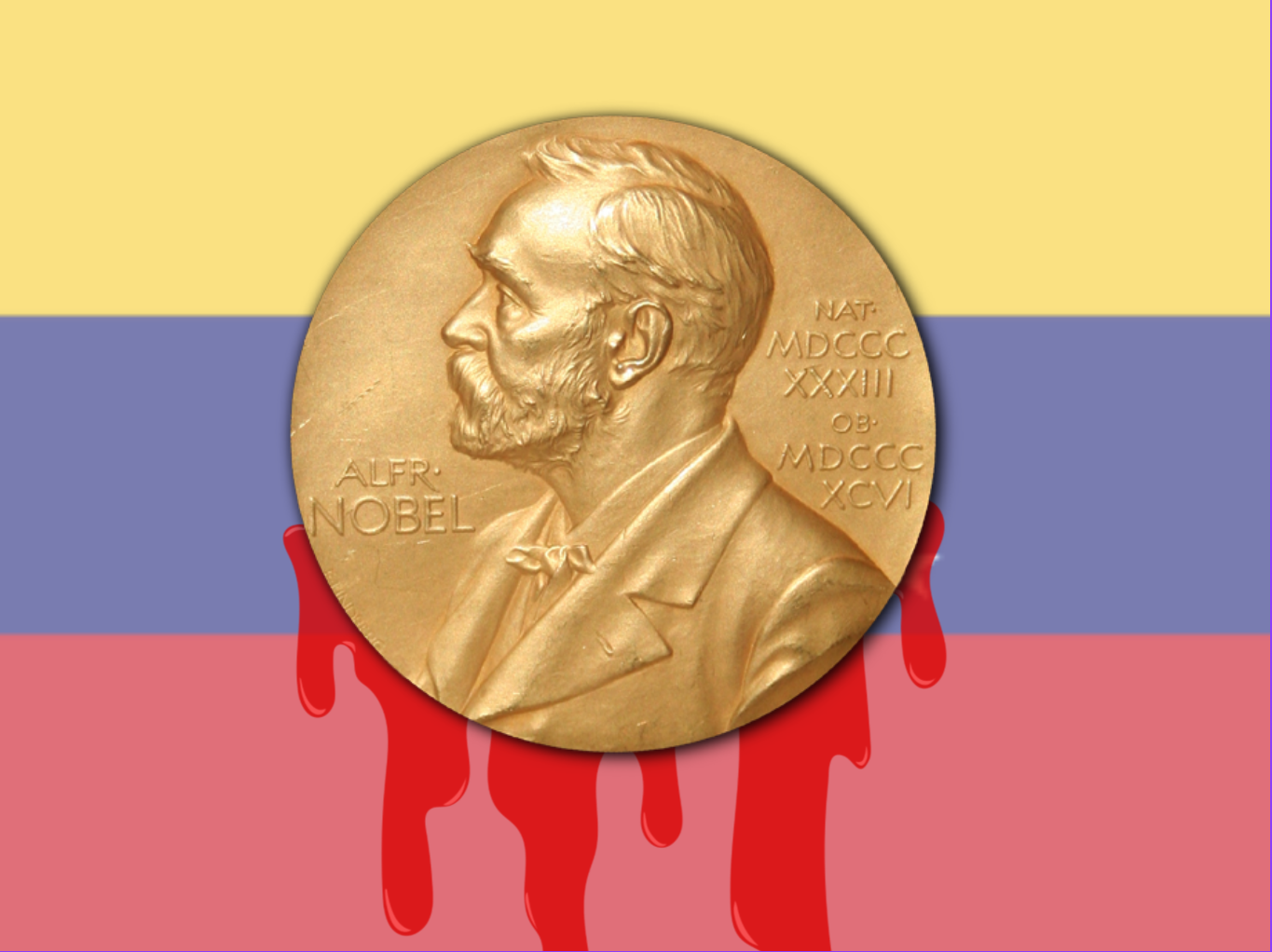
On October 10th, the 2025 Nobel Peace Prize was awarded to Venezuelan opposition leader María Corina Machado. Machado was described by the Norwegian Nobel Committee as “a brave and committed champion of peace,” who received the award due to “her struggle to achieve a just and peaceful transition from dictatorship to democracy.” She attempted to run against Venezuelan president Nicolas Maduro in the 2024 presidential election, but the Maduro regime voided her candidacy. Machado instead supported a fellow opposition figure, Edmundo González, who overwhelmingly won the election. Despite the victory, Maduro denied the results and has since clung to power.
Machado’s courage is certainly commendable, as the Committee has pointed out. Leading opposition efforts against the corrupt and authoritarian Maduro regime, especially given the consequences faced by many who dare to resist, requires extraordinary bravery. Her leadership has given hope to millions of Venezuelans suffering under devastating poverty and repression. However, the enemy of an enemy isn’t always a friend. While Machado may champion democracy, she does not do so peacefully—which constitutes an unfortunate yet not unheard of error by the Nobel Committee.
Backlash came from both sides of the aisle following the announcement of the 2025 prize. In Washington, the White House and other MAGA republicans publicly voiced their dismay that the award had not been given to US president Donald Trump. Conversely, many on the left were quick to label Machado as “right-wing,” drawing parallels to Trump-style populism and authoritarianism. Machado does advocate for liberal economic reform: the privatization of state enterprises, a free market, and a reduced social safety net—a sharp contrast to Maduro’s socialism—but she also has fairly relaxed stances on abortion and gay rights. Machado is definitely conservative, but not a hardliner. The real issue is not her ideological stance, but rather whether she actually represents peace.
Machado has explicitly and repeatedly called for US military intervention in Venezuela. In interviews following her Nobel win, she described Maduro's government as a "narco-terrorism structure,” echoing Trump’s claims that Maduro is perpetrating the flow of illicit drugs into the US. By awarding Machado in the name of peace, the Committee has legitimized Trump's escalating military operations in the Caribbean. This will only further embolden the US to continue the illegal strikes.
Machado’s call to action has certainly not fallen on deaf ears: in the weeks following her Nobel victory, Trump revealed that he had authorized the CIA to conduct covert operations inside Venezuela with the goal of forcefully removing Maduro. The White House also recently sent Congress a memo declaring a "non-international armed conflict" against unnamed drug cartels, effectively issuing a declaration of war. As such, the prize also validates Trump’s dangerous fiction of "peace through strength"—the idea that military might creates stability.
It can be argued that while Machado would probably be better for the future of Venezuela, she is still undeserving of the Nobel Peace Prize. Maduro's regime has driven over one-fifth of Venezuela's population out of the country, presided over economic collapse, and maintained power through election fraud and violent repression. True, Machado has articulated plans to address this devastation and restore democratic governance. But deserving democracy doesn't justify foreign invasion. And awarding a peace prize to someone actively advocating for violent regime change confirms a problematic and antiquated precedent: that democracy can and should be delivered from the barrel of an American gun.
How Tourism Made—and broke—Spain
Following the end of Francisco Franco’s dictatorship in 1975, Spain underwent immense change in just a generation. In 1982 Spain joined NATO, and four years later it joined the EU. Spain’s economy and culture was put on the global stage in rapid succession. Spain, which historically had been a country of emigration and poverty, transformed into one of Europe’s strongest and most important economic and cultural players.
One of the reasons behind this became the massive growth of Spain’s tourism sector, which had already begun at the end of Franquismo, and only continued to grow as the country became better integrated with the West. “Spain is different” became the slogan that drew in millions of tourists annually. The warm, dry Mediterranean climate led to massive growth in cities by the coast such as Málaga and Benidorm. The 1992 Olympics introduced the world to Barcelona, now a global hotspot for tourism. In 2023, 71% of the growth in the Spanish economy derived from tourism. In 2024, tourism accounted for roughly 15.6% of Spanish GDP. However, this economic miracle and tourism boom has not come without consequence.
Housing costs in Spain have reached a record high across many regions, and coupled with the continent wide cost of living crisis, this has made life increasingly unaffordable for many Spaniards. Wages, and hence prices, have historically been very low in Spain, incentivizing tourists from richer countries to visit and spend money. However, as many tourists take up housing via AirBnB or simply buying property, the cost of living (particularly housing) has shot up dramatically, whilst wages have not caught up. Locals have been priced out of cities like Barcelona, Málaga, and Madrid. Spaniards living in the Balearic or Canary islands, massive hotspots for tourism, have protested that their quality of life has deteriorated significantly and called for limits on tourist numbers. In Barcelona, protests made global headlines for throwing water on tourists and occupying luxury shops. Most Spaniards argue that tourism is not the problem in and of itself, but rather that mass tourism strips away their sense of community and ability to find affordable housing.
The current government of Spain led by center-left Pedro Sánchez has unveiled a plan to convert many short-term rentals into permanent rentals for Spaniards, especially young people and those wanting to start a family. However, critics of the plan question its constitutionality and lambast the government for not consulting Spain’s autonomous communities, which do the vast majority of management when it comes to tourism.
As Spain wraps up a year with a forecasted 100 million tourist arrivals, the nation stands at a crossroads. Tourism has undoubtedly fueled Spain’s rise as a global economic and cultural power, yet it now threatens the very communities that made the country so attractive in the first place. Balancing economic growth with sustainability and quality of life will determine whether Spain can continue to welcome the world without losing its soul.
No one wants to be the French Prime Minister
“One cannot serve as prime minister when the necessary conditions are not met.”
Former, now present, French Prime Minister Sébastien Lecornu made this remark on his short 26-day stint as prime minister in a resignation speech delivered on October 6th. He declared that his “mission is over” shortly after facing criticism for his ministerial lineup and in anticipation of a vote of no confidence led by the far-left France Unbowed party and the far-right National Rally.
Four days later, he was reappointed by Macron with a mandate to return to the role. Lecornu’s resignation made him the third French prime minister to leave office since December 2024. Lecornu’s reinstation illustrates the desperate attempt by President Emmanuel Macron to repair the volatile, divided state of French politics.
Macron’s decision to dissolve the National Assembly, the lower house of Parliament, and hold snap elections following his defeat in summer of 2024 has come back to haunt him. The result of the elections was a new parliament split into the left, center, and far-right, with no single group able to form a functioning government. This “hung parliament” has split the government between three ideologically opposed blocs, unable to compromise on France’s most pressing troubles, including the budget.
The budget problem has been the downfall for previous prime ministers Michel Barnier and François Bayrou. Under Bayrou, heavy cost-cutting measures were implemented that ultimately froze welfare, cut civil service jobs, and discarded two public holidays—all measures deeply reviled by the French. French debt currently amounts to 114% of GDP, with government spending high and the future of reforms, pensions, and the state of the historical French welfare system up in the air.
Already, Lecornu has made attempts to resolve the budget crisis in his second term as Prime Minister. In his reappointment, he declared that “we must put an end to this political crisis that exasperates the French people and to the instability that is harmful to France’s image and its interests.”
Lecornu suspended the 2023 pension reform on October 15th under great pressure while advocating for more cost-cutting measures, though the exact numbers are up for debate. These moves work against the far-right and far-left, who have threatened to vote against Lecornu, but won over leftist support from the Socialist Party, with the group starkly against the 2023 reform. The pension suspension was a rare compromise from the prime minister and Parliament, yet illustrated a last-ditch effort to allow Lecornu to stay in power and survive the no-confidence vote.
The institutional instability within parliament reflects wider than the National Assembly—it points to a weakened France, on both the European and world stage. Macron’s approval rating is at a record low of 14%, and his concession to the reform points to the end of Macronism and the collapse of his attempt to modernize France.
The revolving door of Prime Ministers makes this position appear to be a “curse” greater than that of just the national debt problem. The lack of cohesion and compromise amongst the parties makes solving the economic issue nearly impossible, with reforms unable to pass parliament. The internal disorder within French politics further reflects a growing issue in Western Europe of unpredictable, increasingly polarized and fragmented politics.
With vote of confidence after vote of confidence, and resignation after resignation, it is apparent—no one wants to be the French Prime Minister. Resolving the crises involves an uphill battle against the uncompromising political structure which no one seems able to face.
Perhaps in his second run as prime minister, Lecornu will get closer to resolving the issues.
Or, he may simply resign again.
A New Force for Haiti: Promise or Repetition?
As gang violence pushes Haiti to the brink of collapse, the UN’s new security force offers hope, while simultaneously reviving classic fears of foreign overreach.
On September 30, the United Nations Security Council approved a new international force for Haiti, a 5,550-member Gang Suppression Force (GSF) designed to confront the country’s current wave of gang violence and political collapse. The U.S.-backed resolution passed with 12 votes in favor and abstentions from China, Pakistan, and Russia, signaling widespread but hesitant support for another intervention in the Caribbean nation.
The GSF replaces the Kenya-led Multinational Security Support (MSS) mission, launched in 2023 but crippled by underfunding and restricted manpower. That smaller mission never managed to contain gangs that now control about 85 percent of Port-au-Prince. Haiti’s security vacuum has only expanded since the 2021 assassination of President Jovenel Moïse, leaving state institutions deadlocked and violence unchecked.
“The international community failed Haiti with [MSS]. It didn’t have the opportunity to demonstrate whether it was effective or not,” said an analyst with the International Crisis Group.
The new force will work closely with the Haitian National Police and armed forces to conduct intelligence-based operations, protect civilians, and secure key infrastructure. It will also have the power to detain suspected gang members, implementing a more aggressive mandate than its predecessor, the MSS. Alongside the force, the UN is establishing a Support Office in Haiti (UNSOH) to provide logistics, medical aid, and communications support.
More than 5,500 people were killed in gang-related violence in 2024, and nearly 1.3 million Haitians are displaced. The situation on the ground can best be described by the UN as a “multi-dimensional humanitarian emergency” as kidnappings, sexual violence, and food insecurity continue to spread.
The GSF brings hope, as officials from Washington to Nairobi describe the GSF as a “turning point.” U.S. Ambassador Mike Waltz said the mission is “five times the size of its predecessor,” while Haiti’s own UN representative, Ericq Pierre, called it “a decisive moment in the country’s fight for survival.”
But not everyone is convinced. And perhaps rightfully so. Haiti’s history with foreign forces, including a prior UN peacekeeping mission that introduced cholera and allegations of sexual abuse and rape from peacekeepers, has left deep mistrust in the international order.
The GSF thus represents both hope and hesitation: a chance to restore order, but also a reminder of how fragile international aid can be when it substitutes for local governance. Haiti’s future stability may depend less on the force’s strength than on whether it can eventually make itself unnecessary, leaving behind not occupation, but sovereignty.