

The Journal of Foreign Affairs at Carolina
Get the latest from our undergraduates at
The Column at JFAC
The Lights Went Out Again. What Else Is New?
The lights went out again. That’s not news. That’s just life in Cuba.
In Holguin and across the rest of the island, blackouts aren’t moments of crisis; they are part of the everyday life of a Cuban citizen. Power outages are so frequent that people no longer check when the electricity returns, but rather only when it goes. There is a kind of heartbreak that arises from watching your country on the brink of collapse, frozen in time, with no hope for things to improve.
But these outages are only one part of a much larger crisis. Today, Cuba faces a slow and exhausting emergency, shaped by a government that struggles to meet the population’s most basic needs and by outside pressures that make recovery even harder. This crisis reflects the reality of a system that no longer works, and the absence of any clear way out.
Collapse
Cuba’s economic collapse is not a temporary downturn; it is the result of long-standing problems shaped by central planning, missed chances at reform, and lost international support. The country has faced years of recession or near-zero growth. In 2024, Cuba’s economy shrank by an additional 1.1 percent to more than 10 percent below pre-pandemic levels. Core sectors including agriculture and energy continue to severely underperform, while productivity remains low and debt remains high. Reforms have been partial at best as the private sector remains constrained and state-run enterprises bloated and inefficient. These are not issues that can be resolved through a one-size-fits-all policy approach; Cuba’s economic structure is shaped by decades of centralized control, geopolitical isolation, and institutional rigidity. Solutions that may work in more open economies have failed. Effective reform requires not only economic recalibration, but political will, administrative capacity, and an institutional framework that does not currently exist.
The situation has been exacerbated by external factors: the collapse of the Soviet Union in the 1990s triggered a devastating contraction, and more recently, the economic crisis in Venezuela sharply reduced the oil and financial aid that Cuba once depended on. The COVID-19 pandemic further weakened tourism—one of the country’s key sources of income. As of 2025, Cuba faces acute fuel shortages, an unsustainable fiscal deficit, and rising inflation driven by excess money printing. Together, these pressures have left the government unable to guarantee food, energy, or basic public services. This is not just an economic downturn; it is a systemic failure. The state can no longer fulfill even its most basic responsibilities, and everyday life has become centered around scarcity, uncertainty, and survival. Without structural reform and access to external financing, Cuba’s economy is not positioned to recover. And while these conditions are felt most immediately in blackouts and shortages, they are signs of something deeper: a country running out of both options and time.
Scarcity
What might be considered an extraordinary crisis elsewhere has become the framework of ordinary existence in Cuba. Power cuts stretch for hours—sometimes more than a day, shutting off electricity, water, internet, refrigeration, and the ability to cook. People plan their day around what time they might have light or when the stove may work. Cuba produces only a fraction of the fuel it needs, and what it does have is low quality, damaging the aging power plants that continue breaking down. Emergency fuel deals with Russia, Mexico, and Turkish power ships have not fixed anything. Food and medicine are also difficult to procure. In March 2024, the government began rationing staples such as rice and milk and even turned to the World Food Programme for assistance in securing powdered milk. More often than not, pharmacies will have empty shelves, and when goods can be found, inflation ensures they are inaccessible. These shortages are not just a sign of an economy in trouble; they are a reminder of the difficulties of survival in Cuba.
However, this kind of deprivation does more than disrupt daily life; it changes how people think, feel, and plan. Families find themselves rationing not merely electricity or food, but also their own energy, patience, and hope. Over time, scarcity shapes how people anticipate their days, teaching them to expect interruption, instability, and loss. Plans become provisional. Joy becomes cautious. Even rest becomes something earned through exhaustion rather than something freely taken. The emotional cost is cumulative: a quiet heaviness that settles into households and becomes part of how life is understood. Within that accumulating heaviness, the limits of state capacity become increasingly visible. And in the long term, this erosion of public provision does not simply encourage outward migration; it constrains the possibilities people believe exist within the country itself.
Departure
Since 2022, more than 850,000 Cuban citizens have arrived in the United States. This wave is not an anomaly; it is the latest expression of a decades-long pattern of departure. From the Mariel boatlift to the Balsero crisis, migration has been a recurring response to national rupture. The departure of the Cuban people is less about a single trigger than it is about the slow erosion of what staying might mean. When scarcity and uncertainty define daily life, and efforts to speak out are met with repression, people begin to leave not out of sudden desperation but in quiet resignation. The state does not collapse all at once; it recedes, gradually. For many, leaving is no longer a dramatic rupture but the only option left. In fiscal year 2022 alone, Cuban nationals were intercepted at the U.S.–Mexico border nearly 225,000 times and interdicted at sea more than 6,000 times, exceeding the numbers seen during the 1980 Mariel boatlift and the 1994 Balsero exodus. Since the Cold War, Cubans have held a unique place in U.S. immigration policy, especially under the Cuban Adjustment Act of 1966, which allowed most arrivals to gain legal residency within a year. Although the repeal of the “wet foot, dry foot” policy in 2017 narrowed these privileges, Cubans continue to benefit from humanitarian parole pathways and reunification programs that highlight the lingering political weight of U.S.–Cuba relations. What emerges now is a national transformation through subtraction: fewer young professionals, fewer children enrolled in schools, fewer futures imagined on the island. This is not a temporary crisis.
Control and Isolation
Despite the weight of both external sanctions and internal breakdown, what ultimately defines the Cuban condition is not just hardship, but control. Cuba’s isolation is not accidental; it is preserved through state policy, censorship, and repression. Internet access is expensive, limited, and closely surveilled, with service blackouts routinely imposed during protests or politically sensitive moments. Independent journalism is criminalized, and dissent is often punished through arbitrary arrests, smear campaigns, and digital harassment. Activists and critics face systemic intimidation, as the government enforces strict limits on freedom of expression and assembly. Even basic survival is mediated through control. Citizens depend on la libreta, a monthly ration booklet distributed by the state, to receive staples like rice, beans, and oil. Acquiring these often means waiting in long lines for hours. Speaking out against this system has led many to exile or imprisonment. There is no room for criticism, only consequences.
In the end, yes, the lights went out again. But what else is new, when darkness has become the only thing the state can still guarantee?"
Germany: “Not at Peace but not at War”
Germany is at a crossroads. On September 29th, German Chancellor Friedrich Merz said that, “we are not at war, but we are no longer at peace either.”
The Russian invasion of Ukraine in 2022 was a harsh wake up call for the European Union and for individual states like Germany to push defense and security to the top of policy agendas.
Since September 2025, Russia has engaged in an increased amount of drone incursions into NATO airspace. In early October, it was suspected that Russia was sending drones into Germany specifically. These drone sightings led to the shutdown of Munich airport and brought security to the forefront of German political discussion.
Unlike other European Union and NATO countries that have strong militaries that can work within their countries, Germany is different. Currently, the country grapples with two problems.
First, the constitution that the German military follows was written after World War II. Given Germany’s history with the Nazi party, there is a specific clause that denotes that the military cannot take “a key role in the country’s internal security.” This puts Germany at an interesting crossroads because delineating what warrants internal security is murky. Furthermore, German police have the competency to shoot down these drones, but do not currently possess the technology. While the constitution could be amended, this requires a two-third majority in the government that currently seems improbable given weak coalitions.
Second, Germany aims to be a strong military power and meet its NATO active soldier requirement of 260,000 people by the early 2030s. Germany currently has only 183,000 people enlisted. To combat this gap, Germany has contended with the idea of conscription. Earlier this month, Germany decided that a mandatory questionnaire will be sent to all 18 year old men to gauge their willingness to join the military. This form will also be sent to women but will be optional. Additionally, all men who are 18 in July of 2027 will be required to go through a medical exam to test eligibility for duty. The intention behind these questionnaires is to have a list to refer to of eligible soldiers if war were to happen. A voluntary conscription model like this remains contentious for Germans.
As Russia continues to break boundaries and test the limits of its power, Germany must reassess its current framework and plan for a future that lies on a moving pendulum of war and peace.
The Diplomatic Decline of Mexico-Peru Relations
The recent decision by Peru’s Congress to declare Mexican President Claudia Sheinbaum persona non grata (PNG) is the most recent development in what has become a strained relationship between the nations. While labeling a head of state “unwelcome” is more symbolic than anything, it signifies a deteriorating diplomatic relationship.
Relations declined at the beginning of November as Peru’s former prime minister, Betssy Chávez, sought refuge in the Mexican embassy in Lima to request asylum. Peru’s former president Pedro Castillo went on trial in March 2025 and faced charges of rebellion, grave abuse of authority, and disrupting public peace. It’s clear that Peru’s new administration, having already tried Castillo, is now turning its attention to his former prime minister. Following her entry into the Mexican embassy, Peru’s foreign minister announced the immediate severance of diplomatic relations with Mexico. This step alone marks a significant split: full breaks in relations between Latin American neighbors are uncommon and usually reserved for extreme circumstances.
Then, just days later, Peru’s Congress escalated the conflict further by voting to declare Sheinbaum persona non grata. Lawmakers justified the decision by accusing Mexico of repeatedly interfering in Peru’s affairs, and pointed to Mexico’s willingness to grant asylum to high-profile Peruvian political figures. Some members even claimed Sheinbaum had ties to drug traffickers. However, no evidence was presented to back this claim. Mexico counters the allegations and maintains that its actions are consistent with international law.
This most recent development is not an isolated occurrence. The strain in Mexico-Peru relations stretches back to 2022, when Peru expelled the Mexican ambassador after Mexico granted asylum to Castillo’s wife and children following his impeachment and arrest. That moment marked the start of a downward trajectory that neither government has halted some three years later.
Taken together, the asylum disputes, diplomatic expulsions, and now the PNG announcement reflect a relationship rooted in ongoing disrepair rather than one disrupted by a recent break. With neither nation making an effort to rebuild trust, Mexico-Peru ties will continue to unravel and leave longer-term regional cooperation at risk. Such risk and isolation are the last things the states need to be dealing with, given that the Trump administration has injected uncertainty into the Western hemisphere, along with the world more broadly, since returning to office earlier this year. Instead, the nations should focus on where they can collaborate to solve mutual issues.
The New Age of US-Saudi Relations: A Tale of Corruption
Saudi Arabia’s crown prince Mohammed bin Salman (MBS) was welcomed with open arms to the White House last week, as he met with President Trump to discuss everything from US investment to nuclear energy. Trump and his team pulled out all the stops: red carpet, fighter jet flyover, military band, and a lavish dinner in the White House East Room attended by technology CEOs such as Tim Cook, Elon Musk, and Jensen Huang, among others. The embrace of MBS isn’t just another example of Trump’s transactional foreign policy. Against the backdrop of great power competition, corruption is hiding in plain sight.
There was certainly no shortage of moral compromises. Of course, Saudi Arabia’s horrendous human rights record was largely ignored or dismissed. The country is notorious for crackdowns on civil liberties, unfair trials and executions, forced labor, targeted surveillance, and discrimination against women. But even more blatant was Trump’s response to being pressed on the 2018 murder of Washington Post journalist Jamal Khashoggi, which was previously determined by US intelligence agencies to have been ordered by the crown prince himself. Trump referred to Khashoggi as “extremely controversial,” dishonestly insisting that MBS “knew nothing about it.”
If nothing else, it’s clear that the US has taken a sharp turn from its position 3 years ago, when the Biden administration was reconsidering the entire US-Saudi relationship due to what it perceived as unacceptable differences in values and interests.
The Trump administration also seems to be using a similar playbook that it uses for AI competition with China. The logic goes that if the US sells its top-end AI chips to China, such as those made by Nvidia and AMD, the Chinese will get hooked on American technology and thus become disincentivized to develop their own, leaving them reliant on the US. For Saudi Arabia, Trump announced that he would approve the sale of the F-35 fighter jet. Deepening defense ties with the Saudis is likely seen by the administration as a reliable hedge to China and Iran further asserting their own influence.
On the positive side, this approval might be representative of a loosening iron grip by Benjamin Netanyahu over American Middle East policy. Giving F-35s to Saudi Arabia challenges Israel’s regional military supremacy. Israeli officials have stated they would accept the sale if Saudi Arabia joined the Abraham Accords, but this is unlikely to happen. The Saudis have clearly stated they would only join the agreement to normalize relations with Israel if presented with a viable path to a two-state solution, which Israel firmly opposes.
Unfortunately, however, Saudi-China cooperation is already strong enough to create a potential pathway for technology transfer. Pulling Saudi Arabia towards the west in the context of competition with China won’t matter if they simply turn around and hand over the technology to China, which is exactly the situation that the US seeks to avoid. To get the deal done, these strategic concerns have been overlooked.
The justification for the strategic compromise isn’t easy to miss—just follow the money. MBS pledged upwards of $1 trillion of Saudi investment in the US, and the Trump family maintains active business relationships in Saudi Arabia. For example, MBS himself oversees a massive construction project that is in talks to include a Trump-branded property, according to the chief executive of a Saudi firm. In exchange, Trump delivered on the crown prince’s requests in terms of defense, economics, and regional security. It’s purely transactional, barely disguised quid pro quo.
Needless to say, money talks. But foreign policy should be dictated by American interests, not the Trump family’s interests. The administration’s pattern of tolerance (and even reverence) for autocracy and brutality has been clearly defined. American technology and defense industries will benefit handsomely from Saudi investment, but the Trump family's own financial ties to the kingdom reveal even deeper motivation. It’s the latest example of Trump’s transactional approach to foreign policy, but when it’s the family business that stands to benefit, it’s blatantly corrupt, too.
The Baseless Claims Behind the US v. Venezuelan Naval Feud
In August of 2025, President Donald Trump put out a $50 million bounty for anyone who can aid the arrest of Venezuelan President Nicolás Maduro. This reward comes after Trump’s Treasury office labeled “Cartel de los Soles” a terrorist organization. They claim Cartel de los Soles is allegedly headed by President Maduro. Confusingly, Cartel de los Soles isn’t a real organization; it is a term created by Venezuelan journalists in the 1990s to describe drug corruption amongst Venezuelan military leaders. The name ‘Cartel de los Soles’ translates to “Cartel of the Suns” in reference to the Venezuelan military leaders who wear suns on their uniforms much like American soldiers wear stars. The New York Times reports that the D.E.A.’s annual National Drug Threat Assessment has never mentioned the Cartel de los Soles, nor has the UN’s “World Drug Report.” It appears that the ‘terrorist organization’ worth 50 million of the US’s tax payer dollars is only real to journalists thirty years ago and Donald Trump.
Since August, Trump has deployed 15% of the U.S.’s naval power on Venezuelan coastlines. They have carried out 21 strikes on Venezuelan boats (killing 83 people) said to be carrying illegal drugs. The US claims to be motivated by a desire to rid the Western hemisphere of drug crime and corruption—ergo, to protect the US and its people from President Maduro’s poor presidency. In a press conference on October 15th, Trump made numerous dubious claims about the efficacy of the boat strikes. First, he claimed that the sinking of Venezuelan boats saved 100,000 American lives from fentanyl overdoses. PBS states that those claims are entirely baseless—there is no way to know how many lives might have been saved. They point out that if one follows Trump’s math, “...the strikes on five boats in less than two months would have saved nearly double the number of U.S. lives lost to drug overdoses in an entire year.” Even if one could calculate the amount of lives saved by these strikes, we still don’t even know if they were carrying drugs in the first place. No drugs are visible from the video footage of the sinkings, contrary to what the President claimed. In fact, most illicit fentanyl is smuggled in by US citizens from Mexico, not fishing boats off the coast of Venezuela. If it’s true that Trump really wants to protect US citizens from Maduro’s harmful policies, he might want to change his tactics from fear mongering and unnecessary demonstrations of force.
Although it’s true President Maduro isn’t unfamiliar with corruption, it is unclear if President Trump is the man to fix it. President Trump is reported by NPR to have stated, “I sort of made up my mind” about launching a future attack on Venezuela, as well as telling Fox News that, “We just have to take care of Venezuela”. With the future of peace in South America looking unsure, Americans and Venezuelans alike must pay attention to this sensitive issue.
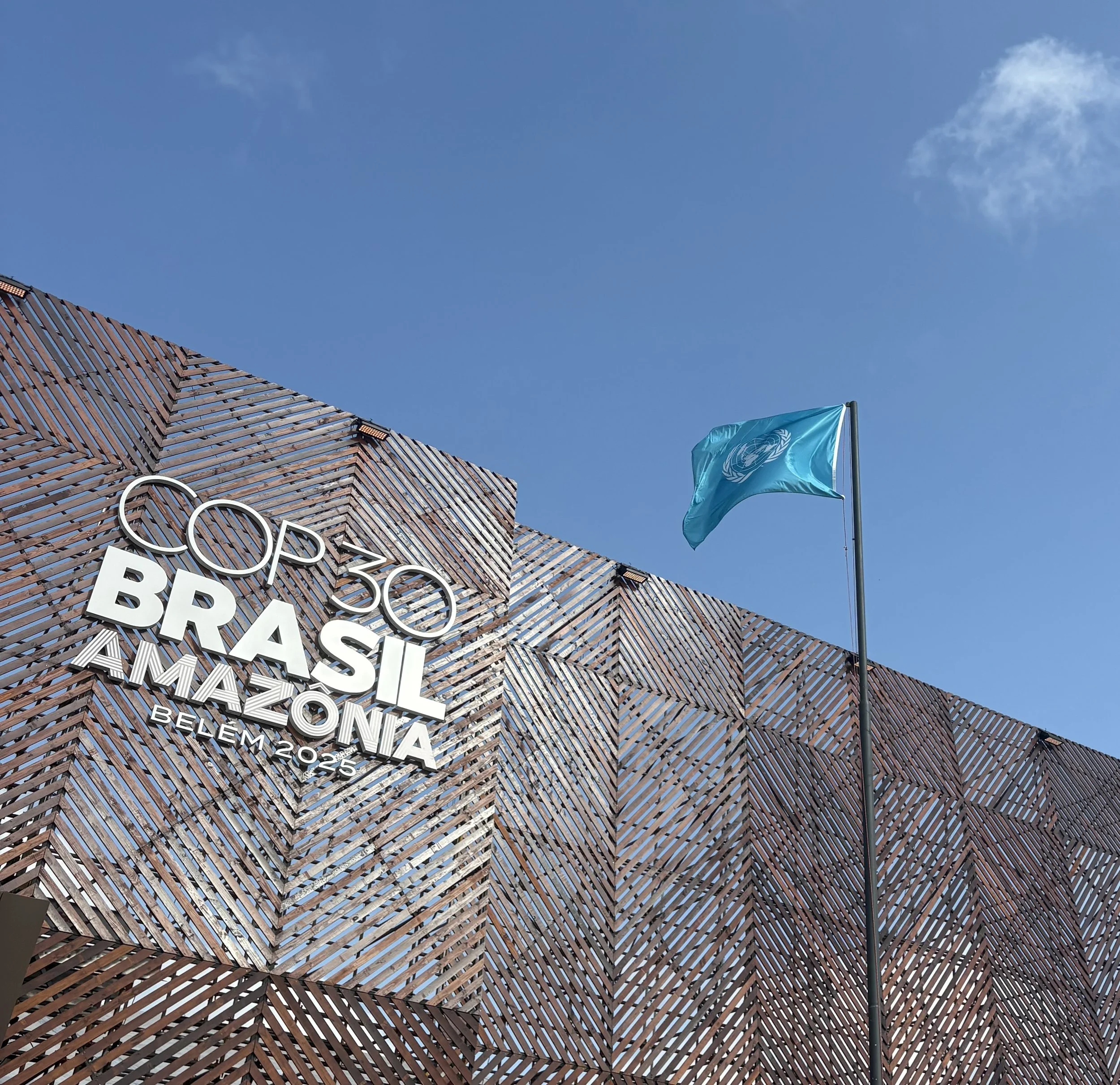
Fieldnotes from COP 30: Negotiations and Strategies
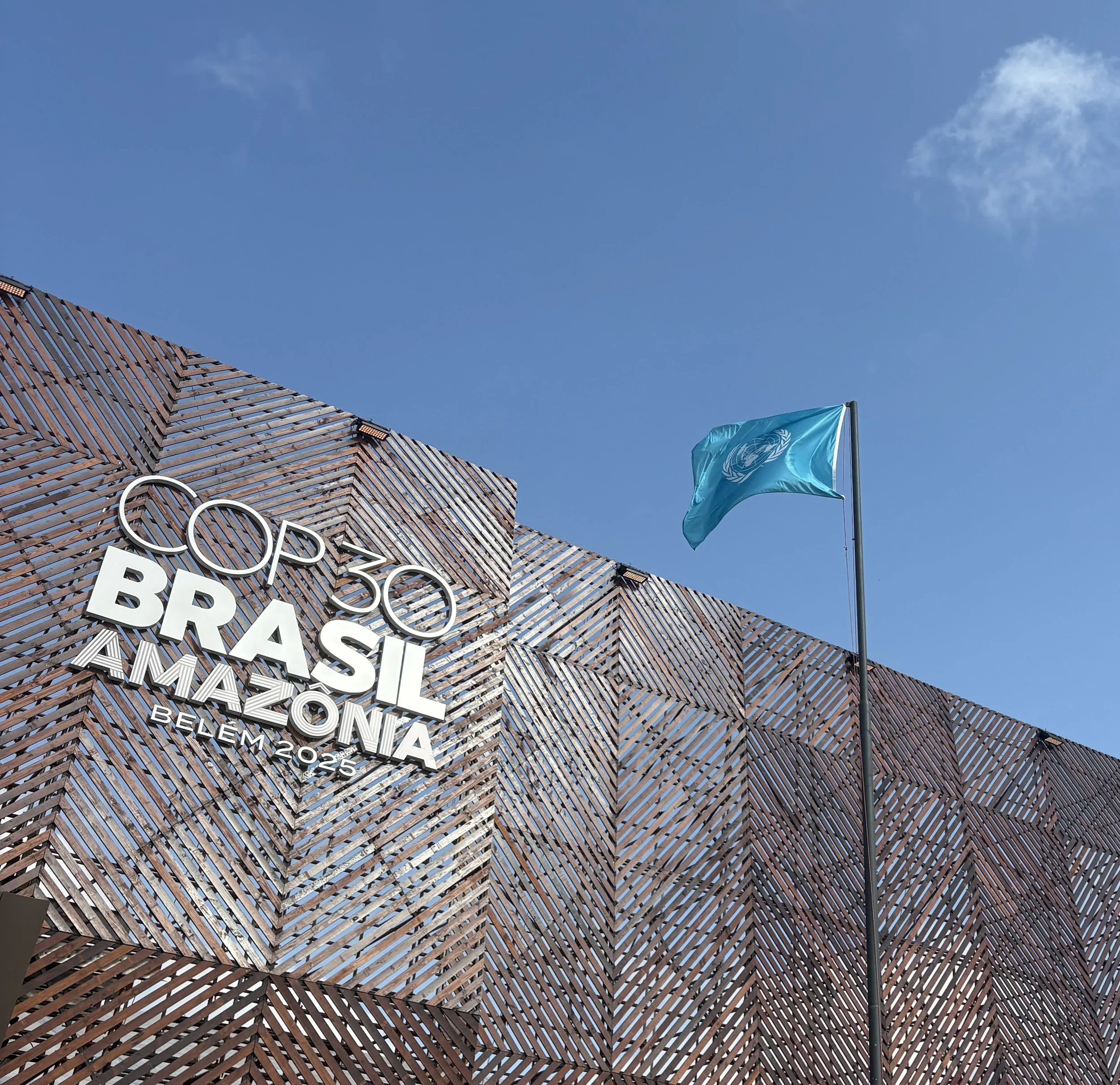
Photo by Carlisle Shore.
This past week, I was given the privilege of serving as a student delegate for UNC-Chapel Hill at the COP 30 climate change conference. Stomaching the irony of the carbon emissions from my trip, I flew to Belém, Brazil, and picked up my observer badge. This badge allowed me access to the venue with the country and NGO pavilions, where different groups held talks about their role in the climate crisis, and also gave me access to what I was most excited about: the negotiation rooms.
COP 30 has gone by many names: the Amazon COP, the Adaptation COP, and finally, the Implementation COP. This last name reflects the COP presidency’s efforts to move COP away from its reputation of being all talk, talk about future talk, and very little action.
Unlike previous COPs, there were no anticipated cover decisions. Instead, negotiators waded through a medley of ongoing dialogues: operationalizing a global goal on adaptation, advancing the Just Transition Work Program, building a functional global carbon market, discussing reforms to the COP process, and more. While not formally on the agenda, the presidency also grouped four key topics—unilateral trade, climate finance, emissions reporting, and ambition through Nationally Determined Contributions (NDCs), which is essentially each country’s emissions reduction goal.
In the spirit of an “Implementation COP”, I tried to follow negotiations about actionable steps toward achieving NDCs, steps that could help us collectively push down the temperature overshoot curve closer to the 1.5C °C warming goal that underpins the 2015 Paris Agreement.
The main threads I followed were:
A) The UAE dialogue on utilizing recommendations from the Global Stocktake (GST), the UN’s tool for assessing collective climate progress, to achieve climate finance and inform NDCs —well, depending on who you're talking to.
B) The Sharm el-Sheikh Mitigation Work Program, which aims to scale up mitigation ambition through finance access, capacity building, and technology transfer. It also provides a platform to discuss a range of topics such as the just transition and circular economies by holding at least two global dialogues per year.
C) Debates over the harmonization of Article 9.1 of the Paris Agreement and Article 2.1(c). Article 9.1 obligates developed countries to provide financial resources to developing countries, while 2.1(c)calls for aligning “financial flows” with low-emissions, climate-resilient development. These talks followed the COP 29 promise to chart a strategy to deliver $1.3 trillion annually in climate finance to developing countries. Much of the debate centered on concerns that sovereign finance (the historical reading of Article 9.1) could be diluted by a new reliance on private finance, which comes with higher interest rates and choosy lending. In my view, a tiered strategy using both streams is necessary. We need a lot of everything—urgently.
The negotiations, admittedly, are highly procedural, chock full of legalese, and often hard to follow. So instead of trying to decode every clause, I started watching the strategies and hunting for subtext. I figured if you are reading the Journal of Foreign Affairs at Carolina, or have even made it this far, you likely have an interest in diplomacy, so below are some of the strategies I saw play out in the rooms.
#1 Grounding. When discussions got lost in procedural weeds—debating whether something belonged in a dialogue or an informal note, or whether it was even in scope—a party (often a Small Island State, mountain nation, or another climate-vulnerable country) would intervene with a sobering reminder of what’s at stake: sea-level rise, displacement, and other looming realities. This often encouraged concessions or raised ambition.
#2 Interests, not Issues: At one point, the Chinese delegation urged countries to speak more directly about their underlying interests rather than hide behind critiques of wording or procedure.
#3 Discrediting Institutions: Questioning the accuracy and composition of structures within the UNFCCC, to delegitimize their recommendations or authority. For example, in negotiations of the Research and Systematic Observations workstream, Saudi Arabia proposed that IPCCC, the UNC scientific body on climate change, should be substituted or complemented with other “accredited scientific agencies.” Delegates I spoke with viewed this as an attempt to bring in research friendlier to delaying fossil fuel phase-outs or over-relying on carbon capture.
#4 Emphasizing Agreements: Conflict remediation 101, but focusing on what you all agree on first and throwing in a small critique or disagreement at the end of the intervention. Like grounding, it brings the room back to a shared purpose.
#5: Mandate, Mandate, Mandate: Constant references to the official mandate were used to dismiss attempts to expand the scope of discussion. This “anti-ballooning” tactic was sometimes strategic, but often seemed like a good-faith effort to keep negotiations focused and avoid overlap with other workstreams.
#6 Running with the Omitted: Parties often leveraged what wasn’t said. If a topic wasn’t explicitly mentioned, some used that omission as grounds for consensus or as space to introduce an interpretation favorable to their interests.
#7 Backdoor Deals: Many agreements are often hashed out before setting foot into the negotiation room. One of the (many) complaints surrounding the US delegation’s absence was the reduced pressure for behind-the-scenes compromises—something for which they were notorious. For example, while standing outside of the negotiation rooms, I saw the UK delegate tap the shoulder of an Italian EU negotiator, verifying they were going to make good on their deal.
#8 Metaphors: This differed by the individual negotiator, but some favored elaborate metaphors over straightforward interventions. For example, one Chinese negotiator compared the presidency’s four key topics to “something old, something new, something borrowed, something blue.”
The list is far from exhaustive. With limited floor time, every word is strategic. At times, the negotiations felt divided and disheartening, but it helped to remember that climate change is a collective action problem. COP negotiations are not peace treaties. While pathways and responsibilities are contentious, the desired outcome—a liveable future—is universally agreed upon.
With Over 130 Brazilians Dead, It is Time to Rethink Drug Raids
In the early hours of October 28th, over 2,500 Brazilian police and soldiers launched the largest drug raid ever before in Rio de Janeiro. The raid targeted the criminal group, the Red Command, in the favelas of Complexo de Alemao and Penha. While 81 arrests were made, along with the seizure of over 90 rifles and a half ton of drugs, it came at a horrifying cost—the deaths of over 130 people.
Though the raid is being touted as a “historic day” in “[confronting] organized crime” by
Rio’s Governor, Claudio Castro, the United Nations and human rights watch groups have issued statements condemning the raid.
Local activist Raull Santiago described the scene as a “massacre”—“We saw executed people: shot in the back, shots to the head, stab wounds, people tied up.” Many others have described the burning barricades of buses and explosions of drone bombs as “war-like.” Streets were closed, public transportation was shut down, and 46 schools and the Federal University of Rio de Janeiro canceled classes in its wake.
In addition to the moral considerations of such operations, their effectiveness must also be questioned. The director of Human Rights Watch in Brazil, César Muñoz, attacked the police, arguing that these operations “... do not result in greater safety for the population, but that in fact cause insecurity”.
Luis Flavio Sapori, a sociologist and public safety expert at Pontifical Catholic University of Minas Gerais, argues that these operations are wasteful. Rather than the masterminds behind the drug operations, these operations target easily replaceable low-ranking members, all while creating unnecessary losses and putting residents in harm's way.
The Marielle Franco Institute, created in honor of politician and activist Marielle Franco, which aims to fight for the rights of poor residents of the favelas, also criticized the raid, stating: “This is not a public safety policy. It’s a policy of extermination that makes the everyday life of Black and poor people a Russian roulette”.
Although the Brazilian Supreme Court's 2020 decision has led to a drop in cases of police violence, this raid has made it clear to many that policies must be put into place to protect the lives of residents and prevent the taking of any more lives.
A European Narcostate? Belgium’s failed war on Drugs
When one thinks of Belgium, images of waffles and dutch-french language squabbles may come to mind. Brussels, the political capital of Europe and home to the EU and NATO, amongst countless other international organizations, defines much of the country as well. However, one would seldom think that Belgium has become the epicenter for drug trafficking on the European continent. Belgian ports have surpassed historically popular ports in the Netherlands and Spain in terms of illegal drugs seized. Meanwhile, just miles away from the headquarters of EU institutions, turf wars and shootings play out in Molenbeek, a neighborhood in Brussels. Belgium’s logistical interconnectivity has made it prone to trafficking, and there has been a consequential rise in recent years that has made the port of Antwerp the EU port with the most illicit material seized in 2022 (111 tonnes) and 2023 (116 tonnes). To put it into perspective, that is well over double the entirety of cocaine seized at ports throughout the U.S. in 2023.
Historically, illicit drugs have entered Europe through Spanish and Portuguese ports. Though both are still popular destinations for trafficking, the rise in Belgium’s status is due to Antwerp’s massive port volume as well as tightening security on the Iberian Peninsula. Cocaine makes up the vast majority of drugs trafficked into Europe, accounting for 82% of total seizures. Marijuana seizures are less common, due to both relaxing laws and social attitudes towards the drug, making the drug a distant second and even less common in Dutch and Belgian ports.
Cocaine trafficking in Belgium has gotten so bad that a judge in Antwerp, who had been living in a safe house for four months, warned in an anonymous letter that “extensive mafia-like structures“ are taking hold of the judiciary in Belgium. The judge argues that organized crime has infiltrated the legal system, and is pushing for legislation that lets the judges work anonymously, amongst other reforms. This judge is not an alarmist, as many may think. Brussels is experiencing a wave of drug-related crime, most notably shootings. The issue has gotten so bad that Belgium’s Interior Minister has signaled that he wants to bring in the army to the streets of Brussels. With more than 60 shootings occurring so far in 2025, many would argue that this is a necessary step to combat the dramatic escalation in violence in Europe’s de-facto capital.
Belgium’s emergence as Europe’s new hub for drug trafficking has intensified criticisms of the country’s governance. Belgium’s famously complex political system creates chronic coordination problems that drug networks have been quick to exploit. Many argue that this fragmentation has produced a state apparatus that is often too slow, too divided, and too under-resourced to respond effectively to evolving criminal structures. The warnings from Antwerp’s judiciary, the spike in drug-related shootings in the capital, and even proposals to deploy the army all highlight a deeper sense that Belgium’s institutions are struggling to keep up. As trafficking surges and violence spreads, the country’s paralysis has become a liability that threatens both the Belgian state and Europe as a whole.
Hurricane Melissa: A test for Trump's foreign aid cuts
The Category 5 Hurricane Melissa made landfall in Jamaica on October 28th, wreaking havoc on the Caribbean throughout the following days. Widespread damage, flooding, evacuations, and fatalities were reported across the Dominican Republic, Haiti, Jamaica, Cuba, and Turks and Caicos. The US government quickly responded, pledging to provide $24 million for rescue and relief efforts. The State Department also sent Disaster Assistance Response Teams (DART) to multiple countries and deployed additional search and rescue teams to Jamaica.
In comparison to the Trump administration’s subdued response to other significant natural disasters, such as the catastrophic earthquake in Myanmar, support for Jamaica appears impressive thus far. However, real humanitarian success is determined over months and years of sustained engagement—in other words, not merely by rebuilding, but by building better. The initial $24 million proves little about US commitment. With a gutted foreign aid infrastructure, Hurricane Melissa will be a true test of whether or not that’s still possible.
Previously, the US Agency for International Development (USAID) would have run point on post-disaster relief and rebuilding. But after seeing its workforce collapse and more than $1 billion in funding terminated due to Trump’s cuts, the State Department inherited its remnants. USAID was by no means a perfect mechanism, but it could guarantee a level of consistency in humanitarian response capacity which is now frighteningly uncertain. While the initial deployment of DART proves that disaster response is still operationally intact, sustained capacity with fewer personnel and resources remains unproven.
Jamaica presents an ideal test case for other reasons, too. While the Caribbean is highly vulnerable to hurricanes and other climate-related disasters, Jamaica stands out as a model of good governance and climate preparedness. Through fiscal reform, innovation in risk financing, and climate-smart policies, Jamaica has exceeded every expectation for a developing nation. It should be able to rely on the international system that it has dutifully bought into to respond, including the United States.
The participation of the US in Jamaica’s rebuilding would not be charity work, but rather shared investment. Sustained recovery efforts could eventually attract the US private sector to fulfill massive infrastructure needs, if the proper mechanism to coordinate such efforts over time exists. US companies can help to provide sustainable development through public-private partnerships, local equity participation, and multilateral development banks.
But before any of that can happen, the basic needs of Jamaicans will need to be restored. Thousands are desperate for aid in remote and rural parts of the island where hurricane damage has destroyed the already limited infrastructure. This is where international organizations, in coordination with the US government, must step in. However, the lingering question is one of feasibility, as experts predict that the NGO response will be weaker following foreign aid cuts that left many US NGO partners with only half of their previous workforces.
If the US foreign aid system can still effectively support relief and reconstruction efforts in the long term with fewer employees and less funding, it would have to be considered a win. There is no reason that a simple cost-benefit analysis cannot be applied to our aid efforts—any lessening of the burden on the American taxpayer without a reduction in capacity is objectively a positive. However, if Melissa turns out to be too much for the US to handle, the seemingly reckless cuts will have proven to be, well, reckless.
Europe's Latin American Pivot: Strategic Autonomy in a US-China World
In the shifting structure of global power, Europe’s pivot towards Latin America represents more than a regional flirtation. It is a calculated stride toward strategic autonomy. The European Union and its Latin American counterparts have identified a shared latitude in resisting over-dependence on the dominant axes of the U.S.–China competition. Europe realises that its historical alignment with the U.S. does not guarantee permanent protection or influence anymore. A recent analysis points out that the United States is less committed to Europe’s security architecture than in previous eras, creating impetus for Europe to carve out its own path. Latin America is no longer a passive appendage to U.S. hegemony or exclusively a playground for Chinese infrastructure policies as the region itself seeks alternative partnerships and diversification.
Consequently, the Europe-Latin America axis becomes a deliberate vector of value-based cooperation. The EU’s orientation is not merely about countering China in South America, but about building a relationship based on shared values and interests rather than a zero-sum game between Washington and Beijing. The recent events of bi-regional diplomacy, for example the EU–Mercosur agreement, reflects this intention to deepen economic ties outside the immediate orbit of global forces. Yet, there is tension between this intention and structural realities. Europe remains, in many ways, institutionally and militarily embedded within the U.S. system, limiting the scope of full autonomy. Latin America, far from homogeneous, exhibits diverse alignments, internal political shifts, and lingering dependency on external capital flows, making the building of a European pivot less straightforward than the rhetoric may suggest.
Ultimately, Europe’s Latin American pivot should be seen not as a grand counter-alliance, but as a calculated sidestep: extending influence, diversifying partnerships, and hedging between global powers. Its success will depend on how deeply and transparently Europe can deliver value to Latin American countries in infrastructure, digital transition, and sustainable investment without reinscribing old patterns of dependency, and whether Latin American states embrace a partnership that is meaningful beyond symbolism. If achieved, this alignment could become a pragmatic expression of Europe’s aspiration to find a more independent role in a US–China world.
“The COP Cop-out:” The U.S. and the COP30 Convention
The United Nations’ annual climate change conference, “COP30,” opened on November 10th, and is set to finish two weeks later on November 21st. This year, the conference is in the Brazilian Amazon city of Belém and marks the 30th meeting of the parties to the UN Framework Convention on Climate Change (UNFCCC).
Things feel a little different this year. Maybe it’s the absence of some of the most prominent senior-level global leaders, who serve as representatives of some of the world’s biggest polluters, namely those of the United States, China and India.
This year is less about climate ideas and more about climate action. COP30 leaders want this summit to be one of “implementation and adaptation,” with a focus on agreeing upon climate-finance goals. At the same time, 2025 is on track to be one of the hottest years on record, and the planet is increasingly approaching the Paris Agreement’s warming threshold.
Since Trump’s first term in office, the United States has been increasingly uninvolved in climate-centered discussion unless the topic involves halting plans for climate action. Beyond pulling out of the Paris Agreement (twice), the United States has stalled talks on a plastics treaty, pressured Europe to abandon green policies, and derailed a landmark deal on international shipping.
Back in October, Trump threatened countries supporting a largely uncontroversial International Maritime Organization (IMO) measure to cut greenhouse-gas emissions from shipping. The Trump administration framed the pursuit as “misguided” and driven by “climate alarmism.” These threats, including potential visa cuts and sanctions on supporters, worked. The IMO, concerned with protecting its relationship with the United States, failed to adopt this agreement.
It wasn’t always this way.
A well-known photo of a large group of world leaders—too many to fit in one frame—shows the once-united stance of those in positions of power on combatting global warming. In the photo, Presidents Obama, Modi, Putin, and Xi stand in front of the large sign at the 2015 COP summit in Paris. That photo now feels like a relic. The new White House position is that the U.S. can leave any agreement that does not “reflect our country’s values or our contributions to the pursuit of economic and environmental objectives.”
Trump’s decision to skip COP30, along with the absence of any high-level White House figure, illustrates an utter disregard for climate change and reaffirms the administration’s negative stance on climate politics. To the Trump administration, it is all about who captures and controls the economic benefits of a green transition. China is currently the clear driver of this renewable-energy boom. Trump has attempted to get his foot in the door with fossil-fuel interests through bilateral talks with India.
The absence of any high-level official from Washington at the COP demonstrates Trump’s preference for bilateral deals and his disregard for multilateralism, including that required by the UNFCCC. It also raises questions about the effectiveness of COP. Without some of the world’s greatest financiers and emitters of fossil fuel, what exactly can COP achieve? Few countries want to risk getting on the wrong side of the United States, given the history of Trump’s tariff policies. To cut global emissions, the U.S. will need to eventually step up, as will the other G20 countries that produce 80 percent of emissions.
Out of the large shadow of the United States comes the smaller nations, particularly voices from key stakeholders and countries most impacted by climate change, such as the Alliance of Small Island States and the G77+China bloc. Still, some Americans, including about 100 state and local leaders, are in attendance, breaking with President Trump’s insistence that climate change is “the greatest con job ever perpetrated on the world.”
America’s Got Protests (And a Killer Soundtrack)
“You’re listening to Easy 182, the smoothest grooves for your commute…
[static crackle]
We interrupt this track with something you won’t find on the charts.
Today’s programming is brought to you by America’s greatest protest and its killer soundtrack.”
Politics is always playing in the background of our daily lives, sometimes with static, sometimes sharp and clear.
So when people say, "everything is political," what comes to mind? Maybe your instinct is to roll your eyes. Everything? Really? But pause. Think again. Politics isn’t just about Capitol Hill or campaign ads. It’s in the news we scroll past, the films we quote, the memes we share, and, most strikingly, the music we blast through our headphones. Politics isn’t an accessory to life; it’s a part of its everyday fabric.
And music? Music turns political pain into emotional depth. It transforms struggle into something people can not only hear but feel. It becomes a form of protest in rhythm, a resistance in melody. It cuts across lines of gender, race, class. It doesn’t shout from a podium; it tells stories, builds solidarity, and lets us breathe through the heaviness that surrounds us in moments of anguish. It shows up everywhere: in the soaring gospel choirs of the Civil Rights era, in the snarling riffs of punk rock, in the relentless beats of trap that echo through car windows and cracked phone screens.
Music and protest have always been bedfellows. Even before Spotify algorithms could slot protest songs into curated playlists, music has given voice to the moment of political change. During the Revolutionary War, protest songs borrowed church hymn melodies to ignite anti-colonial spirit. In the 19th century, abolitionists turned ballads into abolition manifestos while Civil War soldiers marched to tunes that questioned the nation’s soul.
Fast forward to the early 20th century, with union halls echoing with labor anthems demanding justice, dignity, and fair pay. Then, in the 1960s, the Civil Rights Movement gave rise to a soundtrack of resilience, from the spirituals sung on bus boycotts to the folk ballads strummed on protest stages. Music wasn’t background noise; it was armor for people who were an afterthought to the country. Those in need of being heard found a voice through music.
By the Vietnam era, protest music took a more visible, radio-ready form. Artists like Marvin Gaye and Bob Dylan weren’t just topping charts: they were questioning wars, policies, and public conscience.
Into the late 20th and 21st centuries, the genres diversified, but the mission remained. Punk screamed about institutional rot, rap narrated systemic injustice, and even pop started getting politically candid. From Kendrick Lamar to Billie Eilish, protest now lives in autotune as much as in acoustic strums.
Take country music. It's often overlooked as protest music, yet historically, it has expressed working-class frustration, rural marginalization, and distrust of elites. But something shifted after 9/11. Patriotism turned into nationalism, and the mainstream country sound followed. Songs like Toby Keith’s "Courtesy of the Red, White and Blue" and Darryl Worley’s "Have You Forgotten?" weren’t just about pride, they were about drawing lines between us and them. The drawing of these lines further exacerbated a rhetoric that was destructive as much it was divisive, one that redefined national identity not by shared values, but by exclusion, suspicion, and the silence of dissent.
According to political psychologists Li and Brewer, this is what we call "essentialist patriotism": a form of national pride that defines "American" by culture, language, and exclusion. Their research, conducted right after 9/11, found that this form of patriotism is tightly linked to lower tolerance for diversity and greater support for militaristic policies. When unity is defined by similarity, nationalism thrives, but inclusivity suffers. This brand of patriotism doesn’t invite conversation; it demands conformity. It’s the kind of nationalism that waves a flag not as a symbol of unity but as a litmus test for loyalty. And when dissent is reframed as disloyalty, protest becomes suspect, and protest music becomes subversive, not celebrated. In this environment, art that questions power isn’t just marginalized; it’s actively policed. Essentialist patriotism creates a cultural mood where discomfort with difference isn’t just tolerated, it’s endorsed. It legitimizes a political climate where policies are passed not to protect but to purify, and where “real Americans” becomes a shrinking category.
But not all genres sang in step. While country music leaned toward unity-through-pride, hip-hop emerged as a space for counter-narratives. Artists like Mos Def and Immortal Technique weren’t just criticizing U.S. foreign policy, they were redefining what it means to love your country. Love, in their lyrics, meant accountability. Justice. A refusal to accept sanitized versions of truth. Scholar Edward Clough argues that music isn’t just a vessel for protest, it is protest. It doesn’t wait for permission. It bleeds into both public squares and private earbuds, offering communities a language for grief, anger, and survival. Songs don’t just reflect politics. They predict, respond, and often outpace it. Before the mainstream media caught up, protest music was already doing triage on national trauma. It was the siren and the balm. Shaping how we see the world and how we imagine something better. Today’s time reflects a form pop activism is layered with identity politics, who you are, where you’re from, and what you carry.
Music has become both a form protest and a form of healing. So the next time the radio cuts to static, listen closely. Because that interruption? Might be the realest track you hear all day.
A Long Awaited Reform: France’s Amended Rape Law
In September of 2024, Gisele Pelicot became a global figure and women’s rights icon during her trial against her now former husband Dominique Pelicot and 50 other men. For nearly a decade during their marriage, Dominique had drugged Gisele and invited numerous men to rape her while she was unconscious. Dominique was sentenced to 20 years for aggravated rape, with 46 men guilty of rape, 2 of attempted rape, and 2 of sexual assault.
During this case, rape and sexual abuse in France was characterized as any form of sexual penetration using violence, coercion, threat or surprise. The lack of consent mentioned in the law was used as defense for Dominique and his co-defendants, as they were supposedly unaware that Gisele had not given her consent; therefore, the sexual acts could not constitute rape.
In response to this claim, France has now amended the law such that consent cannot be presumed from silence or no response. While seen as a triumph for many, this amendment also comes with many negative implications. Many fear that this could make it harder for victims to achieve justice because they would have to prove nonconsent, rather than focusing on the violence instigated by perpetrators. Nevertheless, this historic change is still touted as a step in the right direction to change a culture of taking advantage of women long steeped in French society.
France has more than 230,000 sexual violence incidents per year, but only 8,000 result in convictions. The drastically low amount of convictions highlights the inability of France’s justice system to make meaningful progress towards gender-based sexual violence justice. One could even argue that the low amount of convictions fosters rape culture, as perpetrators are aware of the low probability that they will be convicted.
In 2017, the French Supreme Court ruled that a case involving 20 emergency service workers who had repeatedly had sex with a young girl when she was between 13 and 15 years old did not constitute rape. The court concluded that Julie, the pseudonym of the girl, had a flirtatious attitude, and there was no proof she was compelled to have sex. Despite the fact that Julie had not given consent and was underage, she was not protected to any extent by French law in this case, and only three of her rapists were charged with sexual abuse. The perpetuation of harmful gender stereotypes, misogyny, and the complete inability of France to protect its youth drew outcry for an age of consent to be enshrined into law.
In order for more victims to feel comfortable speaking out and for perpetrators to receive the sentences they deserve, it is vital that France to continues to reevaluate its laws and implement more policies eradicating sexual violence as a whole. This already overdue change is an important step in the right direction, but the fact that it required the MeToo Movement and a landmark rape case for France to come to this point is concerning for many French citizens and women.
Truce in Korea Signals U.S. Capitulation After Tariff—Proof China Withstands Pressure
Early on the morning of Thursday, October 30th, President Trump and Xi Jinping met in South Korea, marking the first in-person meeting between the two in the new administration. The meeting resulted in a truce, widely seen as a massive victory for China, as the U.S. conceded a major reduction in tariffs, suspended all port fees on Chinese ships, and delayed U.S. initiatives that would have blocked Chinese firms from accessing U.S. technology. American concessions stemmed from Chinese countermeasures, which included comprehensive quotas on industries that could impair key U.S. industries. For the first time, China walked into negotiations with leverage, having proven their ability to stand up to American attacks. The truce in South Korea was a direct result of the U.S. having overestimated the impacts of its tariffs, and China expertly working around tariffs to strengthen its position in the global economy.
Despite trade tensions, the Chinese economy has flourished over the last year, experiencing a 5.3% growth in GDP, funded primarily by, shockingly, stability in exports. While the U.S. share as a whole of Chinese exports has decreased by over 30% over the course of the current Trump administration, overall Chinese exports have stayed stable. Simply put, when the U.S. reduced its purchases of Chinese goods, China looked elsewhere. The decrease of $14 billion in Chinese exports to the U.S. has seen a complementary $7 billion increase in Chinese exports to ASEAN countries (who often pass the goods on to the U.S.). This was not just a drastic reduction; it was a methodical diversification that fundamentally altered the beneficiaries of the trade war.
While exports have not had quite the negative impact that the U.S. anticipated, they have still resulted in a decrease in the acceleration rate of exports. Therefore, China has been forced to adapt and utilize domestic policy to insulate its economy from the potentially disastrous impacts of a trade war. In response to tariffs, Beijing deployed a full array of monetary and fiscal policies to allocate key resources to domestic industries, aimed at boosting domestic consumption and maintaining the stability of supply chains—a pivot from the traditional Chinese economic model of investment-fueled growth. Beijing, fueled by the trade war, is now shifting from this method and moving to technological self-sufficiency and strategic security over the old pursuit of growth at any cost.
This shift is precisely what gave China its leverage in trade talks. The transition of exports to ASEAN countries and adjustment in Chinese policy muffled the impact of American tariffs and proved that China could withstand the economic attacks. Furthermore, its dominance in refinement of the rare earth minerals essential for U.S. tech and defense provided a powerful counter-weapon, which it used to force the U.S. into concessions on technological access.
The meeting in South Korea proved less of a negotiation than framed, and more of a capitulation. American concession served as a quiet admission that their primary economic weapon could be flawed. By methodically rerouting its economy, insulating domestic markets, and sharpening counter-weapons, Beijing has so far proven that it can not only survive a trade war, but win it.
Sudan’s Forgotten Catastrophe Reignites as El Fasher Falls to RSF Forces
After more than 500 days under siege, El Fasher, the capital city of North Darfur, has fallen. Just last month, the paramilitary group Rapid Support Forces (RSF) seized control of El Fasher from the Sudanese Armed Forces (SAF). Tens of thousands of civilians endure starvation and sexual violence, with reports of mass executions emerging from the city.
With the capture of El Fasher, the RSF now controls one-third of the country.
Yale University’s Humanitarian Research Lab describes the level of violence as comparable to the first 24 hours of the Rwandan genocide. In a recent report, they stated that El Fasher “appears to be in a systematic and intentional process of ethnic cleansing of Fur, Zaghawa, and Berti Indigenous non-Arab communities through forced displacement and summary execution.” Additionally, satellite imagery shows RSF forces going door to door, committing acts of violence. The images show scenes consistent with human corpses, along with what are presumed to be blood-stained streets and fields.
Sudan’s civil war began in April 2023 between the SAF and the RSF following years of tensions after the 2019 ousting of President Omar al-Bashir, who had been in power for almost three decades. The army had seized power following large civilian demonstrations, and a new government was introduced, only to be overthrown in 2021 by the two men central to today’s conflict: the head of the SAF and de facto leader of Sudan, General Abdel Fattah al-Burhan, and the head of the RSF, General Mohamed Hamdan Dagalo. Their uneasy alliance fell apart over disagreements on the integration of RSF forces, a development that the SAF saw as a threat.
The RSF’s brutality is not new. In 2013, the RSF was formed by former President Omar al-Bashir to suppress a rebellion in the Darfur region. The initial majority of these RSF fighters were from the Janjaweed militia, who, alongside government forces in Sudan, were responsible for committing genocide against non-Arab populations, killing around 300,000 people in the early 2000s.
This is a war over control, and both the SAF and RSF stand accused of committing atrocities. Over 150,000 people have been killed since the war began, more than 14 million have been displaced, and more than 30 million are in need of humanitarian assistance.
Neither the SAF nor the RSF would be able to continue this war without the backing of international actors on each side. The SAF is supported by Russia, Turkey, Egypt, and Iran, among other nations, while the primary supplier of weapons and fuel to the RSF is the United Arab Emirates (UAE), which is also Sudan’s largest importer of gold. Sudan’s gold resources lie in areas mainly under the control of the RSF. Despite repeated denials of their involvement, the UN and other human rights organizations have found evidence of the RSF use of military supplies from the UAE. These arms are smuggled across the border from Libya and Chad, as well as through Uganda.
What is happening in El Fasher is a chilling echo of Darfur two decades ago. The atrocities in Darfur in the early 2000s shocked the world, but the global reaction to today’s developments in Sudan is not getting anywhere near the level of attention that other major global crises are receiving despite the shocking news, images, and testimony continuously coming out of this country. The atrocities being committed in Sudan are being met with indifference.
Recent diplomatic efforts to resolve the conflict have largely failed. The Quad Initiative, comprised of the United States, Egypt, Saudi Arabia, and the UAE, recently coordinated a roadmap to ending the war, but few believe that it will hold. There are also doubts that an impartial peace process is possible when individual members of the Quad have their own stake in this conflict.
The fall of El Fasher should be a global alarm bell. It marks not only another victory for a militia with a genocidal past but also another failure of international will. What the civil war in Sudan has shown, heightened by the recent seizure of El Fasher, is not just the world’s largest humanitarian crisis, but the indisputable display of mass atrocity.
France's Priceless Loss: A Glimpse at Political Fragmentation
On October 19, 2025, an event occurred at the Louvre museum that seems as though it was taken directly from a suspense novel. On Sunday morning, a team of four burglars managed to pull off a jewel heist from France's symbol of cultural might, making off with over $100 million worth of jewelry.
The team of thieves pulled this off by parking a stolen truck-mounted furniture lift at the foot of the Louvre to pose as a construction operation in an attempt to avoid attention from security. They did just that, as the lift connected to the truck took the thieves directly to the upper level of the Louvre called the Galerie d’Apollon, a room that holds the nation’s crown jewels. The burglars used angle grinders to cut through a window and display cases, allowing them to retreat with 8 French crown jewels, excluding the emerald-set imperial crown of Empress Eugénie.
The remarkable speed and execution of this heist—less than 7 minutes—has left many questioning how France could allow this to happen to their so-called emblem of national pride. The lack of security at the time of the heist begs the question of how this could happen to a museum of this caliber. However, museum budget cuts over recent years have led to fewer security guards and security cameras, though personnel are assigned more than 700,000 square feet of exhibition space. This is not the first time lack of security has resulted in harm to France's precious Louvre. In 2017, a machete attack occurred following a theft in 1911 of the Mona Lisa. As the French say, it is “lapalissade” —an obvious point—to suggest that something is clearly not as it should be for a heist of this magnitude to occur. But how did this happen?
Despite the general population's understanding, the Louvre is not managed by the city because it is not a city museum, rather one of the state. This means the city of Paris is not privy to any security details of the museum’s protocol. Furthermore, although many have questioned how Paris could allow this to happen, this legislatively is not within the realm of the city. Nonetheless, if the Louvre is considered a showcase for French culture and shared patrimony, holding priceless artifacts of the nation’s history, how could none of the jewels be privately insured? The answer lies in French law, which prohibits entities, such as the Louvre, from insuring its property that has not been moved or loaned.
Despite France’s regretful lack of precaution, the nation has mourned the loss of eight priceless jewels. Of the 8 items that were taken, there were two diadems, one with sapphires, a necklace and earrings of two 19th century French queens, an emerald necklace and earrings that belonged to Napoleon’s second wife, and 2 brooches, one of which belonged to Napoleon III’s wife. Each piece of jewelry served as a tangible relic of French history.
Andrea Friedenson, founder of La Plus Charmante, explained to Bazaar that there are certain instances where fine jewelry is created. Oftentimes materials are cheap but labor may be costly, resulting in less intricate work, or vice versa, where the material is expensive but the labor is cheap, as seen in many ornate designs. However, the crown jewels as displayed in the Louvre demonstrate the work of craftsmanship that produces an artifact through the expense of costly materials and meticulous technique. The artifacts lost to the most recent heist had been crafted for French royalty during the 18th century, and their pricelessness lies in the fact that jewelry like this cannot be replicated using advanced technology, rather it is the product of the most intricate work of the human hand and eye of the time.
The grossly misconstrued placement of priorities that allowed this act of injustice to occur serves as a symbolic demonstration of France’s vulnerabilities under the crumbling pressure of the nation's immense tourism. It is “lapalissade” to state that the jewels, more likely than not lost to the black market, live up to their title of “priceless.” With that being said, the weaknesses within the Louvre that allowed for this event to occur unveil the vicious cycle France seems to have trapped itself within. France has begun to resemble its neighboring boot-shaped country Italy in terms of its massive debt pile fueled by political fragmentation.
It seems that this modern-day mystery conveys a deeper problem within the welfare of France. The nation’s fiscal mess has not only affected the political state of the home of the beloved Eiffel Tower, but now also the cultural heritage housed in the Louvre. It is in the best interest of France to view this breach of security as a wake-up call for the nation’s priorities. Whether or not current government spending is strengthening or weakening the state may be up for debate; nonetheless, this devastating loss can be nothing but a stark reminder of the consequences of prioritizing complacency over self-preservation. Although progressives may view this heist as a symbolic rebuke to France’s colonial history, one cannot help but hope for the return of the crown jewels along with a reformation that reignites the national identity and cultural soul of France.
Young Populations led by the Oldest Leader: Biya Re-elected at 92
Paul Biya, Cameroon’s long-standing president, has been re-elected after first taking office in 1982. In a controversial move in 2008, he eliminated the presidential term limit and will now serve his eighth presidential term for another seven years.
Fierce protests have ignited after accusations that Biya disqualified his strongest rival and utilized “state machinery” to secure his victory. In major cities like Douala, Garoua, and Maroua, videos show security forces firing tear gas to disperse protestors attempting to block major roadways. Over 105 protestors have been arrested, and four protestors have been killed as hundreds flood the streets.
Biya has faced numerous controversies, including critics claiming that he led Cameroon from ‘relative stability’ into discord. Cameroon was formed through the merger of two colonial territories, one British and one French. The “Anglophone population,” or English-speaking population, accounts for 20% of people in Cameroon. However, linguistic discrimination has fractured the country due to the alleged marginalization of “Anglophones.” In 2016, English-speaking lawyers and teachers peacefully protested the imposition of French-speaking judges and administrators in schools and courts. They were joined by separatists who advocated for an independent, English-speaking state called “Ambazonia.” The government’s security forces, under Biya’s government, violently suppressed protestors, leading to instability that has lasted until the present day. Over 900,000 people have fled this conflict, leading to one of the world’s most pressing displacement crises. Although Biya attempted to hold “peace talks,” his offers of dropping criminal charges and special status for Anglophones did not appease the separatists.
Due to instability and governmental corruption, Cameroon’s youth have become disillusioned with the future of their country. In 2025, Cameroon’s median age is 18 years, and it is ranked as the 20th youngest country in the world. This stark demographic reality underscores the tension between an increasingly youthful population and an entrenched elder leadership.
The question remains as to whether this age gap reflects experience or a disconnect between representatives and their constituents, as past grievances continue to mar the future.
Winter is Coming: The U.S. Sanctions Serbian-Gas Company NIS
In 2008, under the backdrop of a war-torn economy and years of inefficiencies and profit losses, Serbia’s state-owned oil and gas firm, Naftna Industrija Srbije (NIS), was on the rocks. Russian company Gazprom Neft, the oil arm of the hydrocarbon giant Gazprom, was eager to swoop in. Gazprom Neft purchased 51% of NIS, for what many consider a modest €400 million, along with the promise to modernize NIS’s refineries, upgrade oil export quality to meet European standards, and improve environmental safety practices. The deal is widely viewed as a quid pro quo gesture to Russia for vetoing Kosovo’s independence at the UN Security Council—a nation Serbia claims for its own.
This 2008 deal sets the stage for today’s looming energy crisis. This past January, NIS was added to the list of firms sanctioned by the U.S. Office of Foreign Assets Control (OFAC) due to its majority-Russian ownership and Washington’s broader efforts to curb financing for Russia’s war in Ukraine. Currently, Gazprom Neft owns 44.85% of the NIS, Serbia owns 29.87%, and another 11.3% is owned by JSC Intelligence, another Russian-owned firm. Special licenses offered by the US Treasury have delayed the sanctions by giving NIS permission to operate eight times since January, a pattern which came to a screeching halt this October.
As a result, Croatia’s JANAF pipeline, which supplies the majority of Serbia’s crude oil, suspended shipments to NIS’s refineries, including the major Pančevo facility. Pančevo reportedly has enough crude oil stockpiled to continue operations through November 1st, and enough fuel reserved to maintain stable supply until the year's end. After that, availability becomes more uncertain. NIS petrol stations, found throughout the Balkans, will no longer accept U.S.-bank-issued credit cards, with most commercial transactions now processed in dinars.
According to energy analyst Miodrag Kapor, these sanctions are heavy hitters. NIS contributes 7-13% of Serbia’s budget revenues and employs over 13,000 people. While these sanctions don't signal an immediate collapse, they will significantly squeeze supply, raise fuel prices, and place inflationary pressure on the economy.
A variety of next steps have been floated—few have stuck. Serbian President Aleksander Vučić has refused a (historically un-American) U.S. request to nationalize NIS, calling the move an “expropiation of [Russia’s] capital and property.” Vučić has also been seeking to diversify its supply of crude by developing new pipeline connections to North Macedonia and Romania. This would link them to broader gas networks, including those sourcing from Azerbaijan—which some argue is still a conduit for Russian gas.
Cranking up the heat, the Kremlin warned that if Serbia nationalizes NIS or makes significant changes to the ownership structure, Russia will cut off gas supplies at the end of the year. This warning bears real weight, as Russia meets almost 80% of Serbian household and industrial needs.
Meanwhile, the EU has invited Serbia to join the bloc’s communal gas buying initiative, which aims to strengthen collective negotiation leverage as the EU phases out Russian fuels. But membership is highly conditional. To join, EU Commissioner Ursula von der Leyen requires that Serbia harmonize its foreign policy with the EU. This comes in the form of imposing sanctions on Russia and implementing a variety of other rule of law and media freedom reforms to combat its democratic backsliding. Joining the initiative could mark a step towards Serbia’s EU accession, although Belgrade has yet to comment on any advances.
For years, Serbia has reaped the benefits of its delicate balancing act between Brussels and Moscow. It enjoys significant investments from both poles (and China!). Examples include the EU's Serbia-Bulgaria Gas interconnection, the Trans-Balkan Corridor to integrate Serbia’s power grid into the EU’s synchronized area, general funds under the Western Balkan Growth Plan, and recent ventures to open up Serbia’s lucrative lithium mines in the Jadar Valley. Moscow shares a host of cultural and political similarities with Belgrade, and has been steadfast in its flow of energy resources and support against Kosovo’s independence.
Moscow has made its red lines clear, Brussels is offering potential respite, and the U.S. has accelerated the timeline of decision making—shaking up Serbia’s policy of selective neutrality. What happens remains to be seen, and winter is coming.
A Nation Under Siege: Mali Faces Crushing Fuel Blockade
For the past month, Bamako, the capital of the West African country of Mali, has been under an oil blockade. Lines snake around gas stations, neighborhoods go without power, and in some areas the price of gas has gone up 700%. The culprit is the terrorist group Jama’at Nusrat al-Islam wal-Muslimin (JNIM), which is little known in the West. It has grown from its origins as a coalition of five different jihadist groups, including a branch of al Qaeda, to one of the world’s most dangerous terrorist organizations—second only to ISIS in the number of civilians killed in its attacks in 2024.
Rather than attacking Bamako directly, in early September JNIM declared that it would destroy any trucks that carried fuel from neighboring countries into Mali in an attempt to both demonstrate the government’s weakness and isolate the nation’s major cities. At least a hundred trucks have been burned thus far despite fuel convoys being escorted by the Malian Army. In doing so, JNIM has targeted a major vulnerability of the state, as Mali is landlocked and receives close to 95% of its petroleum from the neighboring countries of Coat D’Ivore and Senegal.
The current conflict in Mali dates back to 2012, when members of the Tuareg, a minority ethnic group that lives mostly in the northeast of the country, launched a rebellion in an attempt to achieve an autonomous nation called Azawad. The situation has worsened since a military junta led by General Assimi Goita overthrew the civilian government in 2020. Since coming to power, the Junta has imprisoned journalists, dissolved all political parties, and broken its own promises about a transition schedule that was supposed to restore democracy to Mali by 2024. They have also isolated Mali from international partners, leaving the Economic Community of West African States (ECOWAS) soon after they came to power. France removed its troops from the country in 2022 after nine years of counter terrorism operations citing lack of success, and the government requested that UN peacekeepers leave the following year.
In their place, the junta brought in Russian mercenaries from the Wagner Group as part of a reorientation from France towards Russia. Between the first deployments of Wagner in Mali in December 2021 and their replacement by the Russian controlled Africa Corps in 2025, Wagner failed to make significant progress in fighting against JNIM. Moreover, Wagner committed human rights abuses, including running secret torture centers that have actually helped JNIM and other jihadist groups recruit. According to the US Department of War-run Africa Center for Strategic Studies, in 2023-2025, Malian government forces and Wagner were responsible for far more noncombatant deaths than the Jihadist groups they were fighting against. This level of violence against civilians, combined with the junta’s lack of political legitimacy and isolation from traditional allies in fighting terrorism, do much to explain JNIM’s growing power in the country.
In the face of the Malian government’s lack of success in combating JNIM or breaking the fuel blockade, the situation for the country appears grim. On October 25th, the United States authorized “non essential” diplomatic staff to leave the country. Hundreds of thousands of Malians have already fled the country, and hundreds of thousands more are internally displaced. Sources suggest that the government has already opened negotiations with JNIM but without any success. If the government should collapse and Bamako fall to JNIM, some have suggested that JNIM might follow the pattern of Hay’at Tahrir al-Sham (HTS) in Syria, another al-Qaeda linked Jihadist group, in moderating to achieve some level of international recognition. This suggestion is overly optimistic: HTS began moderating in its governing ideology long before it overthrew the Assad regime, and JNIM has shown no signs thus far of doing the same. It is more likely that a hypothetical JNIM government would be similar to the Taliban’s rule in Afghanistan. There is already one significant sign that JNIM would take after the Taliban: on October 17th, they demanded that all women wear the veil on public transportation traveling through areas they control.
Who is Japan's New Prime Minister Sanae Takaichi?
On October 21st, the Japanese parliament elected a new prime minister (PM). Sanae Takaichi, Japan’s new leader, is the first woman to hold this role.
As Japan is known well for a lack of gender equality, Takaichi’s nomination for this position is a landmark moment.
So who is Sanae Takaichi and what does she hope to accomplish during her time as PM?
Takaichi is the leader of the Liberal Democratic Party (LDP). Since its establishment in 1955, the LDP has remained a powerful conservative party in Japan. With heavy emphasis on a strong U.S.-Japan relationship and the economy, these missions are central to Takaichi’s approach to leading Japan forward.
Originally from Nara, Japan, Takaichi fought and overcame many barriers to establish herself in Japan’s political system. Generally, Japan’s political units are male-dominated—especially in the LDP. Nevertheless, Takaichi made a space for herself.
There are mixed opinions on Takaichi’s new role as PM largely due to her ultraconservative beliefs that seem somewhat contradictory given her new position. She considers Margaret Thatcher, the UK’s first female PM and staunch conservative, her role model. Additionally, she strongly opposes same-sex marriage and is in favor of following the imperial family male-only succession. It seems that despite being an integral person in the advancement of Japan’s gender equality, she does not have any plans to increase diversity or promote feminism within the country.
In terms of her policy prerogatives, under her leadership, it is likely that the Japanese government will shift to the right. As she works to increase defense spending and address immigration, there seems to be common ground to begin a candid relationship with Donald Trump. However, such policy may prove challenging in relations with nearby countries like South Korea, given an increase in nationalist ideology in Japan.
Sanae Takaichi, with her extensive background in politics, is uniquely qualified for this position. It will be fascinating to see how her personal identity and professional experience shape Japan in the coming years.