
The Journal of Foreign Affairs at Carolina
Formerly known as The Internationalist
Get the latest from our Undergraduates at
The International Relations Column
Kast’s Chile: Governing a Divided Nation
José Antonio Kast will assume office on Wednesday, March 11th, to become Chile’s newest president. Though the campaign is over, Kast will inherit a Chile with lingering domestic and international tensions from the election season.
Kast, a conservative lawyer, has long been involved in Chilean politics as a former presidential candidate and member of the Chamber of Deputies. The election was divisive, with the final candidates representing the far right (Kast) and the far left (Jeannette Jara). Throughout the campaign, issues such as security, crime, and immigration dominated public debate, with Kast emphasizing the need to restore order. His victory also places Chile among a number of countries in the region, including Argentina, El Salvador, and Ecuador, that have shifted towards conservative leadership in recent years.
The president-elect’s victory marks a swing in the pendulum, with President Boric’s more progressive agenda (e.g. adopting more progressive labor policies and increasing taxes on mining companies) likely to be eroded during the upcoming administration. Apart from the concrete policies, Boric was seen as the new face of the left in Chile when he was elected at just 36 years old—a sharp contrast to an older Kast who represents far more traditional and conservative beliefs.
An approximately 15-minute meeting between Boric and Kast in early March highlights the tension surrounding the presidential transition. The meeting, which had been expected to cover transitional key issues, instead became contentious over the Chile-China undersea cable project, which would connect Hong Kong with the port city of Concón. In February, the United States announced sanctions against three Chilean government officials, citing regional security risks linked to the project. Kast claimed he had never been informed about the U.S. concerns, while Boric maintained that the incoming president had been notified. According to reports, Kast immediately pressed Boric for clarification during the meeting, but Boric did not provide detailed explanations, leaving the issue unresolved just days before the change in leadership.
Beyond the immediate disagreement, the cable controversy reflects a broader geopolitical challenge for Chile. The project raises questions about digital governance, information security, and the country’s ability to govern its own strategic technological infrastructure amidst global competition. While the United States views Chinese-linked telecommunications projects as potential security threats, the cable could significantly benefit Chile by improving digital connectivity and strengthening its role in regional technology networks. As the United States and China remain Chile’s two most important economic partners, Kast will take on the task of balancing relations with both while navigating the increasing tensions between the countries.
Kast’s presidency will begin not only with a deeply divided domestic political landscape, but also with growing geopolitical pressure. How his administration navigates both could shape Chile’s political and economic trajectory for years ahead.
Is Venezuela America's Oil "Plan B"?
Doug Burgum, the U.S. Secretary of the Interior, pushed for increased access to Venezuela’s reserves of minerals and gold for the U.S. during his visit on March 4th and 5th. In response, the leader of Venezuela’s interim government, Delcy Rodríguez, promised to introduce new mining measures to national lawmakers that would allow foreign companies to extract Venezuelan minerals.
This deal is the result of an effort by the administration to restore Venezuela’s mining sector and increase investment. Since January of 2026, the Trump administration has essentially seized control of Venezuela’s oil industry. Oil exports have taken a major hit after the US took action against three ships that had been used to carry and export oil last December.
Because the oil export industry accounts for a large majority of the country’s foreign earnings, measures to remedy the inability to export is a top priority for Venezuelan government officials. Oil holds great importance in Venezuela, as it is more than a means for currency, but also a source of national pride to the nation.
President Trump has argued that Venezuela stole U.S. oil and has also announced that the country will provide 30-50 million barrels of oil to the US. Trump has made several recent moves to expand Venezuelan crude exports to the U.S. and even in the last week, new contracts have been signed to supply crude oil and refined products to the U.S. Gulf Coast refineries.
The U.S. has authorized a limited license allowing Venezuela's state-run mining company Minerven and its subsidiaries to export, transport and sell Venezuelan gold to the U.S. None of the gold is permitted to be exchanged with Cuba, North Korea, Iran or Russia. The U.S. has been working towards increased access to Venezuelan oil and mining since January 3rd, following the operation to imprison Mr. Maduro, the Former President of Venezuela.
It is not surprising that the US has exhibited this strong interest in Venezuela’s oil, considering both its rarity and the fact that the country has one of largest oil reserves in the world. Trump’s interest in oil is less about U.S. supremacy, and more about the fact that an increase in leverage for the U.S. in the oil industry could result in an increased supply to the global markets.
Claudio Galimberti, a global market analysis director and chief economist at Rystad Energy, states,
“If you ask any oil company around the world, go to their exploration team, their geologists, and ask them where is oil going to come from in the 2030's and 2040's, their answer is a rather scary, 'We don't know.' So there is going to be a problem of finding oil in the next few years."
Essentially, the global supply of oil is exceeding the demand, so increased production in Venezuela is not a top priority at the moment. But considering estimates are predicting that by 2035, an estimation of 25 million barrels of oil will be needed per day, the U.S. has found itself determined to rely heavily on Venezuela, rather than other countries, to ensure energy security.
Venezuela's insecurity stems from Trump’s claim that the U.S. should essentially “take back” oil that he believes rightfully belongs to the U.S. Venezuela’s oil has done more for the country than boost its finances. Nonetheless, Trump cites the expropriation of assets from U.S. businesses in 2007 to justify his assertions.
It remains unclear whether or not this attempt to control the oil industry from both sides is our best means of efficiently providing for the world’s environmental future. The Trump administration’s current platform on this issue is centered around the argument that the U.S. is the best means for efficiently allocating our oil resources, more than just within the country borders. No matter how many people urge the government to pursue more environmentally sound means for energy, the general public will continue to rage over gas prices, which Trump does believe he will lower long-term through this endeavor.
But are cheap gas prices really the end goal? Maybe the current struggle over Venezuela’s reserves is a mere delay to a much larger problem. This conflict ultimately highlights the much deeper issue that the global economy remains far too dependent on a resource that will not sustain us long-term. Should we be more concerned with the fact that we don’t know who the oil source will be in two decades? Maybe this assertion points back to the proposition that humanity does not have a “Plan B” planet waiting for us when we dry up this one.
Jeffrey Epstein: The World’s Best Friend
Last month, a flurry of European royals and lawmakers faced consequences for their ties to disgraced financier and sex offender Jeffrey Epstein. Andrew Mountbatten-Windsor, the former Prince of Buckingham Palace, was stripped of his titles and evicted from his estate and now faces allegations of sharing confidential trade information with Epstein in 2010. 2,000 kilometers away, former Norwegian Prime Minister and chairman of the Norwegian Nobel Committee, Thorbjørn Jagland, was charged with “gross corruption” for his close links to Epstein; he could face up to 10 years in prison if convicted. Crown Princess Mette-Marit also gave a "profound apology" to Norwegians for her friendship with Epstein after it emerged that they had exchanged messages for three years. But that’s not all: Miroslav Lajcak, the national security advisor to Slovakia’s prime minister, stepped down after his frequent email exchanges with Epstein about young women were revealed. Sultan Ahmed bin Sulayem, the head of the Dubai-based ports giant DP World, resigned after documents showed business arrangements with Epstein and exchanges about women. Additionally, Joichi Ito, a Japanese entrepreneur and venture capitalist, is stepping down from a technology and entrepreneurship project led by the Japanese government after renewed scrutiny over his past ties to Mr. Epstein.
The widespread extent of Jeffrey Epstein’s connections on a global scale demonstrates a continued need for further scrutiny of world leaders. Epstein used everything possible—a science conference, tech companies, friendships with Customs and Border Protections—to bolster his self-image, wealth, and influence. Through further file dumps, the list of co-conspirators and the willfully ignorant just keeps getting longer.
In some cases, the links to Epstein are weaker than others. However, because of the extent to which these connections have been covered up, denials and lack of awareness cannot be accepted as statements of fact when the truth is still so obscure. Even if they could be, resignations, firings, and apologies are not enough to ease the damage that’s been done to Epstein’s victims or to rebuild the trust between the public and its leaders.
The simple reality is that when world leaders choose not to be aware of who they’re involved with, the general public must take actions to hold them accountable. Research. Know your leaders. Where does their money come from? Their power? Who do they know and why? Only then can we really decide who is worth the attention.
Across the Atlantic: Understanding Rising U.S.- Europe Tensions
The transatlantic relationship between the U.S. and Europe is not on the brink of collapse, despite recent tensions. This enduring alliance is likely to persist because both powers share a deep historical and ideological bond grounded in democracy, human rights, and shared security interests.
After the end of World War II, the United States and Europe have maintained a relationship that has lasted 80+ years. Their economic ties commenced with the Marshall Plan, an aid package sent by the U.S. to Western European countries aiming to help them get back on their feet. The construction of NATO as a collective defense organization displayed the desire both powers held for a common good. Current sources of tensions including trade disputes, technological regulation, and defense burden-sharing are modern iterations of longstanding challenges in the U.S.-Europe relationship.
Since President Trump has taken office for his second term, trade and tariff conflicts have intensified. European steel exports to the U.S. fell 30% in the last 6 months of 2025. Additionally, a recent Supreme Court ruling denied President Trump's sweeping tariffs, ruling them illegal and causing the EU to halt the ratification process of its transatlantic trade agreement. In response, President Trump has countered the Supreme Court’s decision with an increased tariff from 10 to 15% on European products, causing Brussels to seek clarity on the situation. These events highlight the mechanisms of negotiation and dependency that historically have stabilized the transatlantic relationship.
Another source of concern has been technology and digital regulation, as the U.S. and EU have displayed conflict and opposing perspectives. Antitrust investigations against Google, Meta, and Apple have resulted in fines and threats of structural break from the tech firms. The EU’s investigation on Google’s adtech monopoly resulted in a €2.95 billion fine for abusing its power in the advertisement industry. These actions reflect Europe’s pursuit of strategic autonomy in tech, contrasting with the U.S.’s innovative and expansion-focused approach. President Trump's aggressive remarks to European leaders and threats to annex Greenland have caused Europe to reduce its reliance on U.S. technology, military tools, and resources. Recent examples include the EU's investment in building AI data centers within the region and agreeing to a FTA deal with India.
The question of NATO burden-sharing underscores that while disputes exist, cooperation persists. The United States has criticized many European countries as being “free-riders”, laying most of the military and financial expenses to the U.S. However, recent findings show that many European countries have increased their defense budget to around 2% of their GDP due to the ongoing Russia-Ukraine War. European allies have been more assertive in their defense budgets when close, ongoing events like the Russia-Ukraine War threaten their security and sovereignty. Differing visions of war resolution—Europe emphasizing sustained support for Ukraine and U.S. officials seeking a negotiated settlement—highlight disagreements rather than a breakdown in alliance cohesion. The European Union seeks to fund Ukraine in order to gain the country as an EU member, while suppressing Russian influence from extending into eastern Europe. The United States’ preferences through negotiated terms would result in a quicker resolution, but likely concludes Ukraine losing territory to Russia. The geographical distance of the war between the two powers indicates why the EU is more expressive in helping Ukraine, as the violence is right on their doorstep. The Greenland situation also reflects tactical tension, as the Trump Administration sees the acquisition of the territory as a strategic move as it supplies shipping routes, resource abundances, and military positioning against Russia and China. EU leaders fear this act by the U.S. undermines NATO unity and Greenland's sovereignty. Historically, transatlantic relations have faced significant strains yet have endured from mutual interests, threats and shared democratic values. The current tensions, framed by President Trump’s "America First” approach, is a continuation of this pattern of temporary friction in response to domestic priorities and foreign security interests.
In conclusion, the U.S.-EU relationship is likely to continue despite these internal challenges, but its structure could change. The United States has strategic interest in continuing to have strong ties and influence in Europe, not only for economic opportunity and social integration, but to also deter the influences of China or Russia from infiltrating the continent. The rich historical connection and shared democratic principles of the U.S. and the EU provide a resilient ideological foundation for their relationship. While the alliance may evolve in collaboration and strategy that is different from the previous status quo thanks to recent shifts in stances on power politics, the shared overarching commitment to democracy and security remains intact.
El Mencho is Dead. The CJNG Isn’t.
In the early hours of February 22nd, Mexican security forces carried out one of the most consequential operations in the country’s recent history. After years of failed attempts, authorities captured and killed the founder and leader of the Jalisco New Generation Cartel (CJNG)—Nemesio Oseguera Cervantes, known as “El Mencho”, and Mexico’s most wanted man for years. At least 62 people died in the operation and its immediate aftermath, including 25 members of the National Guard and 34 suspected gang members. Mexican authorities deployed an additional 2,000 military troops to Jalisco as the cartel unleashed a wave of retaliatory violence in response. The images were dramatic, the headlines enormous.
But behind the spectacle of what the government is calling a historic victory, a harder question lingers: what does the elimination of a cartel leader actually accomplish?
The “kingpin strategy” is built on a deceptively simple premise: criminal organizations depend on their leaders, so removing those leaders should collapse the organization. It has been the backbone of U.S. and Latin American drug policy for decades. It brought down Pablo Escobar in 1993. It eventually put Joaquín “El Chapo” Guzmán behind bars. And now, its proponents argue, it has claimed El Mencho.
The problem is that the evidence doesn’t support the theory. After Escobar’s death, the Medellín Cartel did not disappear—it fragmented, and power shifted to the Cali Cartel and then to a succession of smaller, more horizontal groups. Today, Colombia remains the world’s largest cocaine producer, with the most recent figures pointing to the country producing 3,001 tons of cocaine in 2024 alone. The kingpin strategy didn’t end the trade; it reorganized it. Criminal networks don’t collapse when their leaders fall. They adapt, reroute, rebrand, and new ones emerge to fill the vacuum.
The CJNG is living proof of this cycle. The cartel was born directly out of the consequences of earlier kingpin operations: it formed following the death of Sinaloa Cartel leader Ignacio “Nacho” Coronel and the arrest of other Milenio Cartel figures, a power vacuum that a new generation of operators moved quickly to fill. It is called “New Generation” for a reason. And it did not simply inherit the structures it replaced; it built something more dangerous. The CJNG militarized at a scale that previous cartels had not, using modified commercial drones as explosive devices. In 2015, when Mexican authorities launched “Operación Jalisco” targeting El Mencho, CJNG fighters shot down a military helicopter using a Russian-made RPG-7 rocket launcher, the kind of weapon designed to destroy tanks. The cartel’s reach today extends across money laundering, human trafficking, extortion, migrant smuggling, oil and mineral theft, and an illicit arms trade. These are not activities that shut down because one man is gone. The cartels are complex industries that tend to outlive their founders.
Analysts are now watching for two possible scenarios in the wake of El Mencho’s death. The first is a relatively organized succession, in which remaining CJNG leaders divide the cartel’s vast geographic territory and continue operating with some independence, a messy but contained outcome. The second, more dangerous scenario is an internal split within the state of Jalisco itself. When the CJNG previously fought a rival faction called Nueva Plaza in the Guadalajara metro area, homicides and disappearances surged for years. A repeat of that dynamic is one of the key indicators to watch in the coming months.
Whatever happens, it is rarely the politicians or military strategists who absorb the consequences. Mexico already has 128,000 officially registered cases of forced disappearances, with many more unreported, one of the highest rates in the world. Each cartel transition adds to that number. The ripple effects also extend beyond Mexico’s borders. Due to the interconnectivity of these operations and the international networks they rely on, disruptions to trafficking routes are likely. Ecuador and Costa Rica have been flagged as particularly vulnerable, as rival criminal groups may seize the moment to challenge CJNG subsidiaries operating there.
It would also be naïve to read this operation outside of its geopolitical context. Multiple analysts have pointed to the raid as, at least in part, a response to intense pressure from the Trump administration, which has threatened unilateral military strikes on Mexican territory if the Sheinbaum government fails to deliver results against fentanyl trafficking. The operation shows that Mexican forces are capable of taking down high-value targets, but various analysts agree that claiming a criminal scalp will not spare the government from a messy aftermath. El Mencho left no clear heir, and the remaining leadership could dispute control for years.
This framing matters because Washington’s role in Mexico’s security crisis does not begin and end with diplomatic pressure. The United States is also, consistently, one of the main suppliers of the weapons that make cartel violence possible. Mexico’s Defense Secretary recently confirmed that since October 2024, nearly 80 percent of the 18,000 firearms seized in Mexico came from the United States: among them Barrett .50-caliber rifles, grenade launchers, rocket launchers, and machine guns. About half of the high-powered .50-caliber cartridges seized since 2012 were traced to a U.S. government-owned ammunition plant in Missouri. The country is also the largest consumer of illegal drugs in the Western Hemisphere, a fact that receives considerably less attention than its role as enforcer.
En la guerra contra las drogas, ganaron las drogas—in the war on drugs, the drugs won. That phrase has been circulating in Latin American political commentary for years, and El Mencho’s death only emphasizes it. What these operations tend to produce is a cycle: a dramatic moment of state action, a terrible burst of retaliatory violence, and then a gradual return to the same structural conditions that allowed the organization to flourish in the first place. That is not an argument against enforcement. It is an argument for honesty about what enforcement alone can accomplish. The capture of El Mencho is a genuine operational achievement, and it will test the structural capacity of Mexico’s institutions in the months ahead. But if it is treated as a conclusion rather than a beginning, the CJNG’s own origin story already tells us how this ends.
The Pentagon’s War Against AI
In the early hours of Saturday morning the United States, in a joint operation with Israel, launched a large-scale offensive campaign against Iran. The U.S. military struck over 1,000 targets in the first 24 hours of this campaign and heavily utilized artificial intelligence to do so.
The Maven Smart System is the recent technological advance utilized in this attack, which takes in classified data from satellites and other intelligence sources, processes them through an AI model, and outlines an optimal targeting plan which can then be executed into real-world operations. This is a massive advancement in technology, with one resource doing the work of what once took dozens of analysts. However, there is a staggering irony behind this tactical success. Maven is run through Claude, an artificial intelligence model built by Anthropic. And while the Pentagon utilized Claude to dictate a war in the Middle East, the Trump administration just officially declared Anthropic to be “a radical left, woke company” who is “out-of-control," consequently directing every Federal Agency to “immediately cease all use of Anthropic’s technology.” First used by the U.S. government in November 2024, Claude has been used extensively across the Department of Defense and U.S. intelligence agencies, including in the January 3rd extraction of Nicolás Maduro. This instance sparked the beginning of the divorce between the United States government and Anthropic, as Anthropic asserted its support for the use of the model for national security provided it is not used for the mass domestic surveillance of Americans nor to control fully autonomous weapons. U.S. Secretary of Defense Pete Hegseth refused to accept these terms, saying that Anthropic must abandon any restriction over the use of its model or face backlash and penalties, including the labeling of the company as a supply chain risk. This would explicitly prohibit any contractor that does business with the U.S. military from conducting business with Anthropic, effectively attempting to isolate the company from the American defense and technology sectors and threatening to cut off access to Anthropic’s key resources.
The hypocrisy of this divorce, however, is playing out in real time on the battlefield. Even as Washington uses inflammatory rhetoric to corner Anthropic, the military and Department of Defense remain tethered to its resources. Since Claude is currently the only AI model cleared for classified data, the Pentagon has been forced to implement a six-month phase out period, where it will continue to conduct the most AI-driven offensive in history, powered by a model which the President has labeled as evil and a national security threat. This power struggle has blasted uncertainty into the broader American public, as by designating a $380 billion domestic startup as a supply-chain risk, a label traditionally reserved for companies with direct and extreme connections to foreign adversaries, the government has fundamentally changed the rules of public-private sector engagement, creating concern for any private firms who might pursue contracts with the government.
As Anthropic’s contract fades out, other actors have rapidly rushed to fill the vacuum. In particular, OpenAI agreed to a contract allowing their AI models and tools to be used in the military’s classified spaces, effectively taking Anthropic’s place. OpenAI and the Pentagon’s agreement came with similar red lines as Anthropic’s, agreeing the technology could not be used for mass domestic surveillance, but notably omitting any restrictions regarding control of fully autonomous weapons. Furthermore, OpenAI Ceo Sam Altman, in an all-hands meeting with his employees, said his company does not get to choose how the military uses its technology. While OpenAI moves to integrate its systems into the Pentagon’s architecture, they do so under a new understanding that the government, not the private sector, has the ultimate say over where it draws the line of AI usage. As the war in Iran continues to prove the lethality of these AI models, the ethical frameworks governing them have gotten foggier and foggier.
Why Pakistan and Afghanistan Are Sliding Toward “Open War”
Pakistan’s defense minister’s recent announcement of “open war” against Afghanistan’s Taliban government marks one of the most serious escalations between the two neighbors since the Taliban returned to power in 2021. In late February, Pakistan launched airstrikes on major cities in Afghanistan, including Kabul and Kandahar, as well as Taliban military sites, alleging the Taliban government has been allowing militants to launch attacks into Pakistan from across the border.
Pakistan accuses Afghanistan of harboring groups such as Tereek-e-Taliban Pakistan (TTP) and Baloch separatist organizations, which Pakistan says contributed to a 34% increase in terrorist attacks within the country in 2025. The Taliban has denied any involvement in these groups’ operations within Pakistan’s borders. Tensions between the two countries have also been fueled by other developments, including Pakistan’s forced repatriation of Afghan refugees, which has increased the number of people returning to Afghanistan, and Pakistan’s closing of the Afghan-Pakistan border in October, along with the suspension of trade. These actions have placed immense pressure on Afghanistan’s already stressed economy.
However, the roots of this conflict run deeper than those immediate disputes and tie back to broader regional tensions.
Pakistan and Afghanistan were previously allied. In the 1990s, Pakistan’s intelligence services helped create the Taliban. Pakistan maintained its support of the Taliban during the two decades of U.S. intervention in Afghanistan. However, when the Taliban took power in 2021, Pakistan saw an increase in militant violence, with rising terrorism-related deaths.
The recent declaration of open war follows a year of intensifying hostilities between the two countries since the Taliban’s return to power in 2021. In October 2025, Pakistan and Afghanistan engaged in almost two weeks of fighting before agreeing to a ceasefire mediated by Qatar and Turkey. However, the underlying issues that drove that conflict remain unresolved, particularly Pakistan’s accusations that Afghanistan is hosting militant groups that have engaged in attacks in Pakistan.
The recent conflict involving Iran further complicates the situation and reduces the likelihood of outside mediation. As a result, any meaningful move toward peace may depend largely on actions taken by Pakistan and Afghanistan themselves. International interest in mediating the dispute appears limited. Although previous tensions between the two countries have sometimes been mediated by Middle Eastern states, the instability created by the Iran conflict may draw those potential mediators into other regional priorities. The United States also appears unlikely to play a mediating role, with President Trump recently stating that “Pakistan is doing terrifically well.”
China, however, may get involved in mediating the conflict, as it has been attempting to increase its influence in the region. Peace between Afghanistan and Pakistan is vital to maintaining Chinese interests and investments in the region. Pakistan hosts the $60 billion China-Pakistan Economic Corridor (CPEC), which is key to China’s Belt and Road Initiative, and China is expanding CPEC into Afghanistan. In August, China engaged in a three-way meeting with Afghanistan and Pakistan to strengthen trilateral security relations and economic cooperation. China has witnessed the increasing hostilities over the past year that threaten its security and economic ambitions. It may determine that a more direct role in the conflict is necessary to protect Chinese nationals working on infrastructure projects in both countries and to ensure that its economic goals are not disrupted.
At the same time, Pakistan is in a uniquely challenging position, facing tensions from numerous fronts. The conflict involving Iran, which shares a large border with Pakistan, may further destabilize Pakistan if violence spills over the border into Balochistan, potentially strengthening Baloch separatist movements and further fueling militant violence inside Pakistan. In addition, this past May, Pakistan engaged in its worst conflict with India in decades. As relations between Pakistan and Afghanistan began crumbling following the Taliban’s return to power, India began to develop a stronger relationship with the Taliban government, including reopening its embassy in Kabul in 2022.
Tensions between Afghanistan and Pakistan continue to rise, suggesting that cross-border clashes and airstrikes are unlikely to stop anytime soon. While neither side appears eager to engage in a full-scale war, the fundamental causes of the conflict remain unresolved. The potential absence of foreign mediation, the continued breakdown of ceasefire agreements, and the likelihood of ongoing militant violence in Pakistan suggest that Afghanistan and Pakistan may be headed toward a prolonged conflict.
Water and Protest: Indigenous Mobilization in Brazil
After thirty-three days of protest sparked by indigenous mobilization in northern Brazil, a decree signed by President Luiz Inácio Lula da Silva was revoked on February 23. The decree and the subsequent protest are reminiscent of broader indigenous movements across Latin America which advocate against governmental actions that threaten the environment, particularly regarding water access and privatization.
In late January, hundreds of indigenous people began protesting at a Cargill facility in Santarém, Brazil, over Lula da Silva’s decree. The facility, which includes a river port terminal, is owned by one of the largest agricultural commodity traders—representative of an agribusiness sector increasingly devastating the environment. Operations at the port were suspended after protestors forced Cargill employees to evacuate on Friday, February 19. The protest soon expanded to São Paulo, where a rally was held to protest the decree.
The demands of the Tapajó and Arapiun Indigenous peoples, who live along the waterways affected by the decree, were simple. They wanted the government to revoke a decree that would allow private operators to manage waterways, including dredging and controlling vessel traffic. The dredging is tied to other infrastructure projects in the Amazon, such as a proposed railway intended to facilitate the export of soy and corn. These projects threaten to accelerate deforestation and exacerbate land grabbing on indigenous territories.
Protestors wrote to the Brazilian government, stating that “Rivers are not export channels: they are a source of life, sustenance, memory, and identity for thousands of families.” Water is essential to indigenous culture and subsistence, and activities like dredging would degrade water quality and disrupt fishing, a critical food source. The Tapajós and Arapiuns Indigenous Council also emphasized that the government violated environmental and indigenous laws by failing to consult the affected communities.
Protesting water as a right, something governments and private companies often seek to exploit, is not new, nor is it unique to Brazil. Indigenous leaders argued that privatization violated promises made at COP30, which emphasized a greater role for indigenous voices in environmental governance.
In November 2025, thousands of indigenous people, mainly the Munduruku, protested outside COP30, demanding the protection of their lands to preserve biodiversity and combat climate change. Many of these protests centered on water, opposing decrees that would open waterways to dredging and threaten their way of life.
The view of water as sacred and central to indigenous identity has inspired similar protests throughout the region. In 2000, the Cochambaba Water War erupted in Bolivia over the privatization of water, leading to violence. More recently, indigenous communities in Ecuador and Guatemala have mobilized against water privatization and hydroelectric projects.
More than two decades after the Cochambaba Water War, governments continue to push for privatization of natural resources, often aligning with private corporations, treating the Amazon, Andes, and other territories as a business opportunity rather than an ecosystem stewarded by indigenous peoples.
Yet, just as the Q’eqchi’, Achí and Pomcomchi’ Mayas in Guatemala, the Confederation of Indigenous Nationalities of Ecuador, and the Quechua and Aymara in Bolivia have done, indigenous movements in Brazil continue to gain traction. Their goal remains clear: protect the water, and in doing so, protect the Earth.
Four Years Later: Where things stand in Ukraine, and what comes next?
On February 24, 2022, Russian troops officially launched the bloodiest war in Europe since the Second World War. More than four years later, the war still rages both on land, at sea, in the air, and through digital means. This invasion was hardly a surprise to western intelligence agencies, who knew with high certainty that Russia would launch a full-scale invasion months prior. What did surprise both Russian and Western governments was how long Ukraine has survived, and in some cases launched successful attacks into Russian territory. Before the war, it was projected that Kyiv would fall within a matter of days, yet four years later, it's still standing. The war has also shaken many European countries to the core. In addition to the humanitarian aspect of taking in Ukrainian refugees, the war has drastically changed the perceived security situation on the continent, especially those adjacent to the Russian Federation. Inside Ukraine, there have been certain adjustments as daily life attempts to adapt to the new normal in the country.
Throughout the country, particularly this past winter, rolling blackouts and heating shortages have plagued the country, especially in Kyiv. Russian attacks on energy infrastructure combined with Ukraine’s coldest winter in a decade have left millions freezing in their homes. However, on this front, there is light at the end of the tunnel. As spring arrives and temperatures rise, demand will ease for electricity and heating. In terms of the war front, however, Russia’s slow crawl is advancing. Despite some Ukrainian advances in 2025, Russia has gained some territory in Eastern Ukraine, as well as making incursions close to major cities like Kharkiv and Sumy. These gains, however, are negligible in comparison to the resources that Russia has had to use. Casualty estimates for the Russian Federation are roughly at 1.2 million (deaths, injuries, unaccounted), with deaths alone reaching 320,000 in some estimates. Ukrainian casualties are estimated to be less than half that number, somewhere between 500,000-600,000. This estimated 2-2.5:1 casualty ratio is indicative of a larger trap that both nations find themselves in. Ukraine appears determined to keep defending itself, and Russia is likely to keep digging into the costly stalemate it has created. This will continue either until Putin is pushed out, or until Moscow can extract a postwar outcome in Ukraine that it can frame as a victory.
There is another factor that is worth mentioning, though it is difficult to predict how it will affect the war from this point on. Donald Trump. About a year ago, the infamous Zelenskyy-Trump-Vance meltdown occurred, and it seemed certain that the U.S. was going to abandon Ukraine. Trump’s rhetoric in relation to Putin and Russia has shifted back and forth, but progress is seemingly moving slowly. Meanwhile, U.S. engagements in Venezuela, and most recently Iran, have signaled a pivot away from Ukraine and Europe as a whole. As the situation continues to deteriorate in the Middle East, in addition to increasing risk of a total political and economic meltdown in Cuba, the pivot from Europe will likely continue.
Four years on, the war in Ukraine has drastically changed life both in Ukraine, Russia, and the world at large. As Ukrainians continue to stay resilient in the face of Russian aggression, one thing is clear. Ukraine is still standing, not because the war has become normal, but because Ukrainians refused to let it. Four years in, the fighting continues. But so does the choice facing the rest of the world: whether to treat this conflict as background noise, or as the defining security challenge of our time.

2026 Munich Security Conference: Marco Rubio on the MAGA Foreign Policy

Photo by Prakhyath Deshpande.
Earlier in February, world leaders convened at the Munich Security Conference to discuss the standing of the international order amidst heightened tensions between the US and Europe. Dispatched to calm things down was US Secretary of State Marco Rubio, who took to the stage with the explicit goal of smoothing over the Trump administration’s trademark diplomatic friction. His speech received a standing ovation—clearly, it was a welcome relief compared to Vice President J.D. Vance’s inflammatory remarks at last year’s conference. But while the messenger may have changed, the underlying message hasn’t. The Trump foreign policy doctrine is alive and well.
Vance’s speech at the 2025 conference was more of a lecture: he scolded Europe on free speech violations, democratic backsliding, and the failure to take defense seriously, in addition to effectively endorsing the German far-right party AfD. To his credit, Rubio took a markedly softer tone. He apologized for the “direct and urgent” nature of US demands, justifying any harsh rhetoric as the natural manifestation of a “profound sense of concern” for Europe’s future. He invoked shared cultural heritage as the foundation of the transatlantic alliance, painting a picture of US history as deeply touched by European influence. Instead of throwing a big, fat American punch, he extended the hand of a gentle giant.
Cutting through the pleasantries, the Rubio speech is just a better-dressed version of Vance’s. The cultural heritage argument for the US-European partnership alone is enough to note the continuity of the Trump administration’s worldview. Rubio traced the roots of American civilization back to European immigration—the Italians who brought Christianity, the English who brought language, the Germans who developed the agricultural heartland—and framed modern-day mass immigration as “an urgent threat to the fabric of our societies and the survival of our civilization itself.” Nationalism is clearly still a guiding principle of Trump’s policy vision, but it sounded a whole lot better delivered by Rubio’s measured approach.
On one hand, Trump’s abrasiveness can be viewed as giving Europe a kick to increase defense spending in the face of Russian hostility. Rubio attempted to push this angle when he apologized for the directness of Americans. But he conveniently failed to apologize for the threat to invade Greenland, the actual invasion of Venezuela, and the potential “friendly takeover” of Cuba. Why is this contradictory? Because the US cannot credibly champion Ukrainian sovereignty while openly violating sovereignty itself.
Rubio’s speech was emblematic of the administration’s rhetoric towards Ukraine: it was mentioned exactly once—when he essentially blamed the UN for failing to end the war with Russia. And in practice? The flow of military aid for Ukraine has been unsteady since Trump took office, thanks to the administration’s transactional outlook and adjustment of foreign policy priorities. The message to Europe is less that the US shares its values, and more that Europe needs to prove its worth.
Any remaining ambiguity about the state of the Trump administration’s foreign policy was resolved as soon as the conference ended, when Rubio set off for Budapest to meet with Hungarian Prime Minister Viktor Orbán. Instead of pressing him on his dismantling of democratic institutions or his cozying up to Putin, Rubio instead declared that US-Hungary relations had entered a “golden age” and would remain that way as long as Orbán stayed in power. With parliamentary elections on the horizon in Hungary, bolstering an autocratic outlier within the EU who has consistently been a thorn in the side is telling of where the Trump administration’s real priorities lie.
The main takeaways from Munich are that strength wins, sovereignty is only important for those the US favors, and the rules-based international order is an obstacle rather than an achievement. “Peace through strength” as it is defined by the Trump administration doesn’t mean collective deterrence, but rather unilateral power projection, extended selectively to allies who share the administration’s nationalist orientation. The danger for Europe is as clear as ever: American commitments are conditional, ideological, and subject to renegotiation.
Big Tech vs. Europe
Europe is currently making legislative moves to protect its consumers from harmful content and foster competitiveness and growth for smaller platforms, giving an excuse for President Donald Trump and the executive branch to respond with insults and threats. Just last month, Prime Minister Pedro Sanchez of Spain announced that Spanish prosecutors have been ordered to investigate social media platforms X, Meta, and TikTok for allegedly spreading AI-generated child sexual abuse material. In January, French lawmakers took the first step to pass a bill that would ban social media use for users under 15 years-old. The European Commission has also feuded with Google, which has racked up almost 3 billion euros in fines for breaking EU antitrust rules.
With Donald Trump now coming after the European Union’s Digital Service Act, a statute that enforces digital services accountability, content moderation, and platform transparency, the spotlight is now on the timer before another showdown occurs. President Emmanuel Macron of France shared a prediction with news outlets in early February that an attack by the United States over digital regulations was possibly on the horizon after an eventful year of trade tensions and accusations of democratic erosion.
Consequentially, the federal government’s staunch support for its Big Tech partners has whittled down trust with our alliances overseas. While this has greater implications for solving international issues, there needs to be a broader discussion and review of free speech policies and politics in the United States to understand why exactly Europe took the steps to check US tech powerhouses.
Macron’s concerns aren’t unfounded. A month ago, David Sacks, the White House’s AI and crypto czar and longtime Silicon Valley investor, discussed the “censorship industrial complex” in an episode on his All-in podcast, arguing that free speech suppression has occurred globally under the justification of combating “mis-, dis-, and mal-information”. Sarah B. Rogers, a guest on the podcast and current Under Secretary of State for Public Diplomacy and Public Affairs, said that statutes such as the United Kingdom’s Online Safety Act and DSA are “portals through which existing censorship laws get applied to the internet”. She cites that under the OSA, for example, the UK had the jurisdiction to decide that the social media platform 4chan, “is not allowed to exist unless it pays a bunch of money” for “not policing its speech in accord with UK laws”.
In the United States, DSA and other proposed laws like it, such as Scotland’s hate-crime bill, are criticized as violations of free speech protections. However, there is limited understanding as to why federal intervention has been necessary—social media sites have failed to uphold their own community standards.
Using Rogers’ example, 4chan is a website where users post anonymously. On top of that, content moderation is largely lacking, which has led to real-world consequences such as two celebrity nude photo leaks, a harassment campaign targeting women in the gaming industry, and the use of /pol/, a message board on the site for political discussion. The space has been a magnet for extremist and fringe ideologies, sharing news from far-right and conspiratorial perspectives. For example, mass shooter Payton Gendron reportedly wrote a manifesto in which he cited frequent visits to 4chan in 2020, including /pol/, where he was introduced to the Great Replacement conspiracy theory. In these cases, because of the likes of Section 230 and narrow qualifications for harassment, fighting words, true threats, and incitement speech, 4chan and other social media platforms have been largely immune to liability for the freedoms of speech and expression that has been stretched thin by their users.
In that same episode, Rogers implies that the 140 million euro fine against X from the European Commission was politically motivated.
“Look, I can't speak for the UK regulators, but I can make inferences,” she said. “ X has a particular political valence. We saw Joe Biden after Elon acquired Twitter, saying, you know, we've got to find ways to go after him, and I think that sentiment might be shared.”
US Secretary of State Mark Rubio echoed the same sentiment in a tweet.
“The European Commission’s $140 million fine isn’t just an attack on @X, it’s an attack on all American tech platforms and the American people by foreign governments”, he said. “The days of censoring Americans online are over.”
And, last August, in a post on Truth Social, President Trump said he would “stand up to countries that attack our incredible American Tech Companies”, accusing digital service legislation and digital market regulations of being designed to “harm or discriminate against American technology”. American political leaders are largely misunderstanding the point of DSA and OSA, which is to protect consumers. Such legislation merely holds companies accountable for the community standards they should’ve been upholding in the first place, or, as in 4chan’s case, establishes rules to abide by online. Instead of building a bridge of comprehension and collaboration between the United States and Europe, American leaders have resorted to scare tactics and deception to uphold the interests of tech companies within the current administration’s inner circle. Alliances have been cast out and countries alienated all for profits and favors.
Payton Gendron is not the only person who has taken advantage of his First Amendment rights and Big Tech’s lax online policies. Desmond Holly, who shot and injured two fellow students at Evergreen High School in Colorado, expressed Neo-Nazi viewpoints online and used TikTok to share his collected tactical gear adorned with extremist symbols. In 2021, a woman alleged on Instagram that a Korean spa in Los Angeles let a “man” expose himself to women and girls in the women’s section, which soon spread from social media to right-wing forums and news sites, quickly distorting the accuracy of the claim. The attention resulted in rallies in LA that led to clashes between anti-trans and trans-rights protestors. Multiple trans women told the Guardian they faced violence and harassment both in the streets and online for attending the counter-protests.
Without government intervention, harmful content runs rampant under the radar of social media companies, bearing very real consequences for the people involved. Instead of attacking Europe or other foreign countries that have made similar moves, the United States needs to take the same measures to protect its citizens. And, for the sake of our own safety and our relationships, we need to ask ourselves, how far can we stress First Amendment protections? With such freedoms, we need to be responsible and hold ourselves accountable.
The South Africa Water Crisis: 30 Years of Municipal Failures by the African National Congress
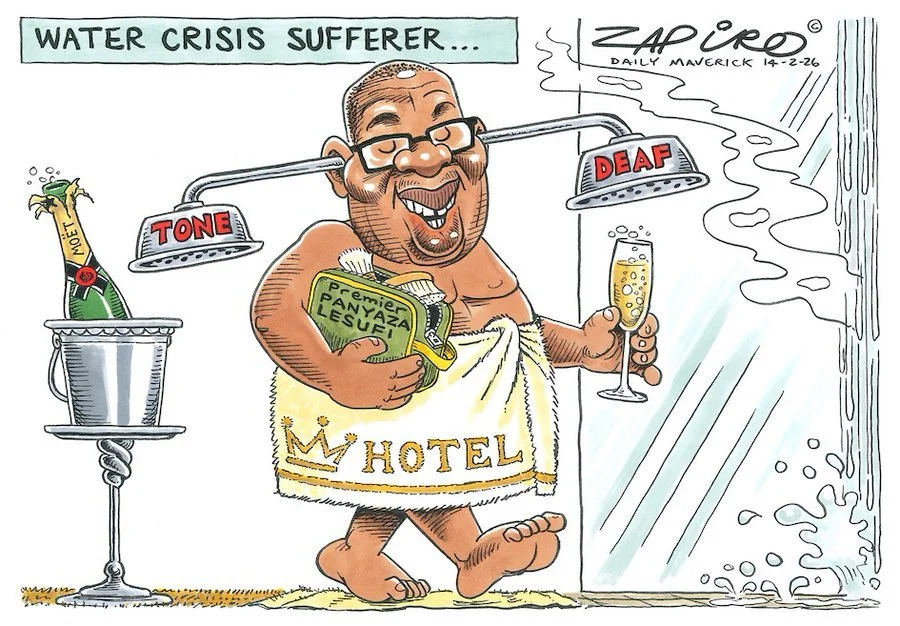
“Howler.” Cartoon by Zapiro, https://www.zapiro.com/260214dm.
The Premier Panyaza Lesufi of the African National Congress (ANC) has come under criticism regarding the most recent water crisis in Johannesburg. As residents of Johannesburg entered their third week without water, Lesufi sympathized with them in a press conference by expressing that politicians were similarly struggling. Lesufi stated that he even had to visit a hotel “so that [he] could bathe and go to [his] commitments.” To the people, this statement came across exceedingly tone deaf, and Lesufi is facing a significant amount of backlash. The controversy surrounding this event represents a broader trend in South Africa with the once renowned ANC falling from favor in the eyes of the people.
The ANC, formerly known as the South African Native National Congress, was formed in 1912 to advocate against racially discriminatory legislation. While their prominence in South African politics would fluctuate throughout the early-twentieth century, the creation of the Youth League within the organization marked the start of a radical movement against apartheid. The presidential election of Mandela in 1994 solidified the end of apartheid and the beginning of a new, unified government for South Africa.
Unfortunately, the ANC has failed to meet many of its promises in the twenty-first century. Despite recognition on the international level, the party has performed poorly when it comes to resolving local infrastructure issues. The 2024 water shortage in Johannesburg is almost identical to the crisis now, and issues extend far beyond water supply to blackouts, potholes, and uncollected trash. The dissatisfaction of all citizens of South Africa was made clear in 2024 as the ANC lost its parliamentary majority for the first time in 30 years, forcing the creation of a coalition government. Although some believe that a coalition government may improve conditions by increasing accountability and consensus-based decision-making, there is the risk that divisiveness will lead to gridlock and worsen current issues. As a new wave of local elections approaches, South Africa President Cyril Ramaphosa is pushing his fellow ANC members to focus on offering stable local services, with his government pledging 54 billion rand ($3.28 billion USD) for water and power infrastructure.
The methods the ANC needs to employ to bolster their reputation are clear. Whether or not representatives will choose to focus on fixing municipality services is largely unknown—many seem to recognize the issues but few have done anything to resolve it. What is evident is that the people of South Africa will not be silenced until the government fulfills its basic obligations to them.
On U.S. Intervention in Iran
This information is current as of 1:00PM, 01MAR2026.
Since the founding of the Islamic Republic in 1979, the US has directly used military force against Iran on four occasions: Operation Eagle Claw (1980), Operation Praying Mantis (1988), the assassination of Qassem Soleimani (2020), and Operation Midnight Hammer (2025). On each of these occasions, the US deemed it within its vital national security interests to take military action against Iran. On the morning of February 28th, 2026, the United States and Israel launched the dual Operations Epic Fury and Roaring Lion.What distinguishes today’s situation from previous cases is the scale of US military action and the risk of a drawn-out conflict with an unclear path toward achieving American objectives.As the US takes military action against Iran, it must delineate clear political objectives to be achieved by the use of force and allocate adequate force to achieving those objectives. If it does not, it risks mission failure resembling that of previous US interventions.
In an 8 minute video posted to the White House’s X account, US President Donald Trump claimed the reasons for the US attack were Iran’s nuclear and ballistic missile programs and that the US was left with little choice but to attack after several rounds of negotiations with Iran failed to produce a breakthrough. President Trump specified the primary goal of the operation is regime change. He encouraged the Iranian people to rise up against their government, echoing his previous statement that “Help is on its way” to the Iranian people during large protests in January. The US ultimately did not intervene on that occasion, and the resulting crackdown by the regime resulted in at least 7,000 killed, with the true number likely closer to over 30,000. Given US inaction during the protests, if the Trump administration seeks to assist the Iranian people in overthrowing the Islamic Republic, it must be willing to support the Iranian people long-term and be able to convince Iranians of the legitimacy of that support. Regime change will not occur in a day.
For the Islamic Republic and what remains of its proxies, this conflict is a war of survival. Groups such as Lebanese Hezbollah and Iraqi Shiite militias, including Kataib Hezbollah, would face existential crises without their primary patron. While Hezbollahsat out ofthe June 2025 12-day war, it had already stated that if the US targeted Iranian Supreme Leader Ayatollah Ali Khamenei, it would be a “red line.” While they have yet to act in response to Khamenei’s death, the strike will likely trigger a wider confrontation across the region, as Iranian proxies seek to defend the regime and ensure their own survival. The US has already confirmed the death of three American servicemembers and Iran has struck or attempted to strike Kuwait, the United Arab Emirates, Qatar, Jordan, Saudi Arabia, Israel, and Bahrain. Kata’ib Hezbollah issued threats against US forces in Iraq and several missiles and drones were intercepted over the Kurdish city of Erbil. The risk of the US being drawn into another “forever war” looms large over the conflict, and it must commit adequate force from the outset to avoid such a possibility. If it does not, it risks being drawn into another Iraq or Afghanistan.
If the US is serious about regime change, it cannot rely solely on strikes to achieve its aims. It must seek to unite the divided Iranian opposition, provide incentives for Iranian military personnel to defect, and support protestors in the streets. The only widely known figurehead of the Iranian opposition is Reza Pahlavi, the son of the former Shah (king) of Iran. Other figures, such as Maryam Rajavi of the Mujahadeen-e-Khalq, are either little known or too unpopular to be able to effectively lead a united opposition. While Mr. Pahlavi is not the perfect candidate to lead a post-Islamic Republic Iran—his father committed atrocities similar to those of the Islamic Republic and he has not been to Iran since he was a teenager—he claims to support a free and democratic Iran and has seemingly widespread support among Iranians. The US can capitalize on the nostalgic view of his namesake and unite the Iranian opposition around the democratic future he may represent, rather than the return of an antiquated and repressive monarchy. Supporting him as a transitional figure would provide some cohesion to a continuously fragmented opposition movement.
If the US adheres only to the use of military strikes to achieve its goals and fails to think about what may come after the Islamic Republic, it risks repeating mistakes made in Iraq, Libya, and other places. The 2003 invasion of Iraq and the 2011 US-led bombing campaign of Libya resulted in brutal civil wars in both countries. While Iraq has become relatively stable, it still bears the consequences of the conflict, while Libya remains ruinously divided today. Among the many errors made in Iraq, the US did not commit enough troops to stabilize the country and hadno comprehensive plan for a post-Saddam Hussein government. In Libya, the US, UK, and France relied almost entirely on air power to achieve its goals, leaving it unable to influence events on the ground.
In pursuing regime change, the US must have a strategy for what comes after and ensure that it is Iranians themselves who take the reins of power. It can use the leverage created by the ongoing military operation and diplomatic channels throughout the region to communicate with opposition groups, make contact with Iranian protesters, and assist the highly educated Iranian diaspora in forming a day-after plan, thus facilitating a transition of power rather than engineering it. Using American technology and influence to support Iranians, as the US did when it provided thousands of Starlink terminals to Iranian protestors in January, would allow the US to maximize the effectiveness of its strikes, while minimizing risk to US servicemembers. It would leave Iran’s fate in the hands of Iranians, bolstered by firm US support.
While the Islamic Revolutionary Guard Corps is largely made up of fanatics who support the Islamist ideology of the Iranian regime, the regular army (or Artesh) is made upprimarily of conscripts who may be persuaded to defect if they believe the regime will fall. As Syrian President Ahmed al-Sharaa did for Bashar al-Assad’s security forces, President Trump has already publicly promised regime forces amnesty if they lay down their arms. While it would be up to any succeeding Iranian government to make that decision, doing so would allow any new government a quicker route to stabilization.
It is improbable that the US will be able to conduct regime change in Iran with airpower alone. The Islamic Republic will not voluntarily give up power or change the nature of its oppressive theocracy. If the US is not willing to match the Islamic Republic’s political will upon taking military action, the current intervention could result in another Afghanistan, Iraq or Libya: long-term division, civil war, and humanitarian crisis. Such an outcome would be neither in US interests nor those of the Iranian people. Right or wrong, the US has already committed to regime change in Iran. It should now follow through on its commitment to the Iranian people for a free, democratic, and tolerant Iran.
As U.S. Sanctions Ravage Cuba, Other Nations Step Up to Help
The United States' enduring apathy toward furthering relations with Cuba makes it easy to forget how deeply our actions shape the lives of Cubans each and every day. Since 1962, Cuba has suffered under a strict financial and trade embargo imposed by the U.S. In the last 60 years, this embargo has cost Cuba nearly $130 billion.
Subsequently, millions of Cubans have fled to the United States over the past few decades. Each year, over 700,000 Cuban Americans send remittances to family back home. Through various organizations, the United States sends millions of dollars of developmental aid to Cuba each year. Clearly, Cubans and Americans are more interconnected than it may seem at first glance. Despite our ideological differences, building a relationship with Cuba is essential for America's geopolitical strength.
U.S. relations with Cuba appeared to be moving in a positive direction during the Obama administration, which was marked by an easing of travel restrictions and the restoring of diplomatic ties. While the effects for many Cubans were limited, the state witnessed an impressive growth in foreign investment and tourism during this period.
The Trump administration, particularly during his second term in office, has reversed much of this diplomatic progress. President Trump has reinstated the country as a state sponsor of terrorism and strengthened economic sanctions. Most recently, after the capture of Nicolás Maduro from Venezuela, President Trump has threatened to impose tariffs on any nation that sells oil to Cuba.
Trump's actions are devastating for the people of Cuba. Foreign sanctions have crippled the nation for decades, but without oil from Venezuela, Cuba is now in a state of humanitarian crisis. Severe fuel shortages have led to power cuts across the country. Food prices have skyrocketed and garbage is piling up higher and higher on the streets. Without electricity, hospitals are unable to treat patients. Even those who depend on U.S. remittances are suffering, with the Cuban peso hitting an all-time low against the U.S. dollar in informal markets this month.
The rapid deterioration of living conditions sparked by these new economic restrictions makes it clear that for now, America is not interested in strengthening its diplomatic relations with Cuba. Nevertheless, someone has to fill that power vacuum and support the Cuban people—and other countries are moving fast.
On February 11, two Mexican navy ships arrived in Havana with 800 tons of food, milk, and personal hygiene items. More ships are expected to arrive in the coming weeks. Last week, Spain announced that they would send humanitarian aid to the country through UN channels. This week, Chile's outgoing administration announced that they will provide monetary assistance to support the nation.
If President Trump isn't concerned about the soft power exerted by Mexico or Chile, he might raise an eyebrow at what China and Russia are doing. Last week, Russian President Vladimir Putin met with Cuban Foreign Minister Bruno Rodriguez in Moscow to reaffirm their support for the nation's sovereignty and condemn the ongoing blockade. Reports from Russian news outlets suggest that Russia is preparing humanitarian fuel shipments for the nation.
Chinese Foreign Minister Wang Yi noted in a recent statement that China is willing "to provide support and assistance to the best of our ability", condemning America's interference in Cuba. China has been a growing source of influence on the Cuban economy since the nation joined China's Belt and Road Initiative in 2018. China has funded solar energy projects across the nation, and sent $80 million in humanitarian aid in January.
None of this is flattering for the United States. Letting Cuba bleed out has only opened the door for other states to exert influence on the fragile, desperate nation. States like China and Russia are eager to expand their reach, and Cuba is the perfect opportunity. There is no need for Cuba, a nation less than 100 miles from the Florida Keys, to become a breeding ground for international geopolitical conflict yet again.
European Countries Inch Closer Towards Social Media Ban
After Australia moved to implement its social media ban on children under 16, many European countries are looking to enact similar restrictions within their own populations. In late January, France’s lower house approved a bill banning social media access for children under 15, and Spain has been pushing for the investigation of tech giants such as Meta and Tiktok over AI-generated content. Italy has also introduced a bill pushing for social media restrictions, and Greece, Portugal, Germany, and Austria are all in talks to potentially follow suit.
Many leaders have cited the numerous pitfalls of social media on children’s mental health, including the onset of anxiety and depression, and their exposure to violence, pornography, cyberbullying and other harmful content. Social media has been well known to have numerous negative side effects, and many country leaders are worried that these platforms are detrimental to children’s developing brains and cognitive function. Political leaders are introducing possible restrictions in the hopes that they can combat social media’s adverse effects and protect minors.
Australia’s ban is centered around not allowing anyone under 16 to create or keep social media accounts, and the addition of various Identification checks to confirm the user’s age. Whether or not European countries will implement these exact restrictions are unknown, but the Australian model is still being referenced. Despite Australia’s ban, many kids are still finding ways to circumvent the restrictions by using VPNs, or through the help of their parents. Despite this, Australia hopes that its policy change is the beginning of changing social and cultural norms surrounding social media use.
If European countries fully implement bans themselves, it is unknown as to whether it will actually work amongst the youth. Since many children in Australia are able to get around the ban, it cannot be said definitively that their model works. If Europe wants to add restrictions, they must be able to find and troubleshoot the areas of Australia’s ban that aren’t working well. It could be argued that rather than just cutting kids of a certain age off from social media, it would be more productive to take preventative measures around the technological and social space. Many of the children who are relieved at the social media ban are those who have faced some type of cyberbullying or have been exposed to hateful communities. It could be more helpful for these children if there was more conversation around content moderation to make the online space safer.
One Year Later: The Impacts of the Dissolution of USAID
Around one year ago, the Trump Administration initiated the largest overhaul of US foreign assistance in this country's history. Public servants were unexpectedly fired, the government’s website for USAID was taken down, and diplomatic relationships were destroyed. It is important to evaluate the global effects of this catastrophic dismantling in the past year.
In 1961, President Kennedy responded to global need by establishing USAID, the federal government's institution for global humanitarian affairs. His efforts were not guided by political gain or economic interests, but rather “...because it is right.” Since Kennedy, numerous presidents have edited and added to the program Kennedy engendered. USAID contributed to global efforts to fight HIV/AIDS, malaria, tuberculosis and more. Although the US is the largest donor of international aid funds, the donated funds only make up 0.24% of GNI, a smaller proportion than any other country, and a number far below the target of 0.7% set by the UN in 1970. Although difficult to quantify, it has been estimated that this less-than-a-quarter percent has saved up to 3 million lives annually, according to research by Our World in Data. This number does not include the lives saved from clean-water initiatives, family planning, and better nutrition, all formerly funded by USAID. A different study reports that in the 21 years between 2001-2021, USAID saved around 92 million lives. That amount is more than the total population of the 17th largest country in the world (Iran at ~93 million). President Kennedy recognized the privilege the United States wielded in 1961, and with it he pledged to lead a country dedicated to its duty as a global citizen. For years after his decision, our foreign aid initiatives have served as a hallmark of our values. For some, the only interaction with the US they will ever have comes from a sack of grain bearing the flag of our nation and the letters ‘USAID’ printed on the front. If not grain, the reputation of the United States came bottled in life saving vaccinations. All a mother might know about American citizens is that our tax dollars saved her children from dying of tuberculosis. Although these outcomes are crucial for millions, they are no longer considered valuable by a select few.
In February of 2025, the Trump administration terminated around 10,000 foreign aid programs in an executive order. In one move, this regime ended disease treatment and prevention efforts, nutrition efforts for children, basic research that is necessary for logical policy decisions, and more. In January of this year, Marco Rubio, the Secretary of State, released a press statement informing the American public of our withdrawal from “Wasteful, Ineffective, or Harmful International Organizations”, where he names USAID as a culprit. He states that the American organization that has saved millions of lives is “irrelevant to or in conflict with our interests.” In addition to the international humanitarian fall out, thousands of Foreign Service Officers lost their jobs without warning. A workforce of around 5,000 people was reduced almost overnight to around 300. The manner of this termination was far from remorseful, or at the very least, respectful of the years they had dedicated to serving our country from home and abroad. Career diplomat William J. Burns recalls that one of his colleagues, a career diplomat, was given just six hours to clear out his office. “When I was expelled from Russia,” he said, “at least Putin gave me six days to leave.” Similarly, it’s impossible to ignore the diplomatic ties destroyed by the flippant withdrawal of funds from key locations. USAID funds were a leading soft power in diplomatic settings. Now that we have torched our long-standing relationships, countries like China and Russia can step in to fill those spots, eager to influence and support. In all honesty, we should hope countries like China and Russia come to aid, because the diseases we helped to suppress for decades do not respect borders and have no concern for what passport you hold.
The Center for Global Development estimates that our ‘budget cuts’ led to 500,000 to 1,000,000 lives lost in 2025. If future trends continue, we could see 670,000 and 1,600,000 lives lost annually. These are people we could have saved—in any other year, we would have. During these times, I am reminded of the words of former diplomat Benjamin Ousley-Naseman, who remarked, “The world is better when we are in it, and when we’re in it representing our values; and when the world is better, it means the world we live in is better also.” To separate the United States from its values is to remove the DNA from our cells. Our values guide us and shape our actions. Although we have retained our strong values for centuries, they are capable of warping. If we do not keep close watch our personal and communal convictions, the DNA of our country will corrupt. In the blink of an eye, the “economic growth” we so desperately crave will become cancerous. USAID and the people who worked closely with it exemplified what is so special about our nation. Our influence, our dedication, our humanity; without it, we will lose track of who our early leaders wanted us to be. And one day, when the fortunes are flipped, we can only hope their values lived on in someone else, as they seemed to have died in us.
Argentina’s Labor Reform: The Most Recent Symptom of Latin America's Right Turn
In the early hours of Friday, February 21st, Argentina's Chamber of Deputies approved a sweeping labor reform pushed by President Javier Milei, 135 votes to 115. Outside Congress, the scene was different. The Confederación General del Trabajo (CGT), Argentina's most powerful union federation, had called a general strike that brought much of the country to a standstill, including transport workers, hospital staff, port workers, and teachers. Twelve vessels carrying nearly 380,000 tons of grain sat inactive in Argentine ports. And Milei, the self-described anarcho-capitalist who has made dismantling Argentina's economic institutions his political project, was not even in the country. He was in Washington, attending the first meeting of Donald Trump's Board of Peace.
The reform has been months in the making and covers significant ground. It restructures severance pay by excluding bonuses and vacation time from the calculation, extends the maximum workday from eight to twelve hours under a new flexible scheduling system, and creates a bank of overtime hours that can be compensated with time off rather than pay. It also limits union power by expanding the list of sectors considered "essential services," which limits their ability to strike and requires union meetings to be authorized by employers, with attendees going unpaid for those hours.
The most revealing provision, however, was the one the government ultimately pulled due to its controversy. Under the original text, medical leave pay would have been tied to the cause of the illness. Workers suffering from what the bill called a “blameless illness” (one the worker could not have prevented) would have received 75% of their salary. Workers whose condition was linked to “voluntary action” (meaning lifestyle choices the employer could deem self-inflicted) would have received just 50%. The language alone tells you something about the logic behind the reform: it distributes moral responsibility onto the worker and financial relief onto the company. The provision was pulled days before the vote to avoid a legislative defeat, but the reform still passed.
This is all happening against a backdrop which elevates the stakes of this labor reform. Argentina's official unemployment rate sits at around 7%, but that number comes along with a more uncomfortable reality: over 40% of Argentine workers are in the informal economy, meaning they have no social security, no severance rights, and no union protections to begin with. The reform's stated goal of incentivizing formal hiring is not groundless in that context. But for the workers who are already formal, organized, and watching their salaries lose ground to inflation, the message reads very differently.
However, none of this is particularly surprising to anyone watching the region closely. When the hard right takes power, labor reform tends to follow a recognizable script: reduce costs for employers, weaken organized workers, and signal to foreign investors that the country is open for business. Argentina has been here before; the structural adjustment programs of the 1990s carried a similar logic, trading worker protections for economic "modernization," and the results were documented: growing income inequality, expanding informal employment, and a surge in unemployment that hollowed out the middle class the reforms claimed to serve. (For a deeper look at this, see Novick et al., International Labour Review.)
The Regional Picture
But Argentina is not alone. The reform is the most visible expression of the right turn that has been taking shape across Latin America in just the past few years. In Bolivia, the socialist party which had governed for nearly two decades was voted out. In Ecuador, center-right Daniel Noboa was re-elected. And in December of 2025, José Antonio Kast won Chile's presidency, becoming the country's most right-wing leader since the end of Pinochet's dictatorship. It would be too simple, though, to treat this as a single unified movement with a single agenda. Kast's campaign, like that of Costa Rica's newly elected Laura Fernández, was centered almost entirely on security and crime following the mold of El Salvador's Nayib Bukele, who built his political brand around dismantling gang violence and, along the way, many of his country's independent institutions. The priorities differ across these governments, but the appetite for executive power, and the erosion of the institutions meant to check it, does not.
What makes the pattern worth watching is what comes next. The political vacuum heading into elections this year opens the door to candidates whose platforms align with what is happening in Buenos Aires. Last week in Peru, President José Jerí was ousted from power after failing to disclose secret meetings with Chinese businessmen who were under government scrutiny, and now the country is expected to hold elections on April 12. In Colombia’s upcoming May presidential elections, a figure being called "El Tigre”, an outsider candidate drawing explicit comparisons to Bukele, has been polling strongly against the candidate backed by current leftist president Gustavo Petro. In 2025 alone, every Latin American country that held a presidential election elected a right-wing or conservative candidate. The direction, at this point, is hard to argue with.
And then there is the hemispheric picture. While Argentine workers went on strike and Congress debated the most contested labor reform in decades, Milei was in Washington, sitting alongside Donald Trump at the first meeting of the so-called Board of Peace. The image is telling not because one caused the other, but because it does not need to. What is happening in Argentina, Peru, Chile, and Colombia is part of the same political moment that brought Trump back to the White House: a moment in which the appetite for disruption, deregulation, and the concentration of power in the hands of a single leader has found an audience well beyond any one country's borders. Argentina's labor reform is one piece of that picture, and it is unlikely to be the last.
Security Serves as Throughline Amidst Hemispheric Disruption
Since returning to the White House last year, President Trump’s foreign policy strategy has been characterized by aggressive messaging, especially in the Western Hemisphere. Be it the forced removal and extradition of Venezuelan leader Nicolás Maduro, talks of making Canada the “51st state,” disputes with Mexico, or talk of seizing the Panama Canal, he has repeatedly employed the strategy of applying “maximum rhetorical pressure then back down in favor of a promise for future cooperation,” says Politico. The case of Colombian president Gustavo Petro is no different.
The two presidents are considered populists by many and stand on opposite ends of the political spectrum—that divide has been strikingly clear: Last year, U.S. sanctions were placed on Petro and his family, and Petro was called “a sick man who likes making cocaine…” Moreover, Trump hinted at a military operation in Colombia following Maduro’s removal from Venezuela in early 2026. Unlike other world leaders who have hesitated to openly challenge Trump, Petro has repeatedly insulted him and his administration. His criticisms have ranged from condemning the U.S.’ role vis-à-vis the Israel–Gaza war to questioning U.S. airstrikes against suspected drug vessels in the Caribbean Sea and eastern Pacific Ocean, as well as opposing potential military intervention in neighboring Venezuela.
Facilitated by Sen. Rand Paul (R-KY), the two heads of state met in Washington, D.C. in early February and discussed counternarcotics cooperation and potential economic opportunities relating to Venezuelan oil and gas. Petro also requested U.S. mediation in Colombia and Ecuador’s trade dispute. In spite of the public animosity, the meeting was described as cordial: Trump said that they “got along very well” and called Petro “terrific.” Following the meeting, Trump gifted Petro a MAGA hat, with an “s” added to pluralize the “America” in “MAGA.”
It was revealed that in the meeting, Petro highlighted the continued need to work together on counternarcotics and especially focus on key figures in the drug trade who live outside the US and Colombia. US deportation flights to Colombia have also resumed, and a key narcotrafficker was extradited to the US.
While the meeting marks progress in US-Colombia relations, it remains to be seen if diplomats and public servants in both countries can implement what was agreed upon. With Petro’s term expiring later this year and many of Trump’s executive orders and policies being challenged in court, it is unclear what can actually be done.
What stands out about the talks is that, despite the tense and chaotic period in Latin American foreign affairs, both leaders focused on a shared priority: combating the drug trade. At a time when diplomacy can feel defined by public insults and ideological divides, the meeting demonstrated that cooperation is still possible when leaders concentrate on overlapping interests rather than political differences. The Petro-Trump meeting serves as a reminder that even rivals can find areas of agreement, and that practical progress begins with something as simple as sitting down and identifying common ground.
The Aftermath of U.S. Airstrikes in Nigeria
On Christmas Day, the Trump administration launched airstrikes in northwest Nigeria targeting what it described as Islamic State militants allegedly responsible for persecuting Christians. With the help of Nigerian intelligence, these strikes focused on the Lakurawa group, a relatively little-known armed organization reported to have ties to the Islamic State Sahel Province. The Lakurawa have increasingly asserted territorial control in parts of northwest Nigeria while attacking civilian populations.
While the administration framed the strikes as a necessary response to escalating violence against Christians, the operation raised broader concerns about both the accuracy of the underlying threat assessment and the effectiveness of U.S. counterterrorism strategy in Nigeria and across the Sahel.
For months prior to the strikes, the United States had escalated pressure on Nigeria by threatening to halt all aid and assistance, suggesting further military intervention, and designating Nigeria as a “country of particular concern” under the International Religious Freedom Act for the alleged Christian persecution. Nigerian President Bola Tinubu pushed back on the claim made by Trump and other Republican lawmakers that the Nigerian government is “allowing” the killing of Christians, insisting that he is committed to protecting all Christian and Muslim Nigerians from terrorism and violent extremism. While these strikes were a joint effort by the governments of Nigeria and the United States, Nigerian government officials have made clear that they view the security threat in their country as extending beyond religion.
The Nigerian government is not alone in this assessment. While the United States has framed the violence occurring in Nigeria as specifically targeting Christian populations, human rights groups claim that this violence is mainly indiscriminate. Attacks by Islamist militants have largely been confined to the Muslim-majority northeast and northwest, with research suggesting that out of 1,923 attacks on civilians in Nigeria as of late 2025, only about 50 attacks targeted Christians because of their religion. Nigerians face a diverse range of threats from religiously motivated attacks on both Christian and Muslim populations, ethnic conflict, secessionist attacks, and clashes over resources. Framing this complex security landscape as a strictly religious conflict against only Christians risks obscuring its true causes.
Nigeria is facing a security crisis from multiple fronts that puts communities across the country at risk. Against this backdrop, the effectiveness of the recent airstrikes remains uncertain.
Although the Trump administration has claimed that these strikes were successful, little public evidence has been provided to substantiate this claim. Findings show that Lakurawa camps were destroyed by these strikes, but there is nothing to show that any militants were killed. In fact, very little is known about the Lakurawa group, which raises questions about the quality and reliability of the intelligence underpinning the strikes.
The growing threat of terrorism is not unique to Nigeria. Almost 20% of terrorist attacks and over half of all terrorism-related casualties occur in the Sahel. While some may believe that U.S. intervention in Nigeria may lead to increased intervention to stop the spread of terrorist threats across the Sahel, this will probably not be the case.
U.S. counterterrorism engagement in the region has significantly decreased. The United States has lost its significant presence in Mali, Burkina Faso, and Niger due to a number of coups d’etats over the past couple of years and the expulsion of UN and French forces. This reduction limits both intelligence-gathering capacity and long-term stabilization efforts.
Early indications suggest that the Lakurawa have continued to make their presence known. Reports indicate that the Lakurawa have moved their camps and continued their attacks after the airstrikes, underscoring the risk that airstrikes alone may produce displacement rather than deterrence. In this sense, the operation may mirror past counterterrorism efforts that disrupted militant infrastructure without addressing the underlying conditions that allow such groups to regroup and expand.
What is next for the Trump administration?
Defense Secretary Pete Hegseth has indicated that there will be “more to come,” suggesting further military action in Nigeria. However, further strikes could make the security situation much worse. If the stated objective is to protect Christian communities in Nigeria, U.S. policy must begin with a better understanding of the multifaceted security crisis that plagues the country. The United States’ framing of the reason for intervention as attacks on Christians by Muslims may lead to greater conflict within Nigeria, especially as terrorist threats have caused harm and destruction to people of all faiths in the country.
Additionally, attacks on terrorist groups that operate across the Sahel could lead to an inflow of militants from across the region to provide support, exacerbating the threat within Nigeria. The Lakurawa, as well as other extremist groups, are growing in power and influence and will continue to pose a greater threat and security concern to not only communities across Nigeria but also to other parts of the Sahel. Limiting their expansion is a legitimate goal, but doing so requires strategies grounded in careful intelligence, regional cooperation, and a full understanding of the local dynamics.
Absent such care and precision, further U.S. action in Nigeria risks creating more chaos within the country and across the region.
Taiwan Sacrifices their Silicon Shield for the sake of Transatlantic Security
America’s relationship with Taiwan continues to develop as a major trade deal has been made between Trump and the Republic, strengthening the economic bond between the nations while simultaneously attempting to loosen Taiwan’s grip on the semiconductor manufacturing industry.
The deal, which was announced last month, provides a direct Taiwanese $250 billion investment toward domestic U.S. chipmaking technology, as well as additional investments from major stakeholders in the chipmaking industry. In exchange, President Trump has promised to reduce tariffs on Taiwanese exports, dropping rates on commodity goods to 15% and providing complete reciprocal exemption on pharmaceuticals. The deal appears weighted in the United States’ favor and provides the nation with the potential for massively increased manufacturing capacity while only offering Taiwan equivalent, if not worse rates as other U.S. trade partners.
The Trump Administration has geared up to direct the investment towards strengthening U.S. domestic chipmaking capacity, opening five new semiconductor fabrication plants in Arizona to compete with Taiwan’s supply chain dominance. The Trump administration is currently seeking to steal the spotlight in the industry, with the lofty goal of reshoring 40% of Taiwanese semiconductor manufacturing to the United States. While these expectations are certainly inflated, it signals a strong desire to decrease reliance on Taiwan’s chipmaking capacities. The disproportionate trade deal raises the question of why Taiwan would accept the potential impact to their monopoly.
The answer is part of a larger cross-strait strategy from Taiwan. The island has faced immense pressures from their neighbors to the west, and as they lack official acknowledgement from NATO or the UN, Taiwan’s options for alliances are slim. The nation is seeking international legal recognition as a sovereign state and strengthened ties to foreign powers. However, it is unclear if their current strategy in achieving this goal is worth the cost of their current market advantages.
Taiwan’s major role on the world stage has been driven by a prominence in the semiconductor manufacturing industry, with their homegrown chip producer, TSMC, which holds 70.2% of the industry. TSMC’s massive market share has provided Taiwan with a ‘silicon shield’ that has played a role in preventing China from realizing their desire of absorbing the nation.
With the threat of Chinese annexation becoming more salient, it is important for Taiwan to hold on to their critical role in the semiconductor industry and maintain their strategic advantage. The $250 billion deal with the Trump Administration, meant to further align Taiwan with North Atlantic trade partners, works against this goal, favoring strengthened relations in the short term over long term domestic manufacturing dominance.
Taiwan’s current foreign policy is pushing for greater recognition as a sovereign territory by potential partners, seeking to make strategic alliances with major powers in order to ensure improved international relations and security from a looming Chinese invasion. However, this strategy has come at the cost of Taiwan’s manufacturing leverage, as the nation prioritizes appeasing America over holding industry dominance. Rather than giving their advantages away to foreign powers, Taiwan needs to utilize their economic success as a bargaining chip for international recognition to establish institutional security while still maintaining the strategic advantages that are fueled by their manufacturing sector.